Ling-3.2-air is a vision language model, and that is not a footnote to the launch. InclusionAI shipped it on 23 November 2026 with open MIT weights, and the model accepts text, image and video as input. It reads images through an image_url field and video through a video_url field, and it returns text. What makes that worth a full post is not just the list of input types. It is how the vision is built in, what a 124 billion parameter open-weights model can do with a camera feed, and what the numbers now say about it.
That last part changed. At launch the model card carried no vision scores and this post opened with the honest note that none existed. That is no longer true. InclusionAI’s own benchmark table, published through the official Ant Ling account on the same day the weights landed, includes a full Vision Language section that scores Ling-3.2-air against Ling-3.0-flash-VL and five frontier models from DeepSeek, OpenAI, Anthropic and Google. The picture that emerges is specific. Air is genuinely strong at document intelligence and at agentic tasks that involve seeing, it is competitive on general image reasoning, and it trails the largest frontier models on the hardest perception benchmarks. This post explains what native multimodal means, walks through the real vision numbers with the wins and the losses both in view, and describes the workloads a self-hosted VLM of this size is actually shaped for.
The launch, briefly, and where vision fits
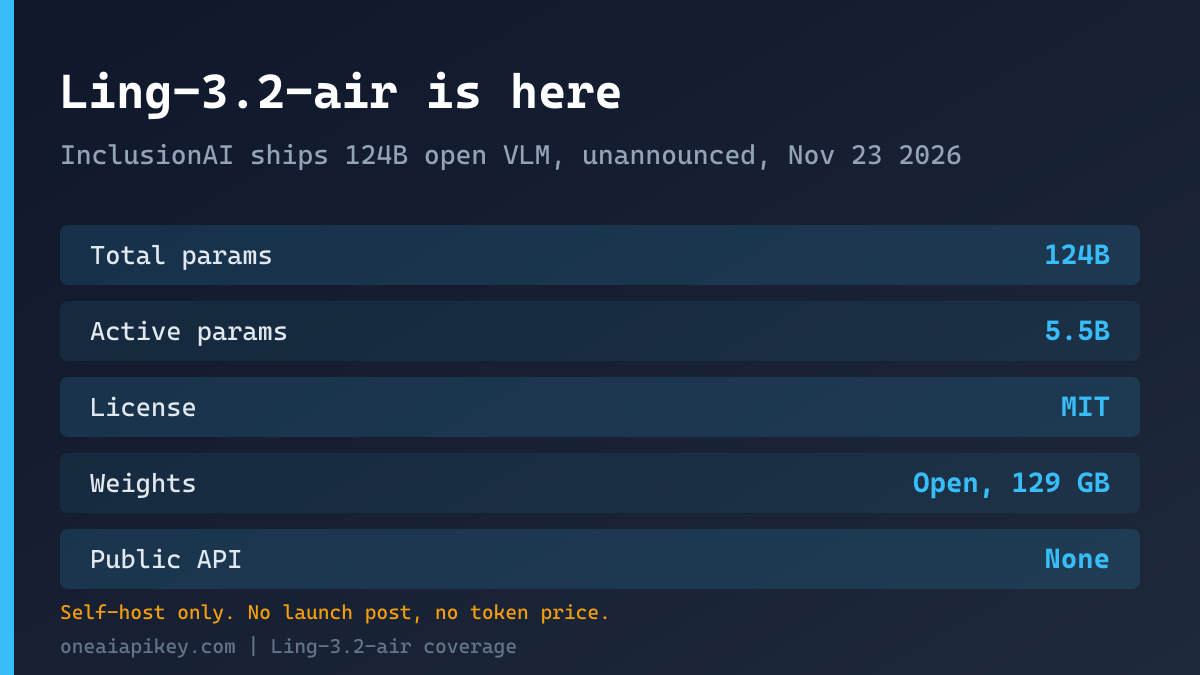
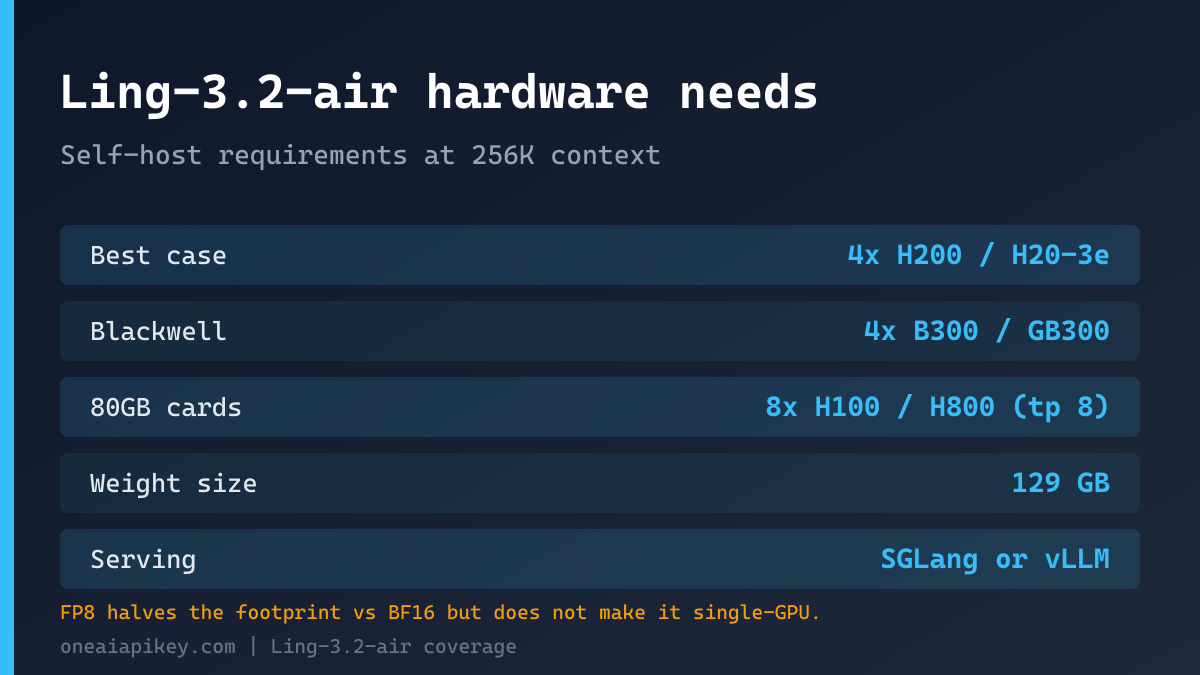
The weights landed on Hugging Face under inclusionAI/Ling-3.2-air without a launch post or an announcement thread. The total download is 129 GB, the license is MIT, and the model is built for self-hosting rather than a hosted API. There is no public token price and no official benchmarks beyond the model card and the Artificial Analysis entry. Our Ling-3.2-air launch post covers the release as a whole, and this vision post is one slice of a wider cluster that also includes Ling-3.2-air benchmarks, Ling-3.2-air architecture and Ling-3.2-air hardware.
Vision is the dimension of this release that is easiest to oversell, which is exactly why it deserves careful treatment grounded in real numbers rather than adjectives. The model is described as a VLM with a native multimodal architecture, in the same lineage as Ling-3.0-flash-VL. Both halves of that sentence carry weight, so we take them one at a time.
The official benchmark table, and where the vision scores live
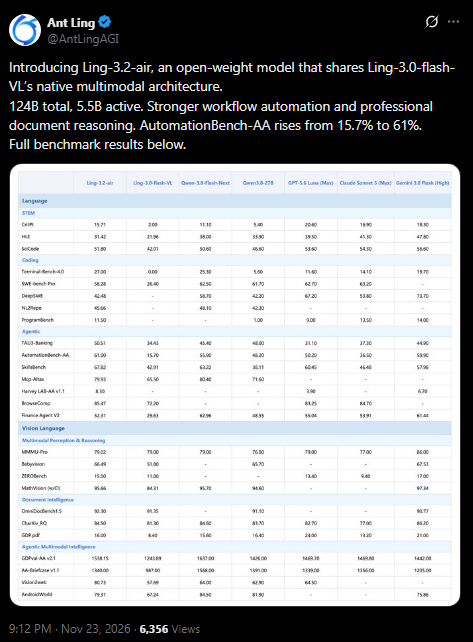
The most important source for this post is a table InclusionAI posted on X through the official Ant Ling account on launch day. It is the single most complete public benchmark set for the model, more detailed than the Hugging Face card, and it is where every vision number in this post comes from. The table compares Ling-3.2-air against its own predecessor Ling-3.0-flash-VL and against five frontier models: Qwen-3.5-Flash, DeepSeek-V3.2, GPT-5.5-Low, Claude-Sonnet-5 and Gemini-3.5-Flash, each shown in a Mini configuration. Those five are the closed models you would actually weigh air against if you were deciding whether to self-host.
What makes the table useful for a vision post specifically is that the vision section is not one row. It is split into four distinct groups, and the split tells you something about how the model was built. There is multimodal perception and reasoning, which covers general image understanding. There is document intelligence, which covers reading structured and semi-structured documents. There is agentic multimodal intelligence, which covers using vision to act, browse and operate. And there is a set of science and math perception benchmarks that sit adjacent. A model that were only good at describing pictures would score unevenly across these. Air’s profile is uneven in an interesting way, strong at the document and agentic end and more ordinary at the hardest reasoning end, and we take that profile apart group by group below.
What native multimodal means, in plain terms
There are two broad ways to give a language model sight. The older way is to bolt vision on. You take a trained text model, attach a separate vision encoder, connect the two with an adapter, and hope the text side learned to use what the vision side hands it. It works, but the vision capability is a passenger. The text model was never trained with images in the loop from the start, so its reasoning over pictures tends to be shallower than its reasoning over words.
The newer way is to build the model multimodal from the beginning. Vision tokens and text tokens flow through the same architecture during training, so the model learns to reason across both from the first step. That is what native multimodal means. Ling-3.2-air is described this way in its own documentation, and the architecture identifier on the model card is bailing_moe_v3_vl, where the vl signals the vision-language lineage. The model sits in the same family as Ling-3.0-flash-VL, which is the predecessor the model card benchmarks compare against.
The practical difference shows up in how the model handles mixed input. In a native design, an image is not a caption that gets pasted into a text prompt. It is a set of tokens that the model reasons over directly, alongside the text tokens in the same sequence. For a workflow where you hand the model a screenshot and a question, or a short video and an instruction, that design is the difference between the model describing what it roughly sees and the model actually working over the pixels.
The input specification: text, image and video
The model card is specific about modalities. Input is text plus image plus video. Images arrive as image_url and video arrives as video_url, the same field-based convention most modern vision APIs use, where you pass a reference to the media rather than embedding raw pixels in the prompt. Output is text only. The model does not generate images or video.
That input set is broader than a still-image-only VLM and it opens a few distinct categories of work. A single image and a question is the base case, the equivalent of showing the model a photo and asking what is in it. Multiple images let you compare frames, read a sequence of slides, or reason across several screenshots of an application. Video input, through video_url, extends this to temporal content, where the model can be asked about motion, sequence, or what happens over the course of a clip. None of this is speculative about the input types. What is unverified is how well the model performs on each, because no vision benchmark measures it yet.
It is worth pausing on video, because it is the input type most likely to be skipped in coverage and the one that most changes what a self-hosted model can do. A model that accepts video can, in principle, be pointed at a screen recording and asked what the user did, or at a short clip from a camera and asked whether something happened. For a team running its own infrastructure, that is a genuinely different capability from image-only, and it is one of the reasons the native multimodal design matters. The model card confirms video input exists. It does not publish results that show how the model performs on video tasks, and we will not invent any.
The parameter math behind a self-hosted VLM
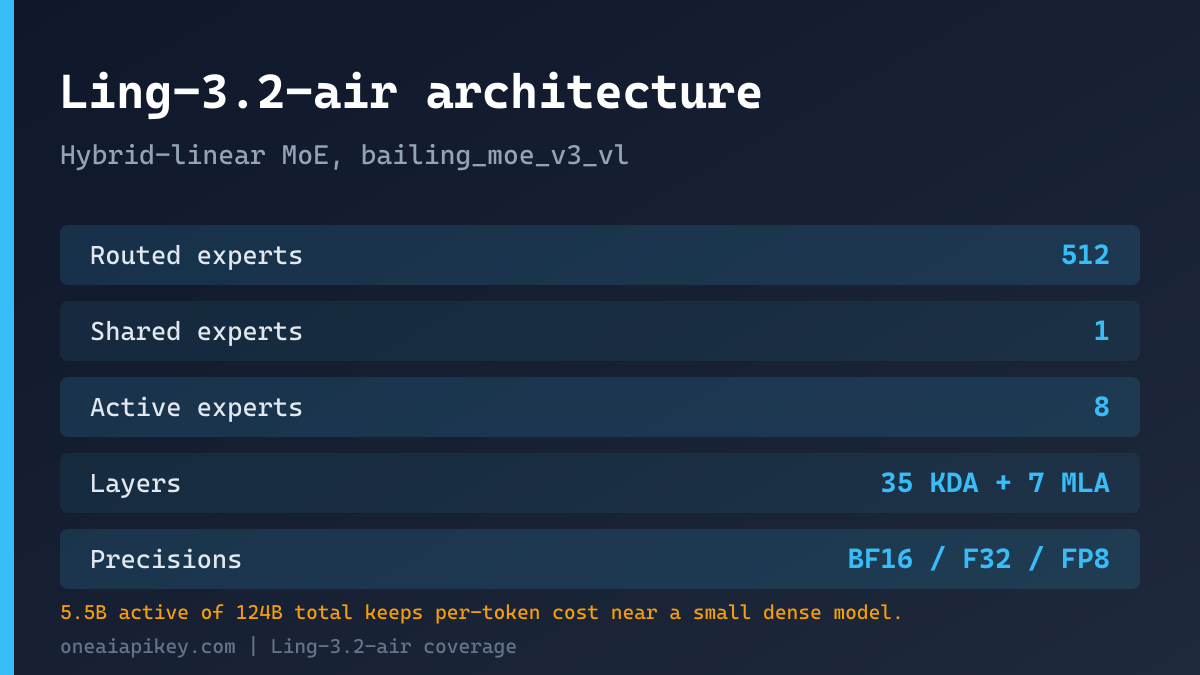
Ling-3.2-air is a mixture-of-experts model with 124 billion total parameters and 5.5 billion active per token. That combination is what makes a multimodal model of this capability self-hostable at all. A dense 124B model would activate every parameter on every token, and running it would demand hardware most teams do not have. With only 5.5B active, the compute cost per token is closer to a small model even though the total capacity is large, because each token only routes through 8 of 512 routed experts plus 1 shared expert.
For vision work specifically, that efficiency matters more than it first appears. Video and image input are token-hungry. A single image can consume hundreds or thousands of tokens once it is encoded, and video multiplies that by the number of frames sampled. A model that activates a small parameter set per token handles that token volume at a fraction of the compute a dense model would need, which is the difference between a vision workload that fits on a four-GPU node and one that does not. Our Ling-3.2-air architecture post goes deep on the expert routing, and Ling-3.2-air self-hosting covers what it takes to run the weights yourself.
The model ships in BF16, F32 and FP8, with the FP8 variant tagged on Hugging Face. For self-hosters, FP8 is the relevant precision for the 129 GB footprint and for fitting the model onto the recommended hardware, which we come back to below.
The lineage: Ling-3.0-flash-VL and why it matters
The model card benchmarks compare Ling-3.2-air against Ling-3.0-flash-VL, and that comparison is worth understanding because it tells you what kind of model this is. Ling-3.0-flash-VL was InclusionAI’s earlier vision-language model, and the improvements Ling-3.2-air shows over it are largest on the agentic side. The AutomationBench jump from 15.7 percent to 61 percent, the Terminal-Bench pass rate going from zero to 27 percent, the AA-Briefcase Elo rising from 987 to 1348. These are the gains the team chose to lead with, and they are about reasoning and tool use.
The vision rows tell the same story in a different register. Air beats its predecessor on every single vision benchmark in the table, but the size of the gap depends on the group. On document intelligence the predecessor was already close: OmniDocBench 1.5 goes from 91.35 to 92.30, a small step, and CharXiv_RQ from 81.30 to 84.50. On perception and on agentic multimodal work the gap is much wider: Babyvision rises from 51.80 to 66.69, AndroidWorld from 67.24 to 79.31, and GDPval-AA v2.1 from 1243.69 to 1518.15. Reading that pattern, the predecessor was already a competent document reader and air is a document reader that got somewhat better. The predecessor was a weaker general perceiver and a weaker seeing-and-acting agent, and air is a large step up on both. That is the real shape of the generational improvement, and it is more informative than any single headline number.
For a self-hoster, the lineage also matters practically. The recommended SGLang serving image is lmsysorg/sglang:dev-Ling-3.0-flash-VL, which means the tooling for running the vision model is built on the infrastructure for its predecessor. Teams that ran Ling-3.0-flash-VL have a head start on serving Ling-3.2-air, and the speculative decoding and Hopper optimizations in the image carry over. That lowers the setup cost for a multimodal deployment, which is not a small thing when the hardware requirements are what they are.
Document intelligence: the strongest part of the vision story
If one part of the vision table is going to convince a skeptic, it is document intelligence, because this is where air beats every model in its comparison set. On OmniDocBench 1.5, air scores 92.30, ahead of Gemini-3.5-Flash at 90.77, DeepSeek-V3.2 at 91.30 and the predecessor at 91.35. That is a narrow lead over strong company, and a narrow lead is exactly what you want to see on a benchmark where the ceiling is near 100 and most serious models cluster together. Air is not dramatically better at reading documents than Gemini, but it is measurably at the front of a pack that includes the best closed models available, on the task that matters most for high-volume document work.
The surrounding document rows fill in the picture. On CharXiv_RQ, which scores reasoning over charts and figures, air scores 84.50, close behind Gemini at 85.20 and Qwen-3.5-Flash at 84.60, and ahead of DeepSeek at 83.70, GPT-5.5 at 82.70 and Claude at 77.00. On MathVision, which measures reading math rendered inside images, air scores 95.66, behind Gemini at 97.84 and essentially level with Qwen at 95.70, and clearly ahead of the predecessor at 84.31. Both are strong results against frontier models.
Then there is GDP.pdf, and this is the honest loss inside the document group. Air scores 16.00 on GDP.pdf, ahead of its predecessor at 8.40 and Qwen at 15.60, but behind GPT-5.5 at 24.00, Gemini at 21.00 and Claude at 18.20. GDP.pdf is a hard all-or-nothing document benchmark where a model has to get an entire PDF task fully right, and on it air sits mid-pack rather than leading. So the honest summary of document intelligence is that air is the best in its set at general document parsing on OmniDocBench and competitive on chart and math reading, but it does not dominate the hardest end-to-end document tasks, where GPT-5.5 and Gemini retain an edge. For a team choosing a self-hosted model for document pipelines, OmniDocBench is the row to weight most heavily, and there air is the leader.
Perception and reasoning over images: solid, not leading
The multimodal perception and reasoning group is where air is good rather than best, and it is worth reading carefully because these are the benchmarks most people mean when they say vision. On MMMU-Pro, a broad test of college-level multimodal reasoning, air scores 79.32. That is ahead of the predecessor at 75.00 and of Qwen and GPT-5.5, both at 75.00, and ahead of DeepSeek at 76.00 and Claude at 77.00. Gemini-3.5-Flash is clearly ahead at 85.00. So air is a solid MMMU-Pro scorer that loses to the strongest Google model by roughly six points.
Babyvision, which probes more basic visual understanding, is a clearer win over the predecessor. Air scores 66.69 against the predecessor’s 51.80, a gain of nearly fifteen points, and it edges Gemini at 67.53 closely while sitting ahead of DeepSeek at 65.70. That jump over the predecessor is one of the larger generational improvements anywhere in the vision section.
ZEROBench is the hardest perception test in the table and the one where air is furthest from the top. Air scores 15.00, ahead of the predecessor at 11.00, GPT-5.5 at 13.40 and Claude at 9.60, but behind Gemini at 17.00. ZEROBench is designed so that strong models score low and near-zero scores are common, so a 15.00 is a respectable result rather than a weak one, but Gemini is still ahead. The pattern across perception is consistent: air is competitive with and often ahead of the Mini-configured closed models, and Gemini-3.5-Flash is the one competitor that stays in front on the most demanding image reasoning. If your workload is the hardest kind of visual reasoning and you have access to Gemini, that gap is a real reason to weigh the closed option, and it is a reason we state plainly rather than bury.
Agentic multimodal intelligence: what the vision is for
The third vision group is the one that most distinguishes air, and it is the group that justifies calling this an agentic multimodal model rather than a model that happens to accept images. These benchmarks measure a model using its eyes to act: navigating documents to complete a task, browsing, operating an interface.
The headline is GDPval-AA v2.1, where air scores 1518.15 on an Elo-style scale. That is ahead of DeepSeek at 1428.00, Gemini at 1442.00, GPT-5.5 at 1469.78, Claude at 1489.60 and the predecessor at 1243.69. Only Qwen-3.5-Flash is ahead, at 1537.00. A nearly 275-point gain over the predecessor on a benchmark that measures getting real multimodal work done is the single most important vision number in the table for anyone evaluating air as a workhorse.
AA-Briefcase v1.1 tells the same story. Air scores 1348.00 against the predecessor’s 987.00, a gain of 361 points, and ahead of DeepSeek at 1291.00 and Gemini at 1295.00. Qwen at 1556.00, Claude at 1356.00 and GPT-5.5 at 1339.00 bracket air closely, so air is competitive at the front of this group rather than dominant. Note this figure sits alongside the model card’s reported 1340 for the same benchmark; the official table and the card differ slightly, and we quote the table’s 1348 here as the more recent publication.
Vision2Web and AndroidWorld complete the agentic group and they are mixed. On Vision2Web, which measures turning web pages into structured understanding, air scores 60.75, ahead of the predecessor at 57.69 but behind Qwen at 64.00, DeepSeek at 62.90 and GPT-5.5 at 64.50. On AndroidWorld, which measures operating a mobile interface, air scores 79.31, a solid gain over the predecessor’s 67.24 and ahead of Gemini at 75.88, but behind Qwen at 84.50 and DeepSeek at 81.90. So air beats its predecessor decisively on seeing-and-acting tasks, is genuinely competitive with closed frontier models on document-driven agentic work, and is mid-pack on browser and mobile operation specifically. The honest read is that air’s agentic multimodal strength is strongest where the task is document-centric and softer where it is web- or device-centric.
Where air sits in its own size class
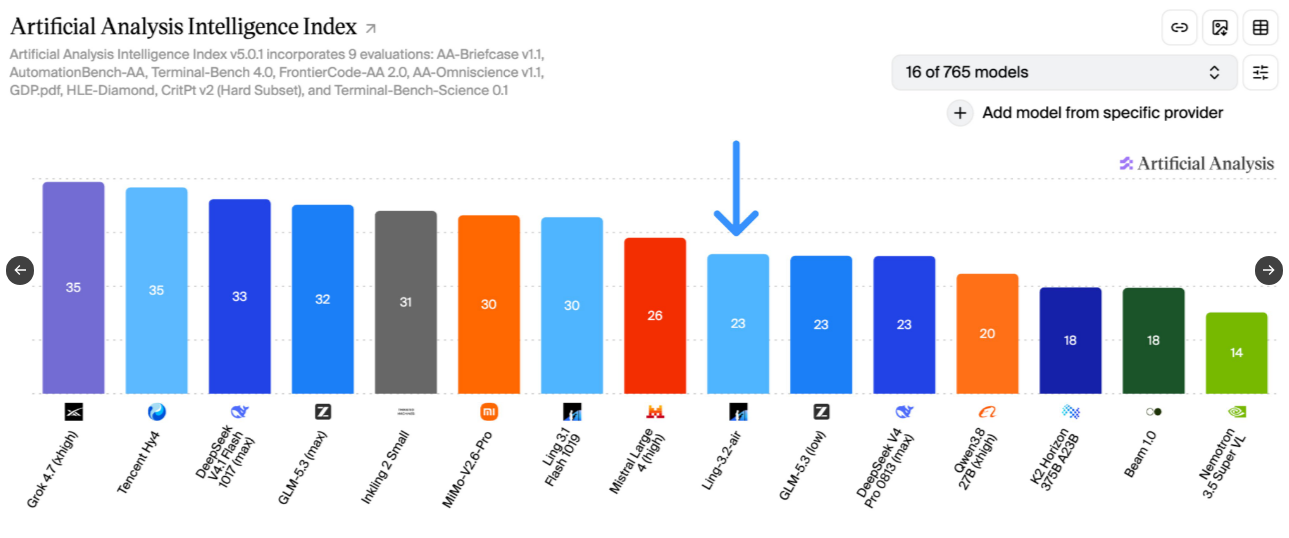
The overall chart places air among open-weights models of all sizes, and it is worth a moment because it is easy to misread. Air’s Intelligence Index of 23 sits well below the flagship open models, with Grok 4.7 and Tencent Hy4 at 35, DeepSeek V4.1 Flash at 33 and GLM-5.3 at 32. Those are much larger models that bring far more compute per token, and air is not competing with them on general capability. What the same chart also shows is air at 23 sitting clearly above Nemotron 3.5 Super VL at 14, K2 Horizon and Beam at 18, and Qwen3B 27B at 20.
The more relevant chart for a self-hoster is the class comparison, because it restricts to models of similar size and similar open-weights positioning. There air scores 23 against Nemotron 3.5 Super VL at 14, Mistral Medium 3.5 at 5, Mistral Small 4 at 4 and Qwen3-120B at roughly 4. Air is first in its class by a wide margin, and the margin matters more than the headline. A model built to run on four GPUs, with 5.5B active parameters, leads its size class on the index by more points than the second-place model scores at all. That is the comparison that answers whether air is a good model of its size, and the answer is unambiguously yes.
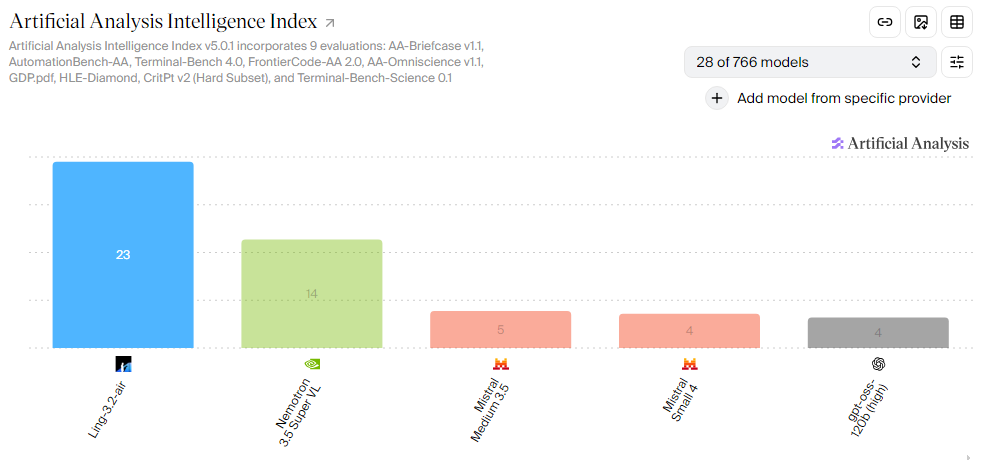
The connection between these class results and the vision table is the point worth holding onto. The index that places air first in its class is built on agentic and reasoning evaluations, several of which involve reading documents and acting on what the model sees. Air’s vision strength is concentrated in exactly those document-intelligence and agentic-multimodal rows where it beats closed frontier models. Its vision weakness is concentrated in pure perception, which the index weights less. That alignment is not a coincidence, and it explains why a model that looks merely solid on MMMU-Pro ranks first in its class overall.
What image and video input actually enable at this size
It is one thing to say a model accepts images. It is another to say what a 124B open-weights model with a camera input is realistically for. The benchmark table lets us ground this map in measured results rather than leaving it as a list of supported input types, so each category below now points at the rows that back it.
Document understanding is the most immediate use, and it is the one the numbers support most strongly. Invoices, forms, contracts, screenshots of dashboards, scanned pages. On OmniDocBench 1.5 air scores 92.30, the best in its comparison set, and on MathVision it scores 95.66 reading math rendered inside images. A native VLM reads the layout and the text together rather than running optical character recognition first and losing the structure, and these two results are the evidence that the design works in practice. For a team processing documents at volume on its own hardware, this is the workload the model is measurably shaped for, and it is the kind where having the weights in-house matters because the documents are often sensitive.
Interface and interface-agent reasoning is the second, and here the evidence is more mixed. Screenshots of applications, error dialogs, design mockups, and beyond that actual operation of a screen. On AndroidWorld, which measures driving a mobile interface, air scores 79.31, a real gain over its predecessor and ahead of Gemini, though behind Qwen and DeepSeek. On Vision2Web it scores 60.75, ahead of its predecessor but behind several closed models. We are careful not to promise screenshot-to-code performance, because no such benchmark exists for this model. What the data supports is that air can see an interface and act on it at a competitive level, strongest when the task is document-like and softer when it is web- or device-centric.
Video and temporal work is the third, and the least explored. Screen recordings, short camera clips, sequential frames. A self-hosted model that accepts video_url can be applied to content that changes over time, which still-image models cannot touch. This remains the newest and least measured part of the offering. The published table scores images and document tasks, not video understanding specifically, so video capability still rests on the documented input support and your own testing rather than a published score.
What ties these together is that the model is designed for self-hosting. There is no public API and no token price, so the entire use case assumes you run the weights yourself. That shapes which vision workloads make sense. High-volume document processing where you cannot send data to a third party, interface work where you need the model inside your own pipeline, and video tasks where per-token costs on a hosted API would be prohibitive. Our Ling-3.2-air vs MiniCPM-V 4.7 post frames the opposite end of the size spectrum, where a 35B model runs on a phone and Ling-3.2-air runs in a datacenter.
The context window you get for vision work
One specification matters more for multimodal work than for text-only, and that is context length. Ling-3.2-air has a documented context of 256K tokens in the Hugging Face model card and the official SGLang recipe, which sets --context-length 262144. Artificial Analysis separately lists the model at 1M tokens. That gap is a real discrepancy and we do not resolve it here, because it belongs to a fuller treatment. Our Ling-3.2-air context window post covers the conflict in detail.
For vision, the relevant point is that image and video tokens count against the same context window as text. A 256K window that also has to hold encoded images or sampled video frames fills faster than one holding only text. A long document with many embedded images, or a video session, eats context in a way a pure text workload does not. That is not a criticism of the model, it is a property of multimodal input, and it is worth knowing before you plan a workflow around it. The 256K documented figure is the one the serving recipe uses, so it is the safe number to plan against.
The hardware you need to see through
Accepting images and video is only useful if you can run the model, and the hardware requirements are public. At the documented 256K context, the model card recommends four GPUs in the 141 GB class, such as the H20-3e or H200, or a four-GPU Blackwell node such as the B300 or GB300. If you are working with 80 GB cards like the H100 or H800, you need eight of them with --tp 8. The recommended serving stack is SGLang, with vLLM as an alternative, and the SGLang image ships with speculative decoding and Hopper decode optimizations already configured.
For a vision workload, those numbers are the floor, not a stretch goal. Video input in particular is token-heavy, and the KV cache that holds the context grows with the number of tokens in the sequence, which means video sessions push memory use toward the top of the documented range faster than text does. Our Ling-3.2-air hardware post breaks down the GPU options and Ling-3.2-air self-hosting covers the serving setup end to end.
The vision scorecard, summarized
With the real numbers in hand, the honest scorecard for Ling-3.2-air as a vision model comes down to three groups.
It leads its comparison set on document intelligence, with the best OmniDocBench 1.5 score at 92.30 and strong chart and math reading at 84.50 and 95.66. This is the clearest reason to pick air for a self-hosted document pipeline.
It is competitive on agentic multimodal work, with a large generational gain on GDPval-AA v2.1 to 1518.15 and AA-Briefcase to 1348.00, and it beats closed frontier models on the document-driven agentic tasks while sitting mid-pack on browser and mobile operation.
It trails Gemini-3.5-Flash on the hardest perception, at 79.32 on MMMU-Pro and 15.00 on ZEROBench against Gemini’s 85.00 and 17.00, and it trails GPT-5.5 and Gemini on the all-or-nothing GDP.pdf at 16.00. These are the honest losses, and they are the reason air is not simply the best vision model in the table.
That profile is the answer to the question this post opened with. Air is a strong document and agentic vision model that you can self-host, and it is not the strongest pure perception model available. For most real multimodal workloads, which are dominated by documents and by acting on what the model sees rather than by maximum visual reasoning, that is a favorable trade.
How to evaluate the vision claims on your own data
Published benchmarks are a starting point, and your workload is the deciding test. If you have a document set, run a sample through the model and measure accuracy against your ground truth, because OmniDocBench tells you air is strong at document parsing in general but not whether it handles your specific forms. If your task is interface reasoning or screenshot-to-code, build a small harness and score it, since that specific capability is not benchmarked. If video is the use case, start with short clips and check whether the model reasons over the sequence correctly.
Two things make self-testing tractable. First, the model is open weights under MIT, so you can run it on your own hardware without sending data anywhere, which matters for sensitive documents and internal interfaces. Second, the serving stack is documented, with SGLang as the recommended path and a specific container image provided, so the setup cost is bounded. Our Ling-3.2-air self-hosting post covers the setup, and Ling-3.2-air benchmarks explains how the general index scores are built.
One honest caution: because the model generates text only, any vision workflow ends with text output. It describes, answers, extracts or reasons in words. It does not produce images or edit them. If your pipeline needs visual output, this is not the model for that stage.
If you are weighing the cost of running these vision workloads against a hosted API, our cost calculator lets you compare self-hosting economics against per-token pricing, and our model catalogue lists what else is available if air is not the right fit. For teams ready to test on their own data, you can sign up for a key and bring your own document samples to measure directly.
Where the vision story sits in the wider comparison
Two comparisons in the cluster are relevant here. Against Ling-3.2-flash, the closed 560B model with a paid API and a 1M context, Ling-3.2-air is the open, self-hosted option at 124B with a documented 256K context. The flash model is larger and runs on someone else’s infrastructure, the air model is smaller and runs on yours. Our Ling-3.2-air vs Ling-3.2-flash post covers that split.
Against Ling-3.1 Flash, there is a genuinely interesting wrinkle. Ling 3.1 Flash scores 29.57 on the Artificial Analysis Intelligence Index, which is higher than Ling-3.2-air’s 23, even though air is the newer and larger model. That is not a contradiction, but it is worth understanding, and our Ling-3.2-air vs Ling-3.1-flash post explains why a smaller-model score can sit above a larger one. That index is built on agentic and reasoning evaluations rather than pure vision, which is why air’s document and agentic vision strength does not fully show up in it.
This section will be updated
This page will be updated once InclusionAI publishes additional vision benchmarks or third-party vision evaluations appear. Based on the official benchmark table published through the Ant Ling account and what the model card and Artificial Analysis confirm, Ling-3.2-air is a native multimodal VLM that accepts text, image and video input through a hybrid-linear mixture-of-experts architecture with 124B total and 5.5B active parameters, built for self-hosting under MIT weights. On vision it leads its comparison set on document intelligence at 92.30 on OmniDocBench 1.5, is competitive on agentic multimodal work at 1518.15 on GDPval-AA v2.1, and trails Gemini-3.5-Flash on the hardest perception at 79.32 on MMMU-Pro against 85.00. That is what is verified, not a prediction. When new vision results appear, we will add them here and revise the scorecard accordingly.
Related reading for this decision
The Gemini 4 Neon launch covers a hosted multimodal alternative. Lingsante 3.1 Flash clinical safety examines a specialist vision model where factual reliability matters more than raw benchmark rank.
The November frontier-model comparison supplies the wider market frame, and Lingsante 3.1 Flash vs frontier compares another family model against closed services. GPT-6.2 Astra pricing is useful when comparing a self-hosted VLM with a metered API. The blog category lists the rest of the vision coverage.
More Ling-3.2-air coverage
This post is part of a cluster covering the launch. Each links back to the hub and to the others:
- Ling-3.2-air launch for the release overview
- Ling-3.2-air benchmarks for what the general scores measure
- Ling-3.2-air architecture for the hybrid-linear MoE design
- Ling-3.2-air vs Ling-3.2-flash for the open versus closed split
- Ling-3.2-air vs MiniCPM-V 4.7 for datacenter versus pocket
- Ling-3.2-air self-hosting for running the weights yourself
- Ling-3.2-air hardware for GPU requirements
- Ling-3.2-air context window for the 256K versus 1M discrepancy
- Ling-3.2-air vs Ling-3.1-flash for the index score comparison
For broader context on related open-weight medical models, see our Lingsante 3.1 Flash launch coverage, and for a smaller multimodal option that runs on modest hardware, our Inkling 2 Mini multimodal vision guide covers a different point on the size spectrum.