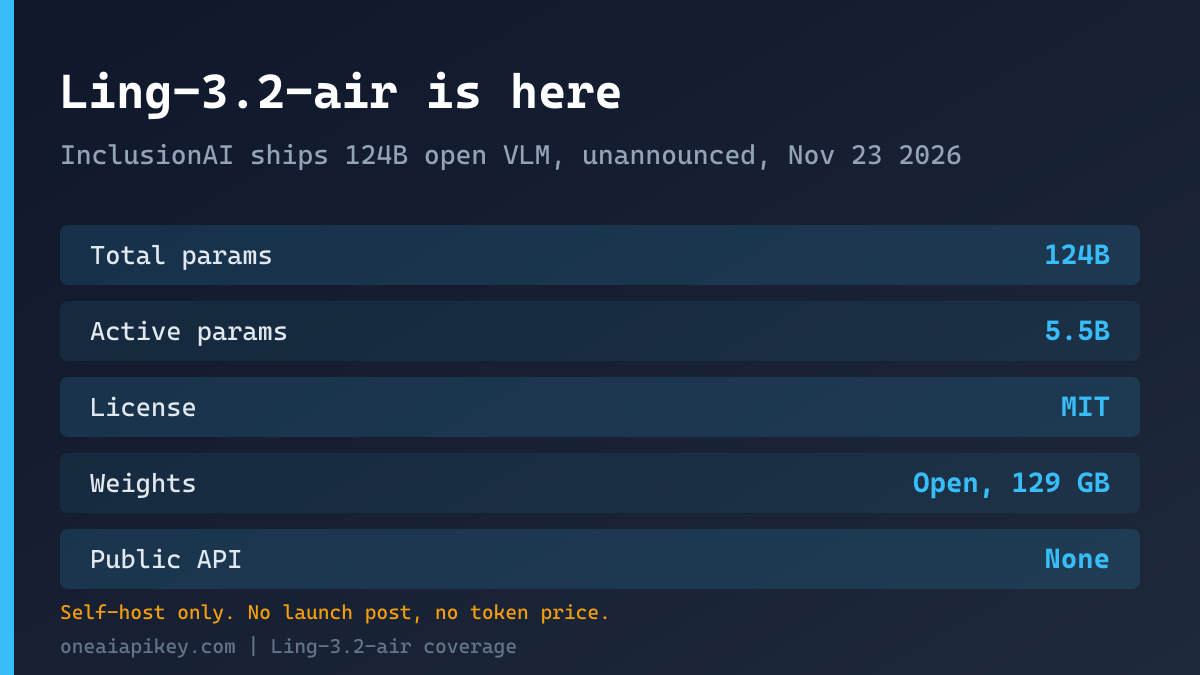
InclusionAI shipped Ling-3.2-air on 23 November 2026, and the strangest thing about the release is how much of the usual launch machinery never showed up. There was no launch blog post, no livestream, no staged rollout with a waitlist, and there is still no API you can sign up for. The weights landed on Hugging Face under an MIT license, apparently unannounced, and the model has been available to download ever since. For a 124-billion-parameter multimodal model from Ant Group’s research lab, that is an unusually quiet entrance, and it shapes everything else you need to know about it.
Quiet does not mean silent, though. On the same day, the official Ant Ling account on X published a benchmark table that compares Ling-3.2-air against its predecessor and against a set of Mini-class closed frontier models, including GPT-5.5-Low, Claude Sonnet 5 and Gemini 3.5 Flash. That table is the single most important new piece of information about this model, because it turns the release from a mystery into something you can actually evaluate. The rest of the machinery is still missing: no launch post explaining the design, no pricing page, no hosted endpoint. But the scores exist, and they tell a sharper story than the release did.
This post is the starting point for a full series on Ling-3.2-air. It covers what the model is, why the unannounced release matters, the architecture in plain terms, the multimodal input, the license, the benchmark picture now that the official comparison table is public, and the self-hosting reality that comes with a model this size. If you want the deeper dives, each has its own post linked at the end.
What Ling-3.2-air is, in one paragraph
Ling-3.2-air is a medium-size open-weights multimodal reasoning model from InclusionAI, the research lab inside Ant Group. It was released on 23 November 2026 with weights hosted on Hugging Face under the repository inclusionAI/Ling-3.2-air. The weights total 129 GB and carry an MIT license, which means commercial use is allowed without negotiation. It is a vision-language model in the Ling lineage, built on the same architectural family as its predecessor Ling-3.0-flash-VL, and it accepts text, image and video as input while producing text output. The model is designed for self-hosting. There is no public API for it, no token price, and no hosted endpoint you can call by the key. If you want to use it, you run it yourself on your own hardware.
That last sentence is the most important fact on this page. Ling-3.2-air is not a model you sign up to use. It is a model you deploy. The whole shape of the release, from the missing API to the missing price to the hardware footprint, follows from that design choice.
The unannounced release, and why it matters
Most model launches are events. The lab writes a blog post explaining what changed, publishes a benchmark table comparing the new model to its predecessor, and opens an API so developers can try it the same day. The announcement does real work: it tells you what the model is for, what it is good at, and how to get access. When that machinery is missing, you lose all of it and have to reconstruct the picture from primary sources.
That is exactly the situation with Ling-3.2-air. The weights appeared on Hugging Face without a launch post. InclusionAI did not publish a companion blog explaining the release or a benchmark table beyond what sits on the model card. There is no public API to call. There is no price list. There is no documented speed figure. The Artificial Analysis page and the Hugging Face card are the two authoritative public sources, and even together they leave obvious gaps.
Two things follow. First, the facts we do have are worth treating carefully, because they come from model cards and third-party indexes rather than a polished announcement. Where a number appears, it is usually verified by more than one of those sources, and where it does not, we say so rather than guess. Second, the absence of a launch post means the community is still working out what the model is best at. There are no verified community reaction quotes we can point to yet, and we will not invent any.
The honest framing for this release is that InclusionAI shipped a real model and skipped the launch. That is not a criticism, but it does mean the burden of understanding falls on the person deploying it. The rest of this post, and the series it opens, is an attempt to carry that burden for you.
The architecture, in accessible terms
Ling-3.2-air is a mixture-of-experts model, which is a design that splits a large model into many smaller specialist parts and only activates a few of them for any given token. The total parameter count is 124 billion. The number of parameters actually active when the model processes a single token is 5.5 billion. The architecture tag on the model card is bailing_moe_v3_vl, and the vl suffix reflects its vision-language lineage.
Why does that split matter? Because it separates two costs that are usually bundled together. The full 124 billion parameters have to live in memory, so you need hardware that can hold the whole model. But the compute cost of generating each token is driven by the 5.5 billion active parameters, which is close to what a small dense model would cost to run. In practice that means Ling-3.2-air thinks like a small model in terms of speed per token while carrying the knowledge of a much larger one. Our Ling-3.2-air architecture post goes through the layer composition, the expert counts, and the attention design in full.
One detail is worth flagging here because it comes up in every discussion of the model size. The Hugging Face sidebar lists the model at 128 billion parameters, while the architecture table lists 124 billion. We use 124 billion throughout this series because that is the figure in the detailed architecture breakdown, but you will see 128B quoted elsewhere and the difference is a known discrepancy rather than an error on your part. Ling-3.2-air context window covers a similar conflict on the context length.
Multimodal by default: text, image and video
Ling-3.2-air is multimodal in its native architecture, not through a bolted-on vision adapter. It accepts three input types: text, image and video. The model card exposes image_url and video_url input types alongside plain text, which means you can pass a screenshot, a photo, or a video clip directly into the same interface you use for text. Output is text only.
This is the same direction the rest of the field has moved. The closest predecessor, Ling-3.0-flash-VL, was already a vision-language model, and Ling-3.2-air continues that lineage rather than starting a new one. What is genuinely notable is that video input is a first-class input type rather than an afterthought. Passing a sequence of frames and asking the model to reason over them is supported at the interface level, which opens use cases that pure image models cannot reach.
The vision side of the model deserves its own treatment, and Ling-3.2-air vision covers what the multimodal input enables in practice. Because there is no published vision benchmark yet, that post leans on the architecture and the input interface rather than measured scores, and it is explicit about that limit.
MIT license, and what it actually grants
The weights are released under the MIT license. That is one of the most permissive open-source licenses in common use, and for a model it means you can use the weights commercially, modify them, redistribute them, and build products on top of them without paying a royalty or negotiating a separate agreement. There is no usage-based cap, no research-only clause, and no requirement to share your own derivative improvements.
For a 124-billion-parameter multimodal model, MIT is a meaningful choice. Many open-weight releases in this size class ship under licenses with commercial restrictions or acceptable-use policies that add conditions. MIT strips those away. If your plan is to fine-tune Ling-3.2-air for a customer workflow, embed it in a product, or run it on your own infrastructure as a replacement for a paid API, the license does not get in your way.
The license is the reason the self-hosting angle is worth taking seriously rather than treating as a footnote. A permissive license plus open weights plus a documented serving recipe adds up to a model you can actually own the deployment of. Ling-3.2-air self-hosting walks through what that deployment looks like day to day.
The benchmark picture: strong on agentic work, weaker on heavy SWE
Here is where the missing launch post used to bite hardest, and where the official Ant Ling table changes things. There is now a real benchmark story for Ling-3.2-air, published by the lab itself on X, and it compares the model not just against its predecessor but against Mini-class closed frontier models. That comparison set is what makes the table worth reading closely.
The official account led its announcement with one number: AutomationBench-AA at 61 percent, up from 15.7 percent on the predecessor Ling-3.0-flash-VL. That is close to a fourfold jump on an agentic automation benchmark, and it is the largest relative gain in the set. In the full table, that 61 percent is the best score of the seven models compared, ahead of Qwen-3.5-Flash-Novt at 55.90, Gemini-3.5-Flash at 53.00, GPT-5.5-Low at 50.20, DeepSeek-V3.2 at 49.20 and Claude-Sonnet-5 at 36.50. An open MIT model beating that group on agentic workflow automation is the headline, and it is earned.
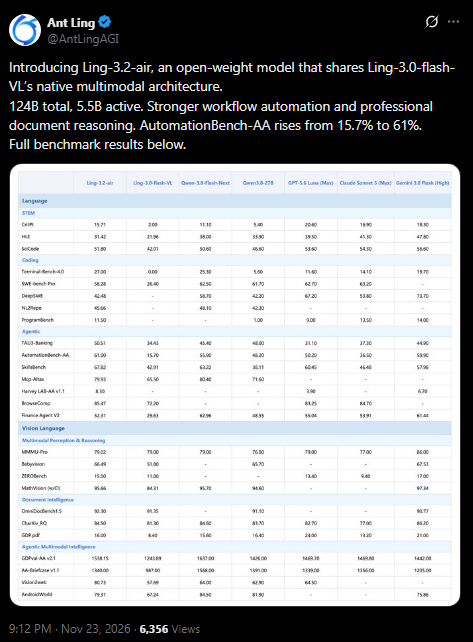
The agentic and terminal cluster is where the model earns its place. Terminal-Bench 4.0 is the clearest example: the predecessor scored literally 0.00, and Ling-3.2-air scores 27.00, which is the best figure in the entire table, ahead of Qwen-3.5-Flash at 25.30 and well clear of GPT-5.5-Low at 11.60, Gemini at 13.70, Claude at 14.10 and DeepSeek at 5.60. TAU3-Banking goes to 50.51, the best shown, against DeepSeek at 49.00 and Qwen at 45.40. SkillsBench is 67.82, again the best, ahead of GPT-5.5-Low at 60.45. BrowseComp lands at 85.47, narrowly ahead of Claude-Sonnet-5 at 84.70 and GPT-5.5-Low at 83.25. On document intelligence, OmniDocBench 1.5 reaches 92.30, the best in the set, against Claude and Gemini at 90.77. And Harvey LAB-AA v1.1, an all-pass metric where low absolute numbers are normal, shows 8.30, the highest figure displayed, against Gemini at 6.30 and GPT-5.5-Low at 3.90.
So the pattern is consistent and it is real: on agentic workflow automation, terminal coding, banking and finance agents, browse, skills, and document intelligence, this 124-billion-parameter open model with 5.5 billion active parameters beats a field of closed Mini-class frontier models. That is the special part, and it is exactly the cluster you would expect a self-hostable multimodal agent to be used for.
Now the honest losses, because a table that only showed the wins would not be analysis. On heavy software engineering, Ling-3.2-air comes last in its comparison set. SWE-Bench Pro is 58.28, the lowest of the seven, behind Claude-Sonnet-5 at 63.20, GPT-5.5-Low at 62.70, Qwen-3.5-Flash at 62.50 and DeepSeek-V3.2 at 61.70. DeepSWE is 42.48, also the lowest, well behind Gemini-3.5-Flash at 73.70 and GPT-5.5-Low at 67.20. On pure STEM reasoning the model is mid-pack rather than leading: CritPt is 15.71 where GPT-5.5-Low reaches 20.80, and GDP.pdf is 16.00 where GPT-5.5-Low reaches 24.00, though both are big improvements over the predecessor’s 2.00 and 8.40 respectively. The takeaway is that Ling-3.2-air is not a heavyweight coding or proof model. It is tuned for agentic and document work, and the table shows exactly that shape.
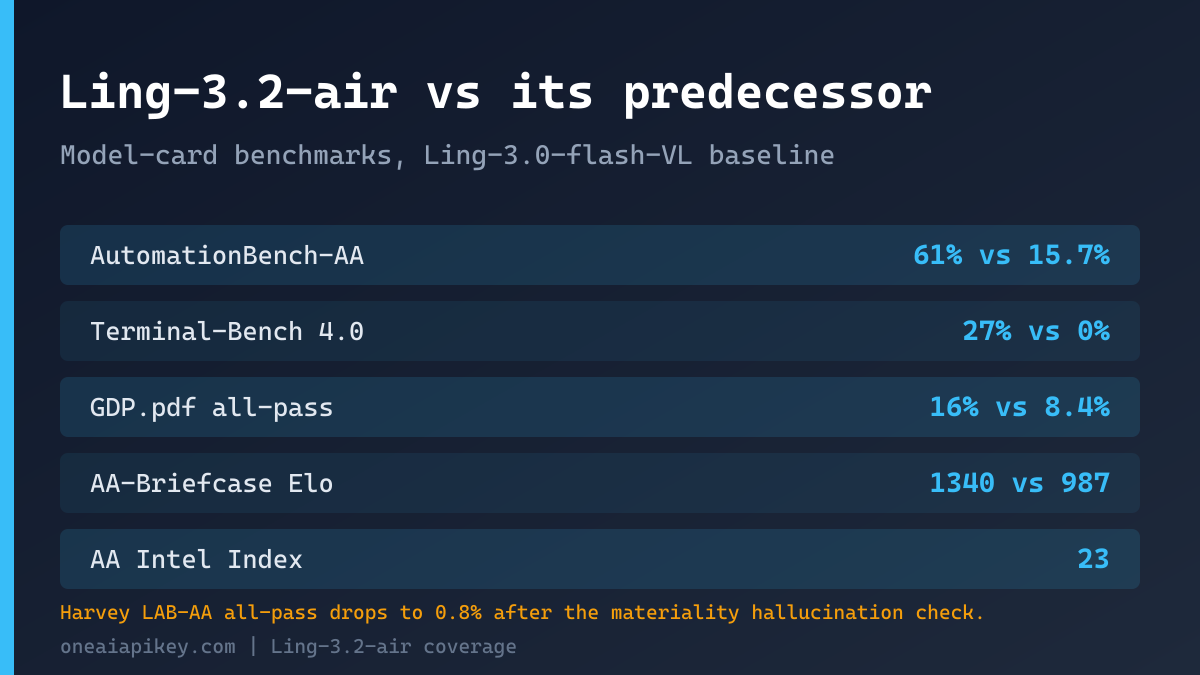
For the independent view, Artificial Analysis scores Ling-3.2-air at 23 on its Intelligence Index v5.0.1, with a raw score of 23.39. That places it first out of five models in its size class, and well above the median of 5 for comparable open-weights models of similar size. No individual coding, math or reasoning sub-scores are broken out for the model, and there is no speed, latency or cost figure, because all of those require an API and there is none.
The official account also published two Artificial Analysis charts that put the 23 in context, and both are worth reading together. In the medium open-weights class, Ling-3.2-air scores 23 against Nemotron 3.5 Super VL at 14, Mistral Medium 3.5 at 5, Mistral Small 4 at 4, and Qwen3-120B at roughly 4. It is first in that class by a wide margin, which is what being a 124-billion-parameter model among mostly smaller peers buys you.
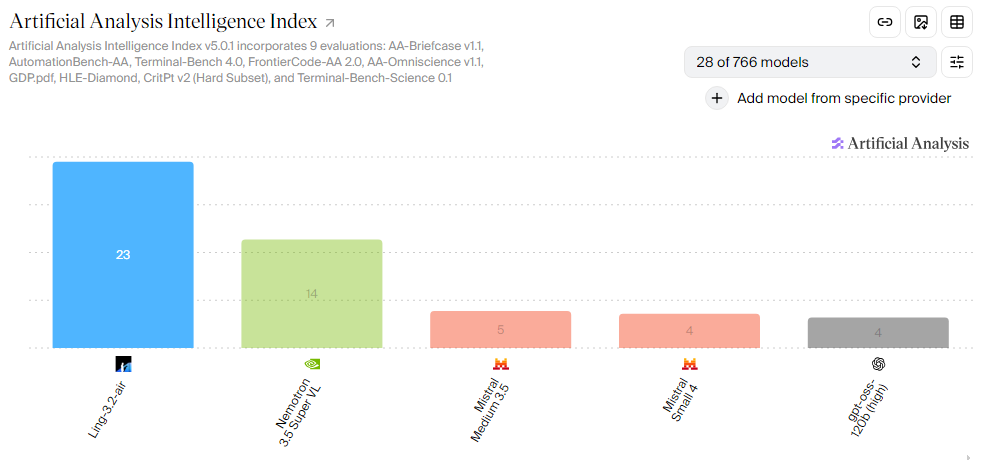
The broader ranking is the more honest picture, because it sets the model against the big dense flagships too. There Ling-3.2-air sits at 23, below Grok 4.7 at 35, Tencent Hy4 at 35, DeepSeek V4.1 Flash at 33, GLM-5.3 at 32, Inkling 2 Small at 31, MiMo-V2.6-Pro at 30, Ling 3.1 Flash at 30, and Mistral Large 4 at 26. It is level with GLM-5.3 low and DeepSeek Pro at 23, and above Qwen3B at 20, K2 Horizon at 18, Beam 1.0 at 18, and Nemotron-VL at 14. Reading the two charts together gives you the honest placement: dominant in its own size class, mid-table against the largest open models, and behind them on heavy code and pure reasoning specifically.
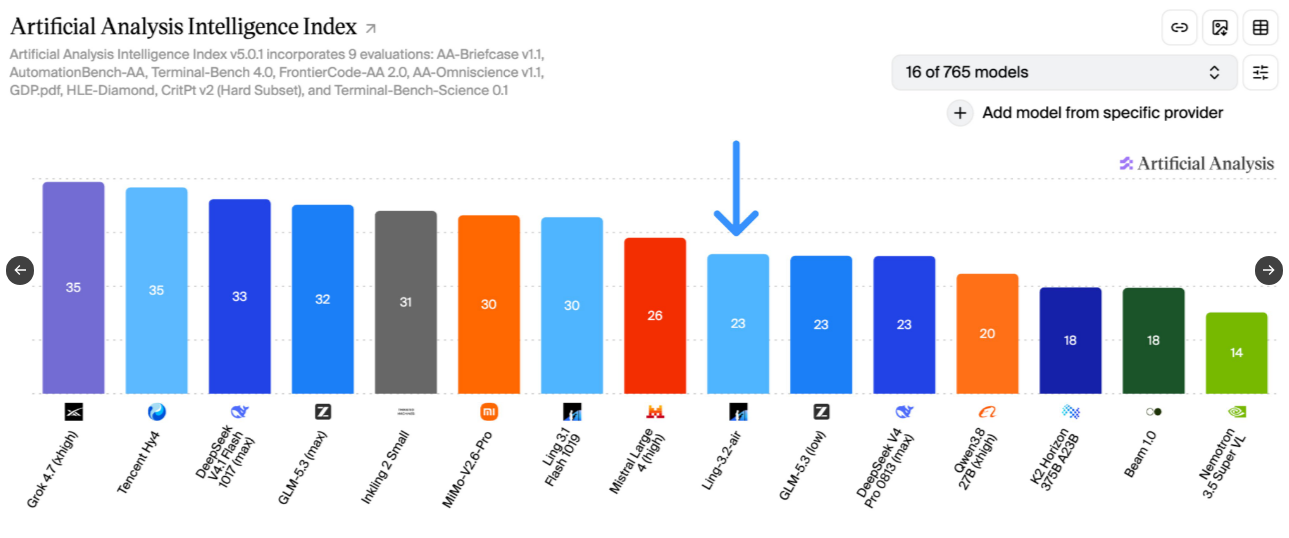
The benchmark story is real and now well documented, but it is still partial. This section will be updated once InclusionAI publishes official benchmarks beyond this table, ideally with independent replication. Based on what the official table and Artificial Analysis confirm today, the agentic and document gains are genuine and the model beats Mini-class closed models in that cluster, while the heavy SWE and pure STEM results are honest losses. That is what is verified, not a prediction. Ling-3.2-air benchmarks goes benchmark by benchmark, and Ling-3.2-air vs Ling-3.1 Flash covers why the older Flash posts a higher composite index number.
Self-host only, and what that costs you in hardware
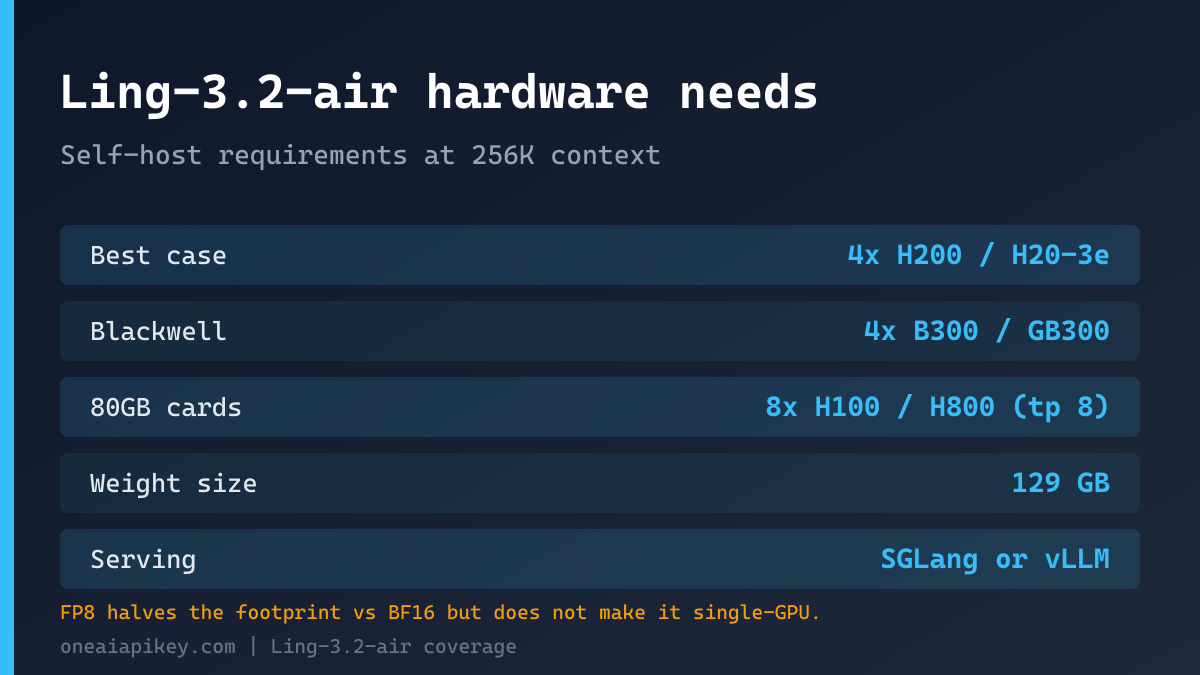
Because there is no public API, using Ling-3.2-air means running it yourself, and the hardware requirements are the practical gate. For the documented 256K context configuration, the model card recommends four GPUs in the 141 GB class, such as the H20-3e or H200, or a four-GPU Blackwell node such as the B300 or GB300. If you are working with 80 GB cards like the H100 or H800, you need an eight-GPU setup with tensor parallelism set to eight.
That is a serious footprint, and it is the direct consequence of a model whose full 124 billion parameters have to sit in memory. The 5.5 billion active parameters keep the per-token compute cost low, but they do nothing to shrink the memory requirement. You are paying for the whole model in hardware even though only a slice of it works on each token. Ling-3.2-air hardware breaks down the GPU options and the memory math in detail.
The recommended serving stack is SGLang, with vLLM as an alternative. The model card documents a specific sampling configuration, with temperature set to 1.0, top_p at 0.95, top_k at 20, and thinking enabled. The SGLang image referenced in the card includes speculative decoding through MTP and Hopper decode optimizations, and the reasoning and tool-call parsers resolve automatically to the ling3 profile.
How it sits next to its siblings
Two comparisons are worth making at the launch stage, and both turn on the same theme: Ling-3.2-air is the self-host option in its family.
The first is against Ling-3.2-flash. The flash variant is the opposite trade. It has closed weights, it is served through a paid API, it is much larger at 560 billion parameters, and its context window reaches 1 million tokens. Pricing for flash is listed at 2 CNY per million input tokens. Air, by contrast, has open MIT weights, no API, a 124-billion-parameter count, and a documented 256K context on the model card. The pair is best understood as two answers to the same question: flash is the option you call, air is the option you run. Ling-3.2-air vs Ling-3.2-flash works through that split in full.
The second is against MiniCPM-V 4.7, and it is a sharper contrast. MiniCPM-V 4.7 is a 35-billion-parameter vision-language model built to run on a phone. Ling-3.2-air is a 124-billion-parameter model that needs a multi-GPU server. There is no shared benchmark between them, so the comparison comes down to specifications and hardware math rather than scores. The framing that fits is datacenter or pocket: one model lives in a rack, the other lives in your hand. Ling-3.2-air vs MiniCPM-V 4.7 does that spec-and-hardware comparison.
For context on how the smaller Ling tier behaves in practice, our Lingsante 3.1 Flash launch and Lingsante 3.1 Flash benchmarks posts cover a related model in the same family, and Lingsante 3.1 Flash self-hosting shows what a lighter self-host deployment looks like by comparison.
Who this model is actually for
Putting the whole picture together, Ling-3.2-air is for a specific kind of user, and it is worth being clear about who that is. It is for teams that want to own a capable multimodal reasoning model outright, that have access to multi-GPU hardware, that need the permissive MIT license for commercial reasons, and that are comfortable running their own serving stack. If that describes your situation, the combination of open weights, video input, strong agentic benchmark gains and a permissive license is genuinely attractive.
It is not for someone who wants to call a model by the key and pay per token. There is no API, so there is no metered access path. If you do not have the hardware or the willingness to manage a deployment, the practical answer today is to wait for a hosted provider to pick it up, or to look at the closed sibling Ling-3.2-flash, which is served through a paid API and handles that layer for you.
It is also not yet a model you can pick based on a complete scorecard. The benchmark story is real but partial, the speed is unknown, and the price of running it is whatever your hardware costs, not a published rate. A team evaluating it should plan to run their own tests on their own tasks, because the public data does not settle the question on its own.
What to watch next
The gaps in this release define what to watch. The first is whether InclusionAI publishes a proper launch post or technical report, which would fill in the benchmark table and explain the design. The second is whether a hosted provider adds Ling-3.2-air to a router, which would give it a price and a speed figure for the first time. The third is whether the community produces independent speed measurements, since the official ones do not exist. Any of those would change the picture meaningfully, and we will update the relevant posts when they happen.
Sign up for a key to browse hosted models, check the model catalogue for what is available through an API today, or run your own volume estimates through the cost calculator before committing to a self-hosting build.
Related reading for this decision
The November frontier-model comparison places the release beside the other models competing for attention. Inkling 2 Mini vs frontier covers a smaller open model with a different deployment target, and the Gemini 4 Neon launch covers a hosted multimodal alternative.
Lingsante 3.1 Flash vs frontier adds context on the specialist side of the Ling family. The blog category lists the full release coverage in date order.
More Ling-3.2-air coverage
This is the hub post for a ten-part series on Ling-3.2-air. Each piece below goes deeper on one area, and each links back here:
- Ling-3.2-air benchmarks on the index score, the model-card jumps, and the Harvey reliability caveat
- Ling-3.2-air architecture on the hybrid-linear MoE and why 5.5B active of 124B matters
- Ling-3.2-air vs Ling-3.2-flash on the open self-host model against the closed API sibling
- Ling-3.2-air vs MiniCPM-V 4.7 on datacenter versus pocket multimodal
- Ling-3.2-air self-hosting on running the model yourself day to day
- Ling-3.2-air hardware on the GPU options and the memory math
- Ling-3.2-air vision on text, image and video input in practice
- Ling-3.2-air context window on the 256K documented window and the 1M discrepancy
- Ling-3.2-air vs Ling-3.1 Flash on why the older Flash scores higher on the index
- Lingsante 3.1 Flash launch for context on the wider Ling family and its smaller tiers