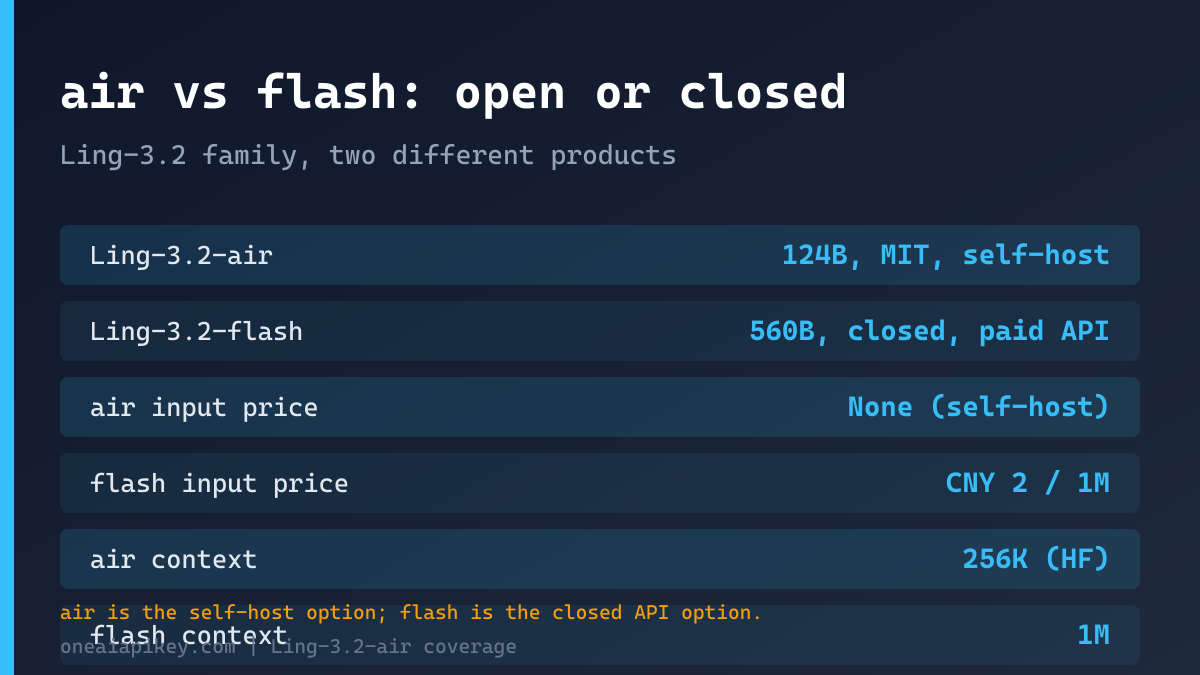
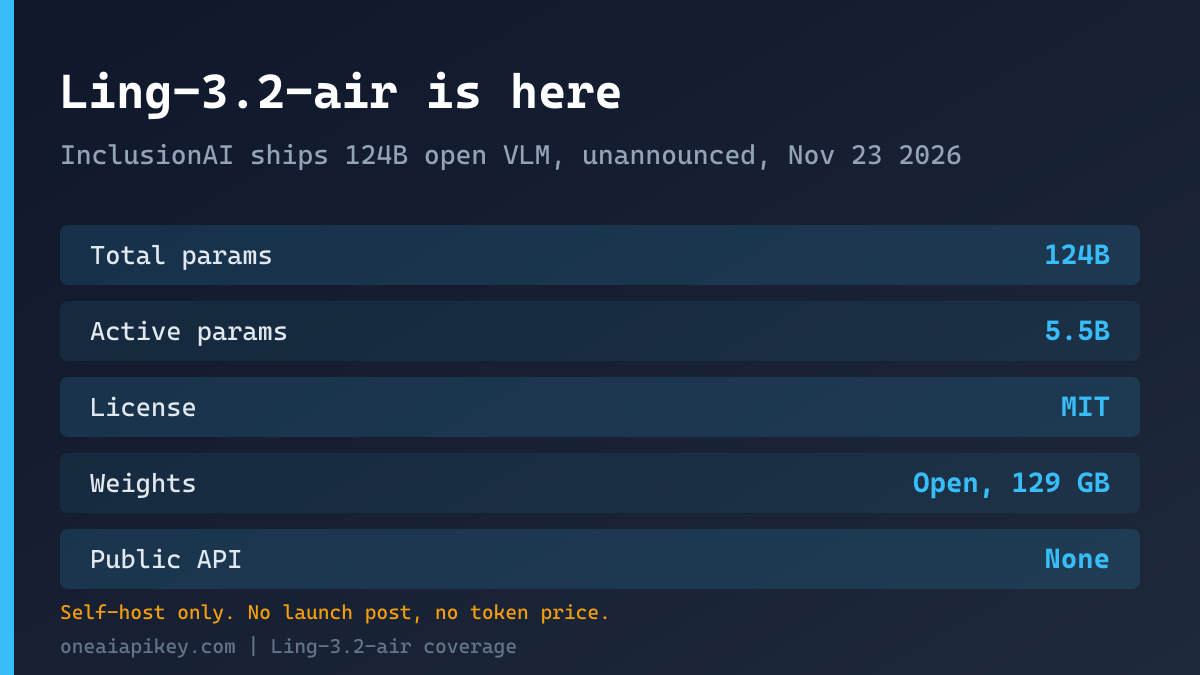
InclusionAI shipped two models in the same family on the same day, and they are close to opposite products. Ling-3.2-air is a 124 billion parameter model with open weights under the MIT license, published on Hugging Face at 129 GB, built for you to download and run on your own hardware. Ling-3.2-flash is a 560 billion parameter model with closed weights, available only through a paid API at 2 CNY per million input tokens. One is a download. The other is a service. That is the entire decision you face, and it is worth being precise about it before you pick.
This post compares them on what is actually verified: parameter count, license, weight availability, price, context window, modality, and how you deploy each one. It does not put them on the same benchmark scoreboard, because there is no published head-to-head between them today. What it does do, in the benchmark section, is show you where Ling-3.2-air actually lands against the closed Mini-class frontier models that occupy the same market space as flash, so you are choosing with real capability data and not just deployment labels. That is the honest state of the data on launch day.
The naming, and what it tells you about intent
It is worth pausing on the names, because they are more descriptive than they first look. InclusionAI put these two models in the same version family, 3.2, which signals they share a lineage and a point in time. Then it split them with two different suffixes, and those suffixes describe deployment posture rather than capability ranking.
“Air” is the lighter, downloadable one. The name suggests something you take with you and run where you need it, and that matches the product: 129 GB of weights you pull down and host yourself. “Flash” is the one behind a service, and in this family flash is also the larger model at 560 billion parameters, which inverts the usual convention where flash denotes the smaller variant. That inversion is a clue that the split here is not size-tiered the way a “mini” versus “max” pairing would be. It is open-versus-closed. The naming describes how you get the model, not just how big it is.
Reading the launch that way reframes the decision. InclusionAI did not ship a big model and a small model and ask you to pick by capability. It shipped one capability in two distribution shapes and asked you to pick by deployment model. That is a cleaner way to think about it, and it is why this comparison resolves on infrastructure rather than on scores.
How the launch shapes the comparison
The circumstances of the release matter for how you read anything either model claims. Ling-3.2-air’s weights landed on Hugging Face unannounced, with no launch post from InclusionAI explaining the release, no press event, and no published technical report. The 23 November 2026 date comes from when the weights appeared, not from an announcement. That is a quiet launch, and it means the model card and the Artificial Analysis entry are the primary sources rather than a marketing page.
A quiet open-weights drop and a hosted API model are measured differently by nature. Ling-3.2-air can be independently evaluated by anyone who downloads it, which is how it already has an Artificial Analysis Intelligence Index score despite never being formally launched. Ling-3.2-flash, as a closed hosted model, is evaluated through whatever access its operator provides. That asymmetry is part of why a shared benchmark does not exist yet. Independent evaluators can reach air on their own; flash they can only reach through the API.
It also means the open model’s numbers are more falsifiable. If a score for Ling-3.2-air looks wrong, someone can rerun it against the public weights. For a closed model you are trusting the operator’s harness. That is not an accusation, it is a structural difference between open and closed evaluation, and it is one more thing to weigh when you pick which model to build on.
The one-line difference
Ling-3.2-air is the open-weights, self-host option. You pull 129 GB of weights from Hugging Face, you bring your own GPUs, and you run it under an MIT license that allows commercial use. There is no API for it. Ling-3.2-flash is the closed, hosted option. You cannot download it, you call it over a network, and you pay 2 CNY per million input tokens for the privilege.
If you already know which of those two describes your situation, you are most of the way to a decision. The rest of this post fills in the specifics, and it also explains why a direct score comparison is not something either company has published yet.
The architecture behind the open one
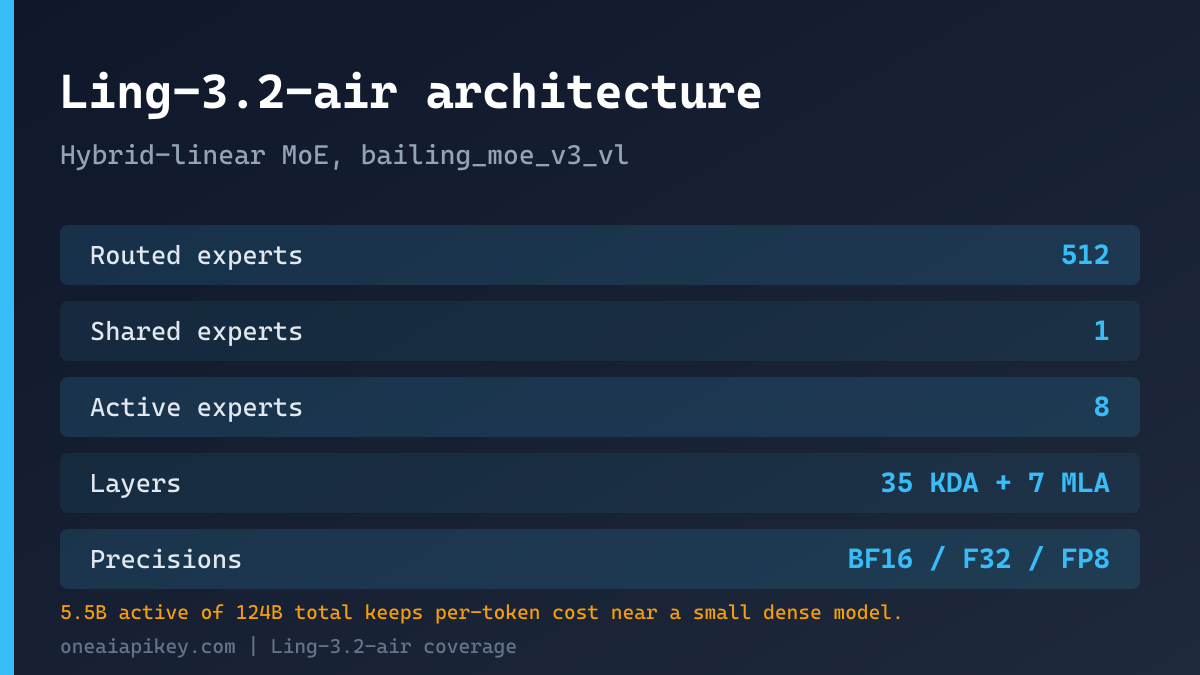
It is worth understanding what you get when you pull Ling-3.2-air, because “124B” compresses a lot of design into one number. The model is a hybrid-linear mixture-of-experts built on the bailing_moe_v3_vl architecture, the same lineage as Ling-3.0-flash-VL. It has 35 KDA layers and 7 Gated MLA layers in a 5:1 ratio, plus 2 dense layers. The expert structure is 512 routed experts with 1 shared expert, of which 8 experts activate per token, giving 5.5 billion active parameters against the 124 billion total. Hidden size is 2560, vocabulary is 157,184 tokens.
None of that is decoration. The 512-expert structure is exactly why the model has a multi-GPU memory requirement despite a small active count, a point our Ling-3.2-air hardware guide works through in detail. And the native multimodal design is why image and video input are first-class rather than bolted on. When you compare air to flash on architecture, the honest statement is that air’s design is fully documented and flash’s is not published in the material we have. You are choosing a known, open architecture against an undocumented one.
How the two models line up
Here is the comparison, built from the model card and the public listings. Every figure here is verified; anything not in this table is not something we have a confirmed number for.
| Dimension | Ling-3.2-air | Ling-3.2-flash |
|---|---|---|
| Total parameters | 124B | 560B |
| Weights | Open, MIT license | Closed |
| Availability | Hugging Face, 129 GB download | Paid API only |
| Price | Free weights, you pay for GPUs | 2 CNY per million input tokens |
| Context window | 256K (per HF card) | 1M |
| Input modalities | Text, image, video | Not published |
| Deployment | Self-host only, no API | Hosted, no weights |
Read that table as two different products rather than two versions of one product. Ling-3.2-air trades model size and context length for openness and control. Ling-3.2-flash trades openness for scale and reach. Neither is strictly better. They answer different questions.
The parameter and memory story
The 124B versus 560B gap is the biggest raw number difference, and it matters most for where each model can physically run. Ling-3.2-air’s 124 billion parameters ship as 129 GB of FP8 weights on Hugging Face, which is what makes a self-host deployment plausible on a small multi-GPU node rather than a datacenter floor. Our Ling-3.2-air hardware requirements guide walks the exact GPU counts, and the short version is that 256K context fits on four 141GB-class cards or a 4-GPU Blackwell node.
Ling-3.2-flash at 560 billion parameters is in a different weight class entirely. A model that size is a cluster-scale deployment no matter how you quantize it, which is exactly why InclusionAI ships it as a hosted API rather than a download. You are not meant to run it yourself. You are meant to call it. Our LingSante-3.1-flash self-hosting guide covers a 560B MoE in detail and reaches the same conclusion: that size does not fit on any single card you can buy.
Open weights versus a paid API
The license and availability split is the part that actually decides most deployments, and it cuts deeper than price.
With Ling-3.2-air you hold the weights. The MIT license permits commercial use, so you can run it in a product, fine-tune it, audit it, and keep it on hardware you control. If your workload has a data-residency requirement, if you need the model to never see an outbound network call, or if you want to adapt the weights to your own domain, Ling-3.2-air is the only one of the two that can do any of that. The cost is that you own the whole stack: GPUs, the serving runtime, uptime, and scaling. Our Ling-3.2-air self-hosting guide covers the serving recipe.
With Ling-3.2-flash you rent access. There is nothing to host, nothing to scale, and no GPU capex, and you pay 2 CNY per million input tokens. For bursty or low-volume workloads that is almost always cheaper than owning hardware, because idle GPUs still cost money. The trade is control. You cannot inspect the weights, you cannot fine-tune them, and your data passes through a hosted service. That is the standard open-versus-closed trade, and InclusionAI has simply offered both sides of it in one family.
Context window: 256K versus 1M
Ling-3.2-air ships with a 256K token context window according to the Hugging Face card and the official SGLang serving recipe, which sets --context-length 262144. Ling-3.2-flash lists 1 million tokens. For long-document work, large codebases, or long multi-turn agent sessions, that gap is real.
One honesty note on the air figure. Artificial Analysis lists Ling-3.2-air at 1M context, not 256K. The 256K number is the documented native configuration and it is what the official serving recipe actually uses, so that is the number to plan a deployment around. Whether the model can be pushed to 1M with more memory is not something InclusionAI has confirmed. Our Ling-3.2-air context window guide covers this discrepancy in full.
Modality: what each one accepts
Ling-3.2-air is multimodal. It accepts text, image, and video input and produces text output, with image_url and video_url input types documented on the card. It is a vision-language model built on the same lineage as Ling-3.0-flash-VL, and our Ling-3.2-air vision guide covers what the image and video input supports.
For Ling-3.2-flash, the input modalities are not published in the material we have. We are not going to assume it matches air’s multimodal input, and we are not going to claim it is text-only either. The modality comparison is therefore incomplete on the flash side, and we will fill it in when InclusionAI publishes a model card. That is a genuine gap, not a judgment.
What we can now compare: benchmarks, and where flash still is not
There is still no published head-to-head between Ling-3.2-air and Ling-3.2-flash, and nothing in this post changes that. But the picture around air is no longer empty. InclusionAI’s official account posted a benchmark table on launch day, and Artificial Analysis has published scored charts, and together they let us place air against a real field rather than describe it in a vacuum. That field does not include flash, so read everything below as context for the decision rather than a proxy score for either model.
The one-line version of what the new data shows: Ling-3.2-air beats a set of closed Mini-class frontier models on agentic work, terminal coding, banking agents, browse, and document intelligence, and loses to those same models on heavy software engineering and the hardest STEM reasoning. That is a real, measurable capability profile, and it is the profile you are choosing when you pick the open self-host model over the closed 560B API.
Where air sits in the broader field
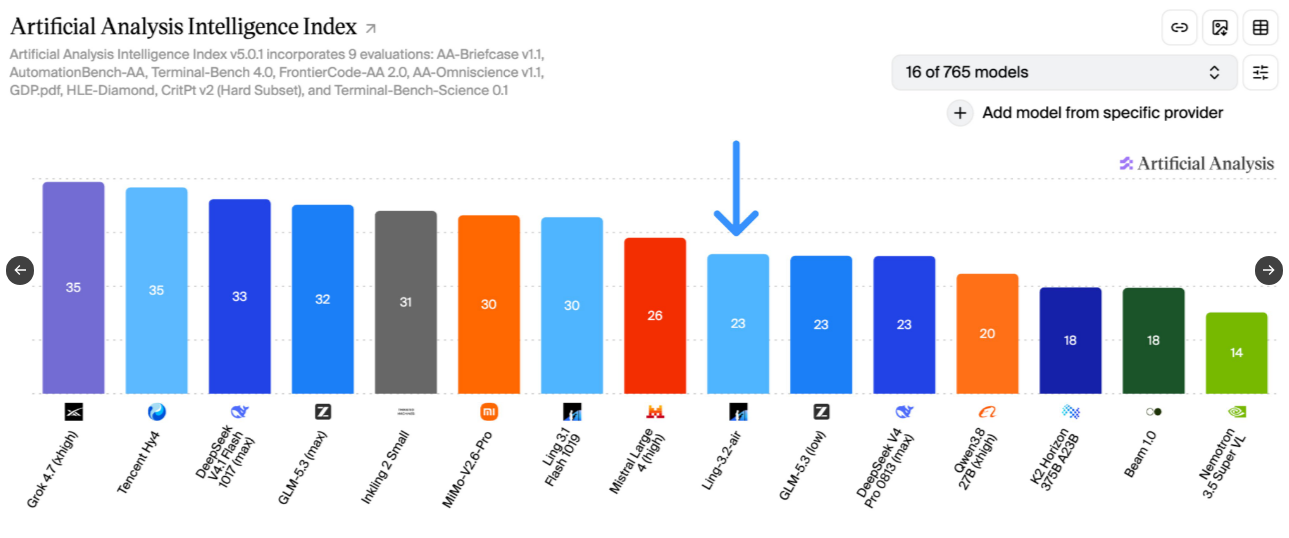
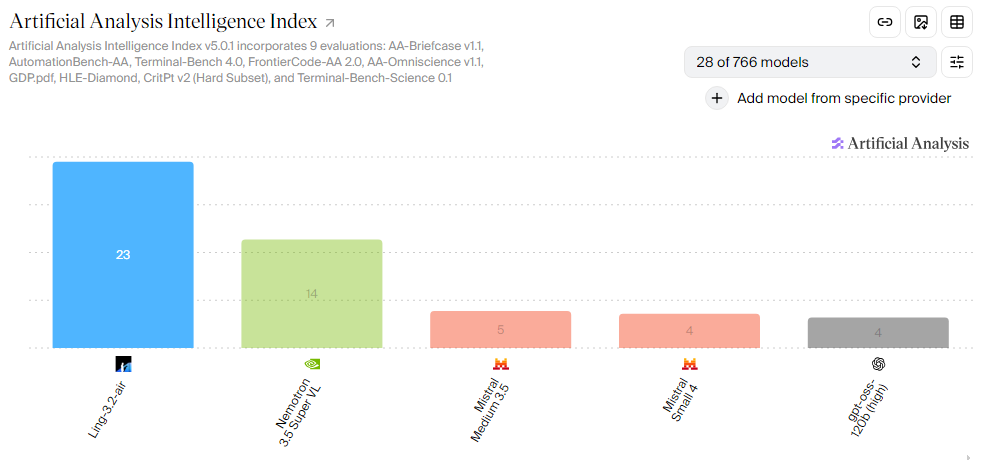
Artificial Analysis scores Ling-3.2-air at 23 on its Intelligence Index v5.0.1, and the broader open-weights ranking puts that number in context. The large dense flagships sit above it: Grok 4.7 and Tencent Hy4 at 35, DeepSeek V4.1 Flash at 33, GLM-5.3 at its top setting at 32. Air, at 23, lands below that group and level with GLM-5.3 at its low setting and DeepSeek Pro, and clearly above Qwen3B 27B at 20, K2 Horizon and Beam at 18, and Nemotron 3.5 Super VL at 14. One related model in that chart is worth flagging for this comparison: Ling 3.1 Flash scores 30, higher than air’s 23, and our Ling-3.2-air vs Ling-3.1-flash guide covers that specific gap.
Within its own weight class the story is different. In the medium open-weights category air is first by a wide margin: 23 against Nemotron 3.5 Super VL at 14, Mistral Medium 3.5 at 5, Mistral Small 4 at 4, and Qwen3-120B at roughly 4. Against comparable open models of similar size, air is not competitive, it is dominant. The honest summary is that air is the best model in its size class and a mid-table model in the overall field, and the 560B flash you would be paying for sits in the flagship tier that the overall chart does not score here.
The wins, and they are specific
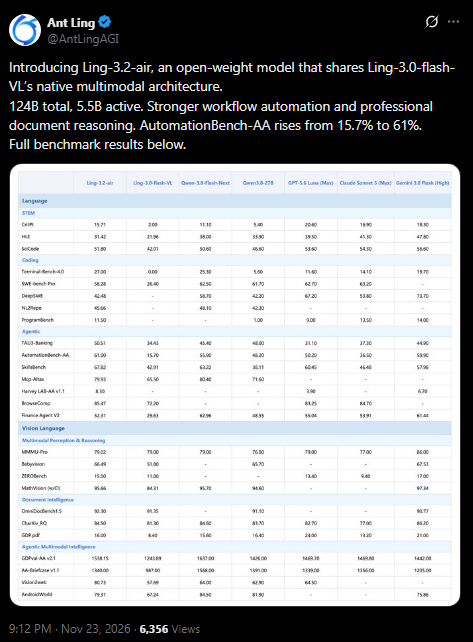
The official table compares air against its own predecessor Ling-3.0-flash-VL, Qwen-3.5-Flash, DeepSeek-V3.2, and the Mini-class closed models GPT-5.5-Low, Claude-Sonnet-5, and Gemini-3.5-Flash. On the agentic cluster air leads the entire set. Terminal-Bench 4.0 goes to air at 27.00, ahead of Qwen-3.5-Flash at 25.30, with every closed Mini model in the teens or below and the predecessor at 0.00. AutomationBench-AA goes to air at 61.00, ahead of Qwen at 55.90 and Gemini at 53.00, and up from 15.70 on the predecessor, which is the gain the official account itself led with. TAU3-Banking goes to air at 50.51 over DeepSeek at 49.00. SkillsBench goes to air at 67.82 over GPT-5.5 at 60.45. BrowseComp goes to air at 85.47 over Claude at 84.70 and GPT-5.5 at 83.25.
The document-intelligence and vision numbers hold up too. OmniDocBench 1.5 goes to air at 92.30, ahead of Claude and Gemini at 90.77. MMMU-Pro is 79.32, behind Gemini at 85.00 but ahead of Claude at 77.00. MathVision is 95.66, strong though Gemini at 97.84 and Qwen at 95.70 edge it.
The honest losses
The same table shows where the closed Mini models pull ahead, and these are not small gaps. On SWE-Bench Pro air scores 58.28, the lowest of the set, behind Claude at 63.20, GPT-5.5 at 62.70, and Qwen at 62.50. On DeepSWE air scores 42.48, again the lowest, well behind Gemini at 73.70 and GPT-5.5 at 67.20. On the hardest STEM reasoning the pattern repeats: CritPt goes to GPT-5.5 at 20.80 against air’s 15.71, and GDP.pdf goes to GPT-5.5 at 24.00 against air’s 16.00, though both of those are still large improvements over the predecessor’s 2.00 and 8.40. ZeroBench and AndroidWorld are mid-table for air rather than wins.
What this means for the flash decision
Put the two halves together and the trade is sharper than it was before the benchmarks landed. Ling-3.2-air is measurably better than a set of closed Mini-class frontier models at the agentic workflow cluster: running terminal tasks, executing multi-step automation, operating banking and finance agents, browsing, and reading documents. If that is your workload, the open model you can self-host beats the closed models you would rent. On heavy software engineering and the hardest reasoning, the closed Mini models win, and a 560B flagship like flash is built for exactly that heavier end. Self-hosting air gets you the agentic and document cluster at open-weights economics. Paying for a closed API buys you the SWE and STEM headroom that air does not have. That is the real split, and it is a capability split as much as a deployment split.
For the full benchmark breakdown, our Ling-3.2-air benchmarks guide walks every row of the official table.
How to actually decide
Set the missing benchmark aside and the decision still resolves cleanly, because the real question is not which model scores higher. It is which deployment model fits your situation.
Choose Ling-3.2-air if the benchmark cluster above matches your workload and you want it on hardware you control. The agentic wins are the reason to pick it: terminal automation at 27.00, workflow automation at 61.00, banking agents at 50.51, browse at 85.47, and document reading at 92.30 all lead a field that includes paid closed models. You get those numbers with weights you can audit, fine-tune, and keep behind your own firewall, which no closed hosted model offers at any price. The cost is the four-GPU node and the operational burden that comes with it.
Choose Ling-3.2-flash, or a closed hosted model like it, if heavy software engineering is your workload and you want the capability without running a cluster. The benchmark table is explicit that air loses the SWE cluster: SWE-Bench Pro at 58.28 and DeepSWE at 42.48 are the lowest in the set, and the closed Mini models beat it on both. For teams whose traffic is bursty, whose volume is low, or whose strength is code generation rather than agentic workflow execution, renting the closed side of the family is the honest pick.
The 1M versus 256K context gap pushes long-context workloads toward flash. The open MIT license pushes regulated and fine-tuning workloads toward air. Multimodal input is confirmed for air and unconfirmed for flash. Those are the levers, and they are enough to make the call for most teams without a benchmark.
There is a middle path worth naming too. Some teams run both. A closed hosted model handles the bursty front-line traffic where elasticity matters, while an open self-hosted model handles the steady core workload where owning the weights pays off. The two distribution shapes are complementary in the same way cloud and on-prem are. You do not have to pick one for your whole organization; you pick per workload, based on which cost and control profile fits that workload’s shape. Our best frontier models roundup covers how the closed side of the field lines up more broadly.
The cost picture, honestly
Ling-3.2-air has no token price because it has no API. Its cost is entirely in hardware and operations, and you can model that with our hosted API pricing page and the cost calculator. Ling-3.2-flash has a published input price of 2 CNY per million tokens, but we do not have a confirmed output token price for it in the verified material, so we are not going to estimate a blended cost per task. If a hosted model is what you want, our GLM-5.4 pricing and gpt-6-2-astra-pricing guides show how to read a rate card when output rates are not printed next to input rates.
Where to go next
This post is one piece of a larger cluster on the Ling-3.2-air launch. If you are weighing the self-host path, start with Ling-3.2-air self-hosting for the serving recipe and Ling-3.2-air hardware for the GPU counts. For what the model can do on its own, read Ling-3.2-air benchmarks and Ling-3.2-air architecture. The Ling-3.2-air launch hub ties the whole series together.
Sign up for a key to browse the model catalogue, or run your own volumes through the cost calculator before committing to a self-host build or an API integration.
Related reading for this decision
Hy4 Flash API pricing and Qwen4-Max API pricing provide two more hosted rate-card comparisons. The blog category lists the full set of open-versus-closed model guides.
More Ling-3.2-air coverage
- Ling-3.2-air launch on the unannounced release and what shipped
- Ling-3.2-air benchmarks on the AA index and the model card numbers
- Ling-3.2-air architecture on the hybrid-linear MoE design
- Ling-3.2-air vs MiniCPM-V 4.7 on datacenter versus pocket deployment
- Ling-3.2-air self-hosting on SGLang, vLLM and the serving recipe
- Ling-3.2-air hardware on GPU counts and memory math
- Ling-3.2-air vision on image and video input
- Ling-3.2-air context window on 256K and the 1M discrepancy
- Ling-3.2-air vs Ling-3.1-flash on the related-model score comparison