Google shipped Gemini 4 Neon on 2026-11-18, dated by Google’s launch post for Gemini 4 Neon and 9to5Google’s launch report. OpenAI’s GPT-5.6 Terra has been listed in our catalogue since its 2026-07-09 release at a lower list price, with a status flag we will state plainly. This is the value comparison for Gemini 4 Neon vs GPT-5.6 Terra: Neon holds a 9.67-point lead on the Artificial Analysis Intelligence Index, and Terra holds the cheaper invoice. Which number matters depends on what your workload actually bills for, and the answer is not the same for every task. Our Gemini 4 Neon launch explainer covers the picker change and the Argon handoff; this post keeps only the Neon versus Terra ledger.
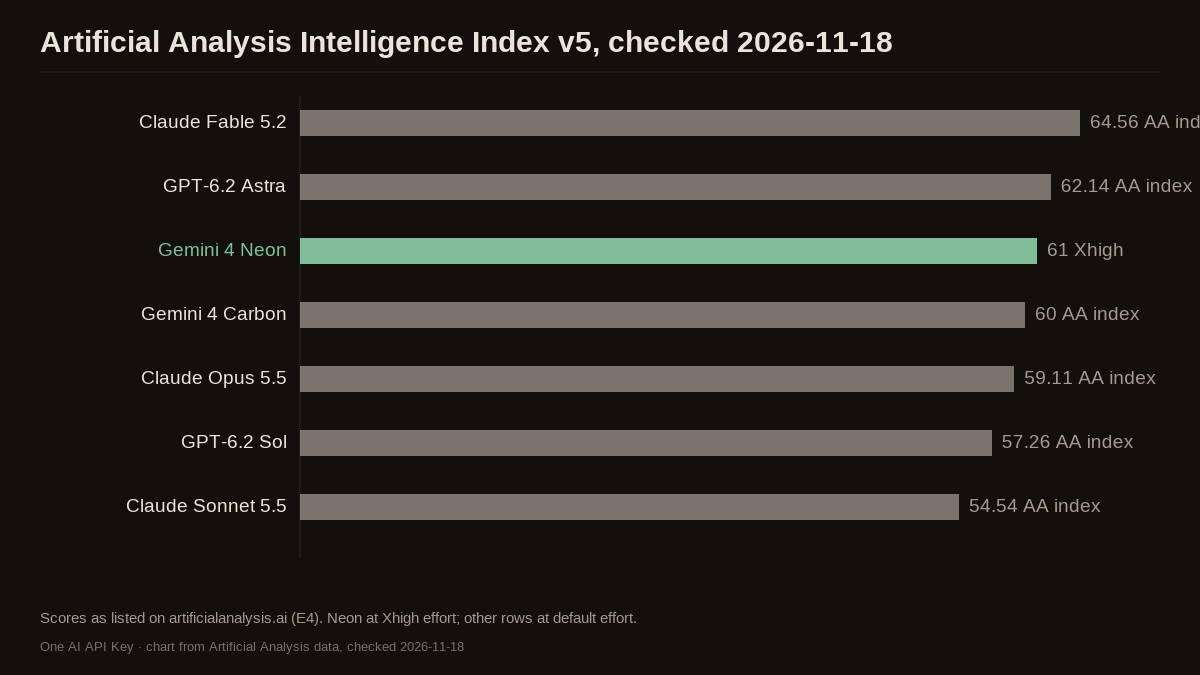
The chart above shows the field around the two models: Claude Fable 5.2 at 64.56, GPT-6.2 Astra at 62.14, Neon at 61, Gemini 4 Carbon at 60, Claude Opus 5.5 at 59.11, GPT-6.2 Sol at 57.26, Claude Sonnet 5.5 at 54.54 and GPT-5.6 Terra at 51.33, all Artificial Analysis Intelligence Index v5 figures from the same check window. Neon and Terra sit at opposite ends of the value band on that board, and the rest of this post is what that distance costs and what it buys.
What each model is, and what our catalogue says
Artificial Analysis lists the Artificial Analysis page for Gemini 4 Neon with an Intelligence Index v5 score of 61 at Xhigh effort, a list price of $3 per million input tokens and $15 per million output tokens, a speed of roughly 110 tokens per second, and a 1M-token context window. OpenRouter’s google/gemini-4-neon model page shows the same $3 and $15 among four pricing rows, which we treat as a timing note rather than a conflict, explained below. Our catalogue entry for GPT-5.6 Terra lists $2 input and $12 output per million, a cached input rate of $0.20, a 1,050,000-token context window, 128,000 tokens of maximum output, and a release date of 2026-07-09. That entry was checked on 2026-10-21, and our catalogue marks GPT-5.6 Terra as status unavailable: the model is listed, but no working upstream was reachable at check time. Gemini 4 Neon, for the record, is not listed in our model catalogue at all, so neither model is routable through this gateway today.
One naming trap needs naming: neon.com documents a Databricks-hosted gemini-4-argon gateway product also called Neon, with its own $4/$20 pricing and a 1M context window, which is not Google’s Gemini 4 Neon. We keep the two separate throughout this post, including where we link our Gemini 4 Argon page.
Benchmarks: the 9.67-point gap on the AA index
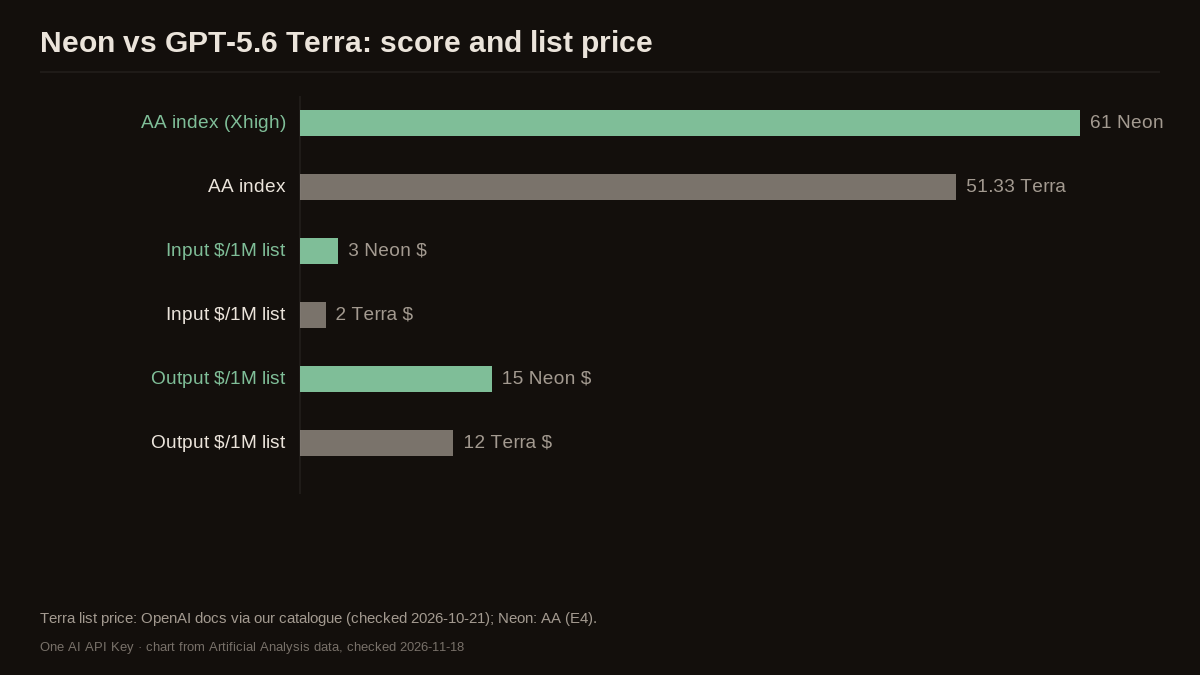
On the Artificial Analysis leaderboard, Neon scores 61 at Xhigh effort and GPT-5.6 Terra scores 51.33, a gap of 9.67 points, both read from the same index at the same check. Neon’s effort tiers read 61 at Xhigh, 60 at High, 55 at Medium and 44 at Low, so the 61 is a specific effort setting, not a free-floating number, and a buyer who runs Medium effort is buying a different model on paper. The index itself is Artificial Analysis’s aggregate across its public reasoning, coding and agentic suites, and Xhigh is the highest of the four effort tiers it lists for Neon, which is also the setting the $6.44 cost per task below was measured at. Rank wording conflicts and we flag it as C1 in our ledger: Artificial Analysis places Neon sixth of 96 models, while Google’s launch claim, as reported by 9to5Google, says third overall. We cite each wording with its source and do not average them.
Google’s own benchmark table, as reported by 9to5Google, lists Neon first on Legal Research Bench, first on Tax Agent Bench, second on Agent Arena steerability, and first on the AA Coding Agent Index at 58.6, with Terminal-Bench 4.1 at 65.2 and FrontierCode 2.0 at 46.2 at high effort. Those are Google-published rows, not our measurements, and we repeat them with that attribution. Our ledger holds no per-benchmark rows for GPT-5.6 Terra beyond the 51.33 index score, so we will not invent any. The Neon benchmarks teardown walks through what each suite measures, and our rankings page tracks the throughput we meter on this gateway for the models we do serve.
Pricing: $3/$15 against a $2/$12 list
Neon’s $3 input and $15 output come from the Artificial Analysis page and match OpenRouter’s rows. 9to5Google reported at launch that Neon was not yet available on OpenRouter, while the OpenRouter page now lists four pricing rows including those two; we date-stamp both observations to this launch window and treat the difference as timing, not contradiction. Terra’s $2 input and $12 output are our catalogue’s list figures from OpenAI’s published rates, checked 2026-10-21.
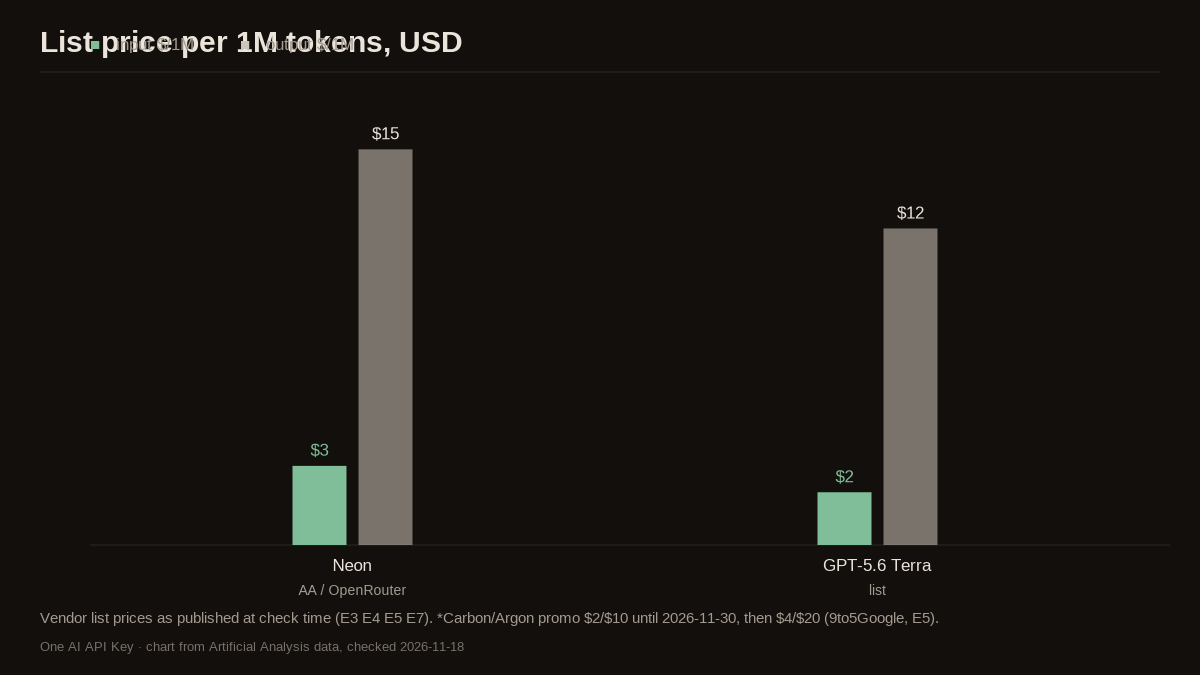
Per token, Terra’s list is 33 percent below Neon on input and 20 percent below on output. Terra also lists a cached input rate of $0.20 per million, and our ledger has no cached rate for Neon, so we do not compute one. These are list prices, not gateway prices; our pricing page is where any rate we actually sell would live, and today neither model appears there.
Two billing realities sit behind the headline rows. Effort changes both price and score: Neon’s index drops from 61 at Xhigh to 44 at Low, so a buyer who lowers effort pays less per call and buys a lower score, a trade our ledger cannot price because Artificial Analysis has not published a Medium or Low cost per task for Neon. Cache changes the input line: Terra lists $0.20 cached input, and Neon’s measured run reported a 95 percent cache hit, yet no Neon cached rate exists in our ledger, so any cache-adjusted Neon total would be invented and we do not print it.
Cost per task: arithmetic with labelled assumptions
Artificial Analysis measured one Neon run at Xhigh effort: $6.44 per task, 21.5 minutes per task, 283 million output tokens across the run, a 95 percent cache hit rate, and a blended $2.21. Our ledger holds no equivalent measured run for Terra, so the Terra side below is list arithmetic only, and every assumption is labelled.
Assumption set A, a small batch job: 100,000 input tokens and 20,000 output tokens, no cache. Neon is $0.30 input plus $0.30 output, $0.60 total. Terra list is $0.20 input plus $0.24 output, $0.44 total, so Neon costs about 36 percent more on that shape. Assumption set B, a long agent run: 1,000,000 input and 100,000 output. Neon is $3.00 plus $1.50, $4.50. Terra list is $2.00 plus $1.20, $3.20, so Neon costs about 41 percent more. Assumption set C, a cache-friendly run on Terra only, because Neon has no published cache rate in our data: 1,000,000 input of which 900,000 hits cache at $0.20, plus 100,000 output. Terra is $0.20 uncached input plus $0.18 cached input plus $1.20 output, $1.58 total. We cannot build the Neon twin of that row without inventing a rate, so we do not.
| Assumption set | Input | Cached input | Output | Neon list | Terra list |
|---|---|---|---|---|---|
| A, small batch | 100,000 | none | 20,000 | $0.60 | $0.44 |
| B, long agent run | 1,000,000 | none | 100,000 | $4.50 | $3.20 |
| C, cache-friendly, Terra only | 1,000,000 | 900,000 at $0.20 | 100,000 | not computable | $1.58 |
Every cell is list-rate multiplication from the two catalogued price cards, set C is marked not computable for Neon because no cached rate for Neon exists in our ledger, and no row includes taxes, retries or gateway markups.
The trade in one sentence: a 9.67-point index gap is 18.8 percent of Terra’s 51.33 score, while the list-price gap on the two comparable shapes above is 36 to 41 percent. If the index gap buys your workload a pass rate that actually improves, the premium can be rational; if your task is bulk completion where either model passes, the premium is just a premium. The cost calculator takes your own token counts instead of ours, and both totals above exclude gateway markups, taxes and retries by construction.
Where GPT-5.6 Terra still wins on value
Three rows. First, price per token: $2 against $3 on input and $12 against $15 on output, with a listed cached input rate of $0.20, below both Neon lines on every published figure we hold. Second, output ceiling: our catalogue lists 128,000 tokens of maximum output for Terra, and our ledger has no Neon ceiling to compare, so we say only that Terra’s ceiling is published and Neon’s is absent from our data. Third, availability when it returns: Terra is listed but marked unavailable at our 2026-10-21 check, so today you cannot route to it through us; if and when a working upstream returns, the $2/$12 list is the number to re-check, and the catalogue entry above is where that status will flip.
A fourth row is context size, and it is close enough to call a tie: 1,050,000 tokens for Terra against 1,000,000 for Neon. A 50,000-token difference at the top of the window matters only to workloads that already overflow 1M, and neither vendor’s recall quality across that window is measured in our ledger.
Who should wait for that return: workloads that bill mostly on token volume, jobs that need more than 100,000 output tokens in one call, and teams whose prompts already overflow 1M context, because Terra’s list beats Neon’s on every published line and its ceiling and window are both the larger of the two. Who should not wait: anyone whose task fails silently at a lower score, because a cheaper invoice cannot fix a wrong answer, and anyone who needs a model this week, because a listing marked unavailable is not a purchasable option on our catalogue.
The value case for Neon: score per dollar, not the dollar
A 61 against 51.33 at $3/$15 means the index gap costs $1 per million input and $3 per million output at list, which is the arithmetic the Gemini 4 family ladder post puts in family context: Carbon at 60, Hydrogen at 54, Argon at 50 on the same index, with Flash-Lite far below. If Neon’s measured $2.21 blended figure from the Artificial Analysis run holds for your prompt shapes, the effective rate lands below the headline $3/$15, because the 95 percent cache hit in that run is doing real work. Google’s positioning, as reported by 9to5Google, is complex coding, analytical reasoning and production-grade enterprise workflows, and the roundup of November 2026 frontier models places Neon in that top band against Fable 5.2 and GPT-6.2 Astra, while our Qwen4-Max versus every flagship post and the Neon versus Opus 5.5 post give the neighbouring comparisons on the same index. Neon’s roughly 110 tokens per second from Artificial Analysis is the only speed figure we hold for either model, and it is a vendor-adjacent measurement, not a gateway measurement.
What we did not measure: nothing here is our own run. Every score, price and speed figure above is read from the cited Artificial Analysis pages, Google’s published table via 9to5Google, OpenRouter’s rows, or our own catalogue, and we will republish the arithmetic the day Artificial Analysis posts Terra columns or our catalogue flips Terra’s status back to available.
Where to try it
Neither model is live on this gateway: Terra is listed in our catalogue but marked unavailable, and Neon is not listed at all. What is live is the free lane behind a new account: 100 requests and 5,000,000 tokens daily, refilled at 05:30 IST, plus a $10 trial credit for new accounts. Start in /chat with the models we do list, create your key on the sign-up page, and read the quickstart docs and API reference for base URL and request shape. Your API keys page holds the key itself, the usage log meters every request so a launch-day price surprise shows up as a number rather than a bill, and the free models list shows the zero-cost rows. The Neon pricing post keeps the $3/$15 arithmetic current if either rate moves, and the catalogue is where Neon or Terra will appear if either lands here.