Phonic-1.1 High is the stronger starting point for tool-heavy voice agents in the evidence checked on 2026-11-24. It leads the Artificial Analysis Speech-to-Speech Index at 89.1 versus 77.3 for Eleven Realtime v1 Max default and wins the embedded agentic preference comparison. The separate DIAL chart, which labels the entry simply Phonic-1.1, reports higher naturalness and fewer turn-taking defects than its Eleven Realtime v1 Max row. Eleven wins non-agentic preference at 1135.44 versus 1056.32 Elo. The frozen six-source record does not contain a like-for-like Eleven time-to-first-audio figure, so it does not establish a cross-vendor speed winner. Neither option wins every lane. Phonic introduced the model on 2026-11-23; the Phonic-1.1 launch summary covers the release context.
For booking and support agents that must complete tool calls, start the pilot with Phonic-1.1 High. For open-ended conversation where non-agentic preference matters more, start with Eleven Realtime v1 Max default. For short FAQs where response delay dominates, test both on the same transport because the supplied evidence does not settle that lane. Those are starting hypotheses, not production verdicts. The supplied evidence does not settle multilingual quality, regulated-call requirements or a model-specific public price.
The short answer
- Phonic-1.1 High leads the composite: 89.1 versus 77.3. The separate DIAL chart reports higher naturalness and a lower defect rate for its Phonic-1.1 entry.
- Eleven Realtime v1 Max default leads non-agentic preference: 1135.44 versus 1056.32 Elo. A comparable cross-vendor TTFA result is not frozen here.
- The strongest Phonic case is task completion: booking, changes, cancellations and support flows that end in a correct tool call.
- The strongest Eleven case is open conversation: longer sessions where users judge the exchange rather than a completed transaction. Short FAQs still require a local latency test.
- Important unknowns remain: Full Duplex Bench, language coverage, data terms and comparable public pricing are incomplete.
- Gateway boundary: neither Phonic-1.1 nor Eleven Realtime v1 Max is claimed as served on this gateway.
What do the AA composite, Arena and DIAL actually measure?
The headline 89.1 belongs to Artificial Analysis, not Phonic. The Artificial Analysis Speech-to-Speech board defines the index as an equal-weight composite of Big Bench Audio, agentic performance, Arena preference and task success. Each component contributes 25%. A model needs all four to appear. That design rewards balance, but it does not make the index a universal voice-quality score.
At the live check, the Phonic-1.1 High payload contained 99.5 for Big Bench Audio, 82.7953 for agentic performance, 81.1332 for the Arena component and 92.8962 for task success. Their mean rounds to 89.1. There is a source conflict inside that calculation. The 82.7953 value matches tau-Voice 1.0, while the current agentic chart and methodology describe tau-Voice 2.0, where Phonic-1.1 scores 87.1. Do not state that the composite definitely uses the 2.0 score. Our detailed Artificial Analysis benchmark explanation keeps the versions separate.
The date also matters. Artificial Analysis showed 89.1 when checked on 2026-11-24. Phonic’s launch image showed 88.9. Treat that as a snapshot difference, not an arithmetic dispute.
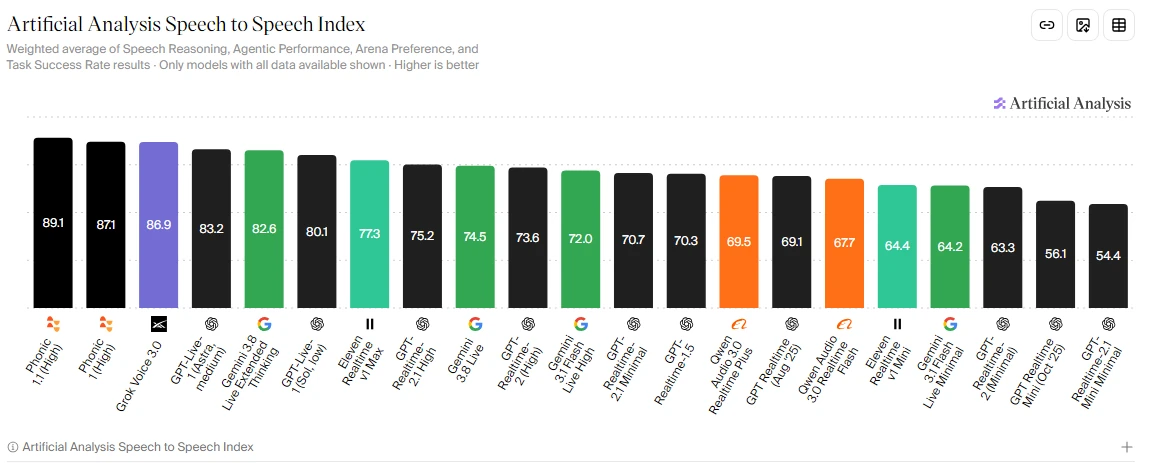
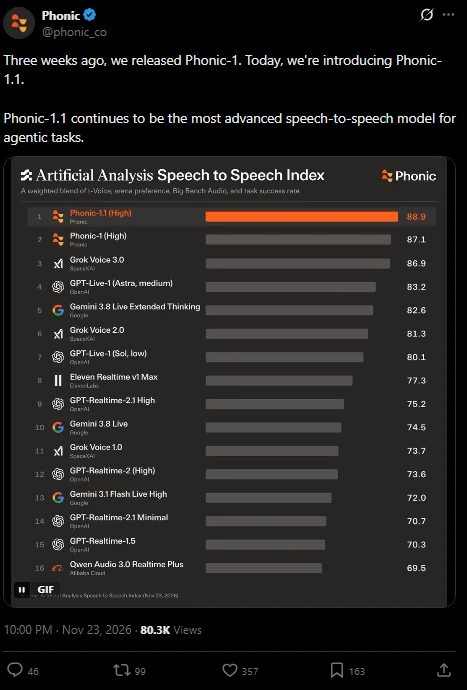
The Speech Agent Arena answers a different question. It uses blind live voice conversations and Bradley-Terry preference Elo, anchored to GPT-Realtime-1.5 at 1000. Its task-success rate measures correct final task-completing tool calls. Phonic-1.1 High ranked seventh overall at 1053 plus or minus 26 Elo, with 806 samples and 92.9% task success. The 95% interval for task success runs from 89.8% to 95.1%. First on the composite and seventh in the overall Arena are compatible results because the rankings measure different combinations of evidence.
DIAL v1.1 adds two conversational signals in Phonic’s launch report: naturalness on a five-point scale and the share of conversations containing at least one turn-taking defect. Higher naturalness is better. A lower defect rate is better. These charts are Phonic’s reproduction of the David AI DIAL leaderboard, not a test run performed for this article. The supplied pages do not give detailed sample sizes or the rater protocol, so the intervals and ratings should not be treated as a guarantee for your callers.
Where do the two exact variants split on the measured metrics?
Every number below belongs to a named configuration or a named source label. Phonic-1.1 High is not interchangeable with Phonic-1 High. Eleven Realtime v1 Max default is the AA configuration, not a claim about every Eleven voice product. The DIAL and Phonic intelligence-table rows use the shorter labels printed in those reproductions. The table keeps those source boundaries visible and does not fill missing values with guesses.
| Metric | Phonic-1.1 | Eleven Realtime v1 Max | Source and date context |
|---|---|---|---|
| AA Speech-to-Speech Index | 89.1 | 77.3 | S2 live board, 2026-11-24; Phonic High and Eleven default |
| Time to first audio (High) | 0.80 s | Not frozen here | Phonic value from S2; no like-for-like Eleven value in the six-source record |
| Overall Speech Agent Arena Elo (High) | 1053 ±26 | Not supplied | S1 live board, 2026-11-24 |
| Arena task success (High) | 92.9% | Not supplied | S1/S2, 2026-11-24; Phonic interval 89.8 to 95.1 |
| DIAL v1.1 naturalness | 4.21 / 5 | 3.45 / 5 | S6 reproduction of DIAL, dated 2026-11-23; DIAL labels have no High suffix |
| DIAL v1.1 conversations with a defect | 46.3% | 70.0% | S6 reproduction of DIAL, dated 2026-11-23; DIAL labels have no High suffix |
| tau-Voice 2.0 (High) | 87.1 | Not frozen here | S2/S6, dated 2026-11-23 |
| Big Bench Audio (High) | 99.5 | Not frozen here | S2/S6, dated 2026-11-23 |
The 11.8-point index gap favors Phonic-1.1 High. Phonic-1.1 High also regressed on first-audio latency against Phonic-1 High, which measured 0.61 seconds. That is a 0.19-second increase, about 31%, even though the composite rose from 87.1 to 89.1. A better agent can still feel slower before it begins speaking. Cells marked “Not frozen here” may be visible in a supplied screenshot, but they were not transcribed into the controlled fact record and are not used for this comparison.
TTFA is not total response time. The supplied record does not define whether AA’s numbers include any network, audio transport, tool-backend or final-confirmation delay, so those layers need local measurement. The streaming contract for incremental responses and performance notes for measured gateway latency explain why a fast model can still produce a slow user experience. Our streaming versus buffered response explainer covers the same distinction for text clients.
Why does agentic preference favor Phonic while non-agentic preference favors Eleven?
The embedded Artificial Analysis comparison splits preference into two slices. Phonic-1.1 High beats Eleven Realtime v1 Max default on agentic preference, 1052.47 to 975.09 Elo. Eleven Realtime v1 Max default wins non-agentic preference, 1135.44 to 1056.32 Elo. Those are separate rows from the overall Arena ranking.
Show as table
| Item | Phonic-1.1 High | Eleven Realtime v1 Max default |
|---|---|---|
| Agentic | 1052.47 | 975.09 |
| Non-agentic | 1056.32 | 1135.44 |
Agentic preference is the more relevant signal when a call must change state. A booking agent may need to identify a service, collect a date, check availability, reserve a slot and confirm the result. A support agent may need to find an order, verify the caller, apply an eligible remedy and close the case. The tool-calling contract behind agentic task success matters because a pleasant conversation is not enough if the final tool call is wrong. Phonic’s stronger agentic row and higher DIAL naturalness make it the first candidate for that work.
Non-agentic preference fits a different job. A caller asking for opening hours, a directions question or a short explanation usually wants a quick, natural answer without a transaction. An open-ended companion session may run longer and place more weight on conversational flow. Eleven’s advantage in the non-agentic row makes it the first candidate there. The evidence does not establish that Eleven will retain that advantage over long, noisy or interruption-heavy sessions, so test those conditions directly.
Do not turn an Elo difference into a claim about correctness. Preference ratings can reward warmth, pacing and delivery while missing a wrong reservation or a failed refund. The workload-first model-selection method is a useful transferable discipline even though coding and voice are not identical: define the task, define the failure and then choose the measurement.
What do tau-Voice and Big Bench Audio add?
Tau-Voice 2.0 tests tool-using conversations more directly than a general preference rating. It contains 50 English tasks in each of airline, retail and telecom, runs three trials and reports pass@1 averaged across them. GPT-5.5 at low effort simulates the caller. Infrastructure failures are excluded and rerun. Phonic-1.1 High scored 87.1, compared with 85.6 for Phonic-1 High. Artificial Analysis’ launch commentary places that difference within the margin of error, so it supports a cautious comparison rather than a decisive generational claim.
Tau-Voice 1.0 is a different scale. In Phonic’s intelligence table, the rows labelled Phonic-1.1 and Eleven Realtime v1 Max scored 82.8 and 47.6. That is a large published gap, but it cannot be compared numerically with 2.0. It also cannot resolve the composite’s version conflict. Keep the version beside every score.
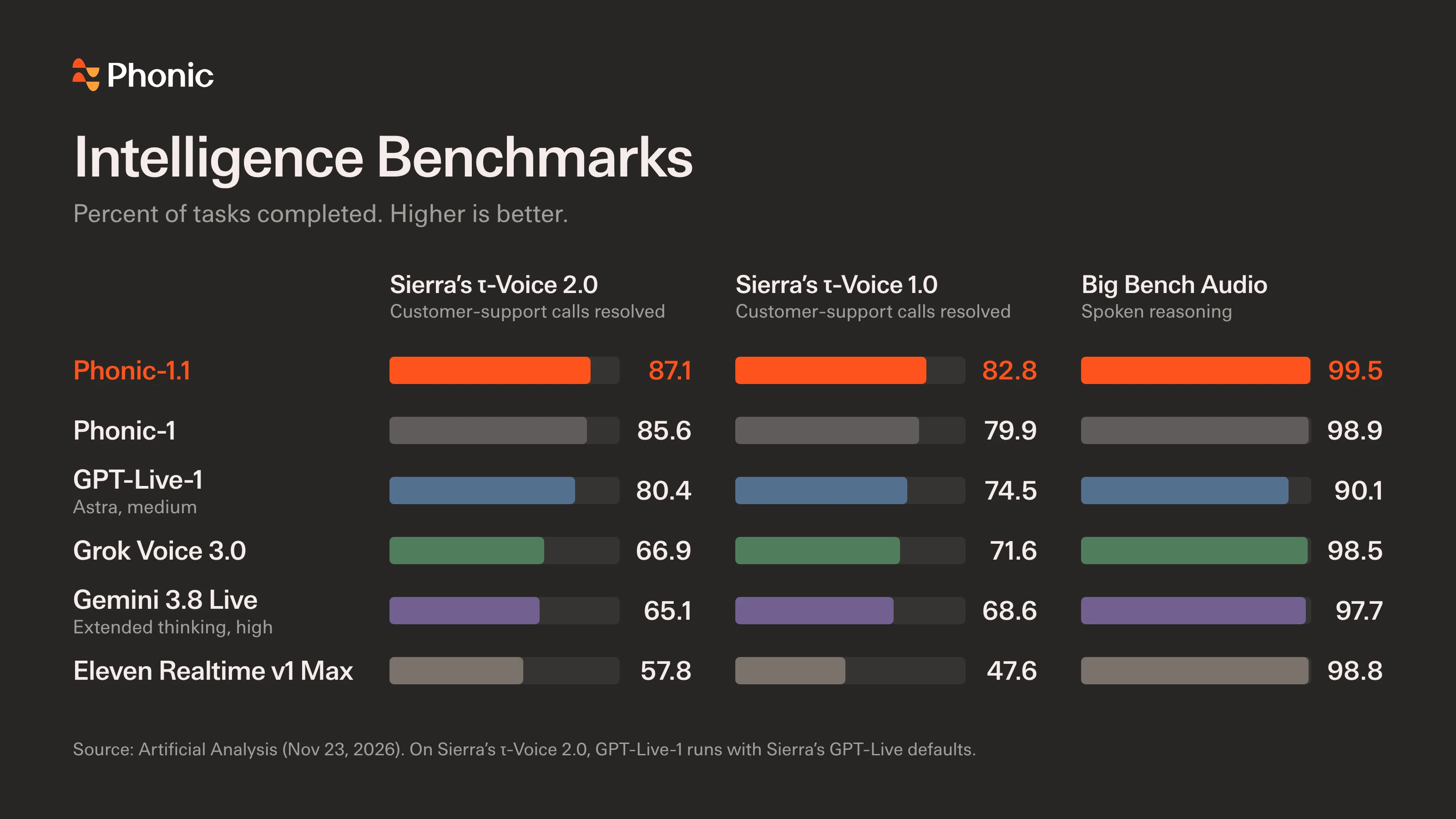
Big Bench Audio contains 1,000 spoken reasoning questions across four categories, scored correct or incorrect. Phonic-1.1 High scored 99.5 versus 98.9 for Phonic-1 High. The benchmark is nearly saturated. A 0.6-point lead does not prove broader reasoning skill, better conversation recovery or better decisions inside your booking system.
One naming caution matters when checking older material. The BenchLM page for Phonic-1 is a baseline for Phonic-1, not Phonic-1.1. It can provide context for the earlier model, but its values must not be relabeled as 1.1 results.
What does a 46.3% DIAL defect rate mean?
It means 53.7% of rated DIAL conversations had no recorded turn-taking defect. The inverse, 46.3%, means at least one defect occurred in nearly half of the rated conversations. It does not mean 46.3% of turns failed. It does not mean 46.3% of all production calls will fail. The denominator is rated DIAL conversations, and the supplied material does not describe enough of the sampling and rater process to generalize further.
The comparison is still favorable. The DIAL row labelled Eleven Realtime v1 Max recorded 70.0%, while the row labelled Phonic-1.1 recorded 46.3%. That is a 23.7 percentage-point reduction in conversations with a defect. It is not a claim of defect-free operation.
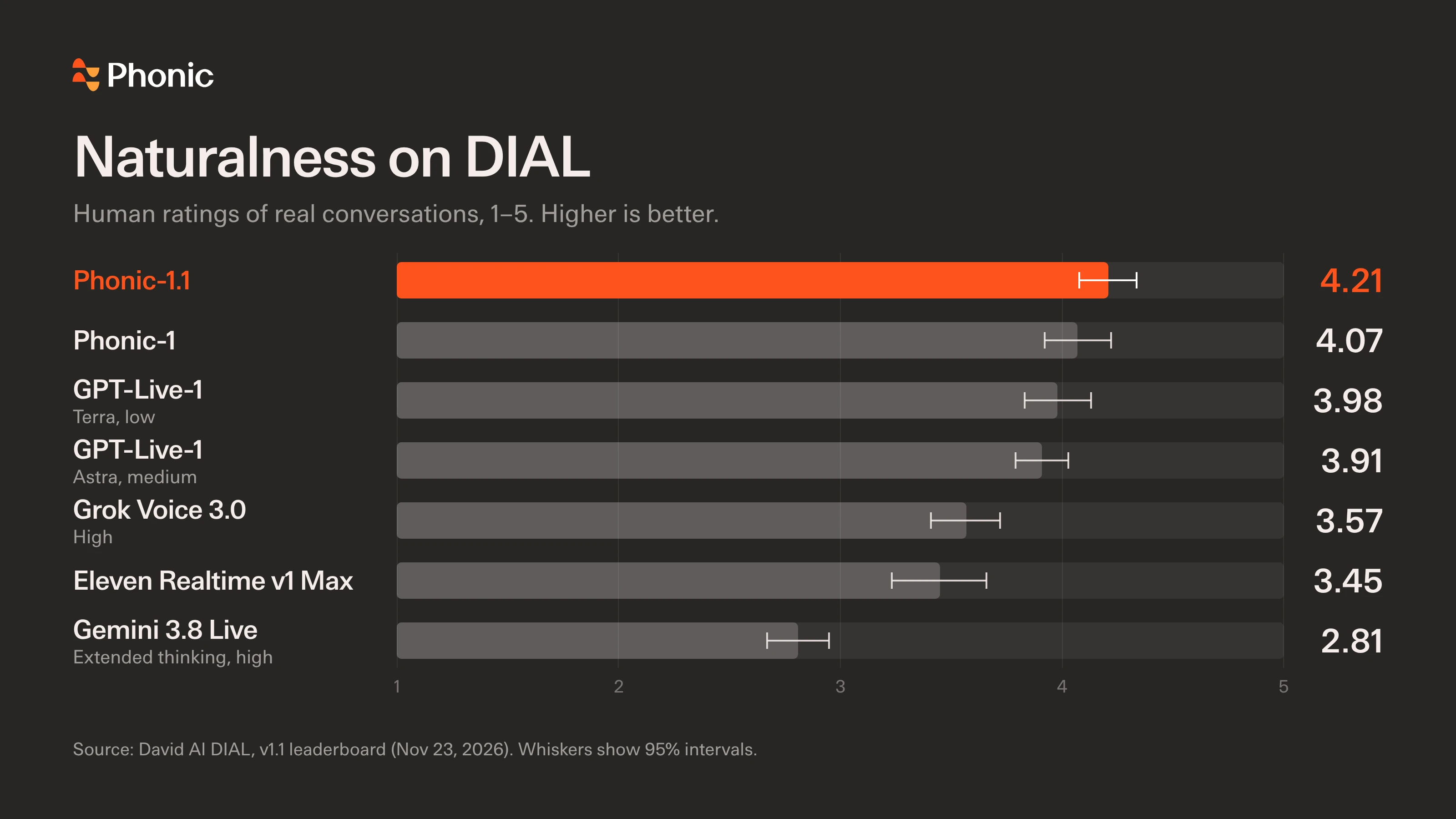
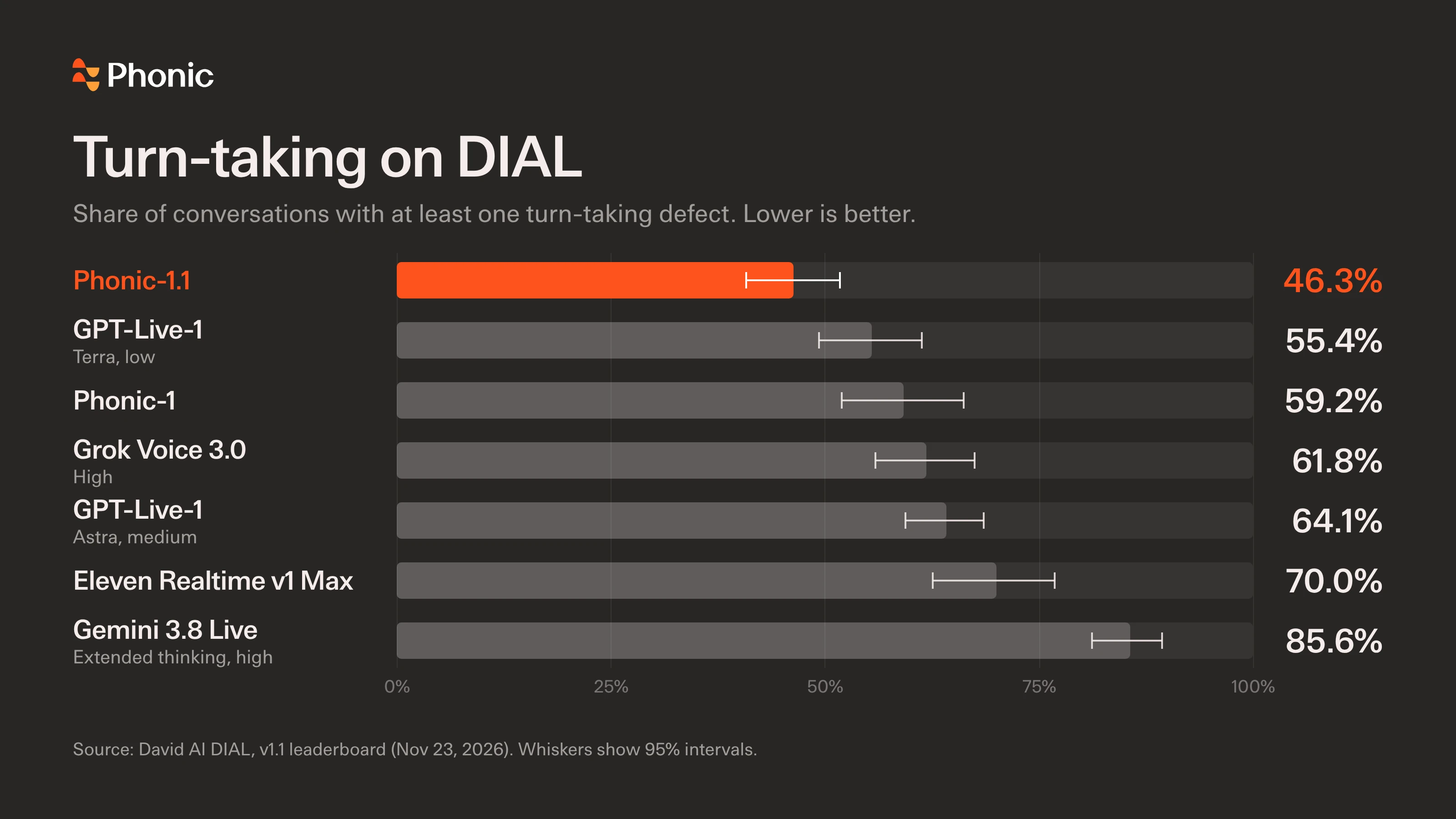
Naturalness and turn-taking need separate review. In the DIAL reproduction, Phonic-1.1 scored 4.21 out of 5 against 3.45 for Eleven Realtime v1 Max, yet both still produced defects. A voice can sound warm and still cut off a caller, wait through a valid pause or fail to recover after an interruption. Score those events at the conversation level, then inspect the underlying turns to find the cause.
What do the missing Full Duplex Bench cells leave unknown?
The cited comparison displays Full Duplex Bench values for other models, but those comparator values are not frozen in this article’s controlled record. The Phonic-1.1 High cell is blank.
Full Duplex Bench results for Phonic-1.1, along with tau-Banking and tau-Entity results, are not supplied. OrcaRouter’s comparison of Phonic-1.1 and Eleven Realtime Max highlights the missing cell. OrcaRouter is a commercial gateway vendor, so treat that article as industry commentary and criticism, not neutral hands-on testing. Its observation is useful because it identifies a real gap, not because it settles the gap.
If your callers routinely interrupt, speak over the agent or recover from false starts, make that behavior a primary bake-off criterion. Do not substitute the DIAL defect rate for a full-duplex benchmark. They are different measurements with different denominators.
Which workload should route to which model?
Route by the failure you most need to prevent. The matrix below is a pilot priority, not a final procurement decision.
| Workload | First candidate | Evidence | What to verify |
|---|---|---|---|
| High tool load | Phonic-1.1 High | Higher index, agentic Elo and tau-Voice 2.0; lower DIAL defects | Correct final tool calls, corrections, retries and recovery under injected failures |
| Low-latency FAQ | Bake-off required | No comparable cross-vendor TTFA frozen here | End-to-end p50/p95 delay, barge-in behavior and any tool fallback |
| Open-ended companion | Eleven Realtime v1 Max default | Non-agentic Elo 1135.44 versus 1056.32 | Blind ratings over long sessions, noise, accents and interruption patterns |
| Multilingual support | No evidence-led winner | No comparable language breakdown in the supplied sources | Each target locale, code-switching, names, numbers and escalation quality |
| Regulated recording | No model-level winner | Consent, retention and deployment terms are not established here | Contract terms, processing region, deletion, audit logs and recording controls |
For high-tool-load work, Phonic’s agentic evidence is the best available starting signal. It still needs a test against your schemas, permissions and failure modes. For low-latency FAQs, the supplied record does not declare a cross-vendor winner, and your telephony path may change the result. For open-ended conversation, Eleven’s non-agentic preference advantage is relevant, while the absence of long-session evidence limits confidence.
If your traffic contains several lanes, keep the routing rule explicit instead of forcing one model to cover everything. A short confirmed FAQ can take the low-latency path, while a request to change a reservation can take the tool-heavy path. Do not switch models in the middle of a transaction unless the handoff preserves the conversation state, collected slots and tool-call history. Log which lane selected which model so that later quality changes can be traced to routing rather than blamed on the voice model alone.
Multilingual support is an explicit unknown. Tau-Voice 2.0 describes English tasks, and the supplied DIAL material does not establish comparable performance across your required languages. Test locale by locale rather than assuming an English result transfers.
Regulated recording is also not settled by a model benchmark. Phonic advertises enterprise self-hosting, but the supplied sources do not establish open weights or a downloadable 1.1 checkpoint. Review the routing and privacy boundaries for voice traffic, then obtain written terms for consent, retention, deletion and processing location. Neither model becomes compliant because it sounds natural.
How should you run a fair two-vendor bake-off?
Use the production voice-agent architecture guide to define the surrounding system before comparing the models. A fair test holds the workload and infrastructure constant, preserves failures and blinds the human judgment where possible.
-
Freeze the same prompts and caller simulator. Build one pack covering successful tasks, corrections, ambiguous requests, silence, interruptions, background noise and invalid tool arguments. Record the expected final state for each case. Run the same simulator voice, pace and timing rules against both exact variants.
-
Hold the network path constant. Use the same client machine, audio codec, region, connection profile and concurrency schedule where the providers allow it. Log provider TTFA, time to first audible audio, time to a correct tool result and time to the final spoken confirmation. Report medians and tail latency, not only the fastest sample. Separate model delay from transport and tool delay.
-
Use one sandboxed tool backend. Seed the same inventory and account state for every run. Keep tool latency fixed, make writes idempotent and inject identical timeouts, validation errors and rate-limit responses. The error handling reference for interrupted voice sessions and rate-limit behavior for simultaneous sessions should inform the harness, not become extra advantages for one vendor.
-
Pre-register the scoring rubric. Score binary task success from the final tool call and system state. Rate naturalness from one to five. Count conversations with turn-taking defects. Measure whether the agent recovers after an interruption. Have human raters assess blinded, randomized clips, and record disagreements instead of hiding them. Use the metrics reference for a head-to-head test to keep the logs consistent.
-
Keep failed attempts in the accounting. Label provider, network, simulator and tool-backend failures separately. Track retries, abandoned sessions and duplicate actions. Reconcile the invoice with session logs and ask how each vendor bills failures and silence. Apply spend controls for a two-vendor bake-off before traffic starts.
-
Isolate credentials and data. Follow API-key security practices for a multi-vendor pilot. Keep provider keys server-side, use separate evaluation credentials and send synthetic or approved recordings only. Do not put sensitive calls into an unapproved pilot.
The $4.20 per benchmark hour reported by Artificial Analysis is a normalized calculation over a fixed 40-question Big Bench Audio subset. It is not Phonic’s list price and should not be used as one. Use the Phonic-1.1 API and pricing checklist to request the missing commercial terms.
Set the sample size and stopping rules before the first call. Include enough repeated cases to expose intermittent failures, and keep the prompt order balanced so that time-of-day drift does not favor one vendor. Run both variants through the same failure injections more than once. A single clean demonstration is not evidence of reliability, just as one timeout does not describe the whole service. Report the distribution, the failures and the conditions that produced them.
Compare paired results on the same case before looking at aggregate averages. If one model succeeds where the other fails, inspect the transcript, tool arguments and backend state to identify the cause. If both fail, check whether the harness caused the failure before attributing it to either model. Keep excluded infrastructure failures in a separate ledger with the reason for exclusion, so the final success rate cannot be improved simply by dropping difficult runs.
Pilot worksheet
Which option fits your measured pilot?
Score each option only after the bake-off. The neutral starting values are placeholders, not Phonic-1.1 or Eleven Realtime v1 Max benchmark scores.
Scale: 1 = fails the requirement, 3 = acceptable with evidence, 5 = strong measured result.
Blind human ratings on your real callers and prompts.
Interruptions, false starts, silence handling and recovery.
Correct final tool calls, not just a fluent conversation.
Measured end to end on the network your users will use.
Written rate, billing unit, data terms and exit path.
Needs evidence: replace the neutral placeholders with measurements from your own pilot.
Weakest current evidence: none yet.
This is an editorial worksheet, not an Artificial Analysis score or a vendor guarantee.
60 out of 100. Needs evidence: replace the neutral placeholders with measurements from your own pilot.
The worksheet weights turn-taking most heavily because it can undermine an otherwise correct task. Change the sliders only from your own evidence. A strong composite score cannot substitute for a failed booking, an unapproved recording or a rate you cannot reconcile.
What do pricing, access and deployment still leave open?
Phonic’s launch post says Phonic-1.1 was available through signup, documentation or a demo. It also advertises a startup program with 144,000 minutes across 12 months plus engineering access, subject to application. That program is not universally available and should not be treated as a public price.
The six supplied sources do not establish a Phonic-1.1-specific public list price. They also do not provide a comparable Eleven rate for this decision. Do not quote a per-minute rate, minimum spend, silence discount or model identifier from outside this evidence set. Enterprise self-hosting is advertised, but that is not the same as open source.
Before signing, request the billing unit, treatment of failed and abandoned calls, concurrency limits, processing regions, retention defaults, deletion process, service commitments and exit path. OrcaRouter’s index commentary raises useful criticism about the headline score and the defect-rate interpretation. It remains commercial commentary from a gateway vendor, not independent production validation.
So which model should you choose?
Choose Phonic-1.1 High first when the job is transactional and tool-heavy, and when its stronger agentic evidence matters more than the measured first-audio regression against Phonic-1 High. Booking changes, order lookups and multi-step support are reasonable pilot candidates. Accept that nearly half of rated DIAL conversations still contained a turn-taking defect.
Choose Eleven Realtime v1 Max default first when non-agentic preference is the main requirement. Short FAQs and open-ended companion sessions fit that preference hypothesis, but response speed remains a bake-off criterion because no comparable cross-vendor TTFA is frozen here. Accept that the supplied evidence does not show equivalent agentic strength, and verify tool-heavy flows before relying on it.
Hold the decision when the workload is multilingual, depends on full-duplex behavior or requires recording controls that are not documented. In those cases, a controlled bake-off and written commercial terms are more useful than another leaderboard screenshot. Use the side-by-side model comparison page to organize the current options, then check the live model-status page before budgeting around any alternative served here.
What do buyers ask most often?
Is Phonic-1.1 simply better than Eleven Realtime v1 Max?
No. Phonic-1.1 High leads the composite and agentic preference. The separate DIAL chart gives its Phonic-1.1 entry higher naturalness and a lower defect rate than its Eleven Realtime v1 Max entry. Eleven leads non-agentic preference. The supplied record does not establish a cross-vendor TTFA winner. The right first candidate depends on whether the workload prioritizes completed actions, open conversation or a locally measured latency budget.
Why can Phonic lead the index but rank seventh in the Arena?
The index combines four equally weighted components, including reasoning and task success. The overall Arena ranking comes from blind live preference conversations. Different inputs and weighting produce different ranks. Neither result cancels the other.
Does a 46.3% DIAL defect rate mean 46.3% of turns fail?
No. It means at least one turn-taking defect appeared in 46.3% of rated DIAL conversations. The other 53.7% had none recorded. It says nothing directly about the share of individual turns or all production calls.
Is the missing Full Duplex Bench cell a zero?
No. A blank means no comparable Phonic-1.1 result is supplied. Other comparator values may appear in the cited screenshot, but they are not frozen here and are not used to rank the models. Missing evidence cannot prove inferiority.
Can I call either model through this gateway?
No. Neither Phonic-1.1 nor Eleven Realtime v1 Max is claimed as served here. The gateway can support surrounding text-model and orchestration work, but that is a different scope from providing these realtime voice models.
What should I do if multilingual support is mandatory?
Run a locale-specific evaluation with native speakers, local names, numbers, accents and code-switching. The supplied English task results and absent language breakdowns do not identify a winner for that requirement.
What can you evaluate on this gateway today?
The honest offer is the surrounding reasoning stack, not either voice model in this comparison. Browse the live gateway model catalog for models actually served and the gateway’s published pricing for their rates. Use the API cost calculator for the surrounding text-model workload and the monthly API-cost estimation workflow to budget extraction, routing, summarization and post-call analysis separately from voice minutes.
If that adjacent work is useful, create a separate key for the surrounding model stack. It is not a route to Phonic-1.1 or Eleven Realtime v1 Max. Keep the voice procurement decision tied to your own prompts, tool backend, network, human ratings and written data terms. The benchmarks identify where to start testing; they do not replace it.