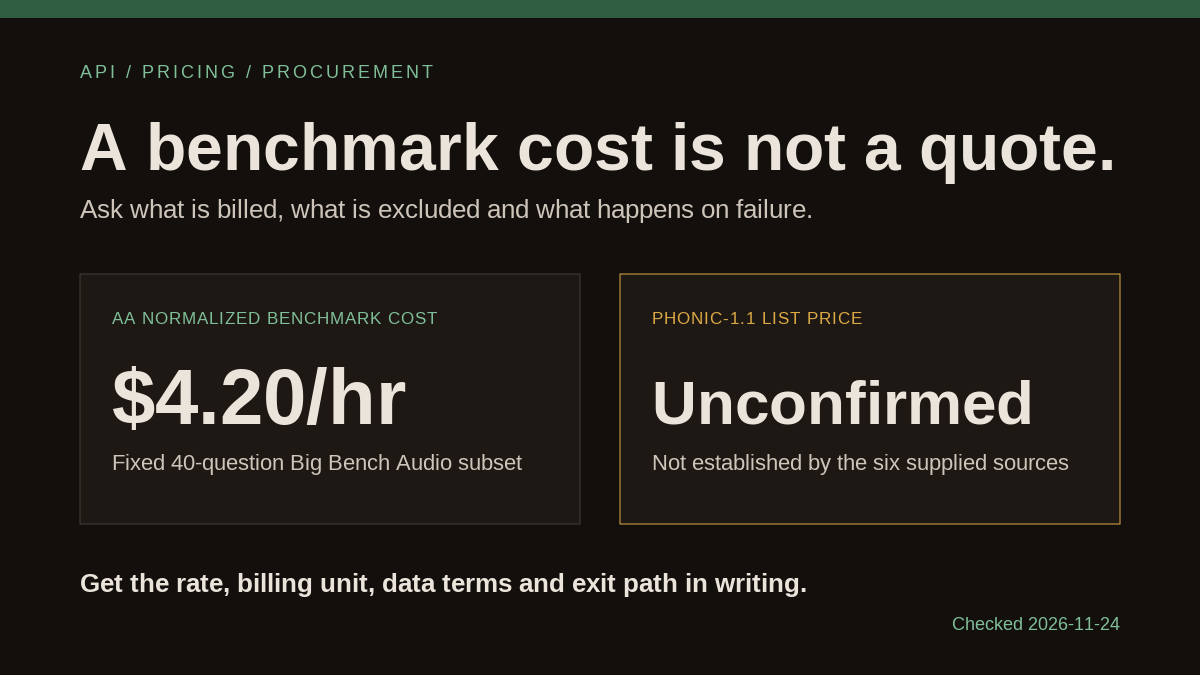
Phonic introduced Phonic-1.1 on 2026-11-23 as a speech-to-speech model for agentic conversations. Phonic’s launch post said it was available through signup, documentation or a demo. That establishes an access route, not a public price. The six supplied sources do not establish a Phonic-1.1-specific list rate, minimum spend or silence discount. Artificial Analysis’ $4.20 per hour is a normalized benchmark cost, not a vendor quote. Buyers need a written commercial offer and a measured pilot before they can budget production use.
TL;DR for the procurement file
- Access: the launch post described signup, documentation and a demo as routes to Phonic-1.1. It did not publish a model-specific price in the supplied record.
- Startup program: Phonic advertised 144,000 minutes across 12 months plus engineering access, subject to application. That is not an automatic entitlement.
- Benchmark cost: $4.20 per hour comes from a fixed 40-question Big Bench Audio subset calculation. It is not a per-minute rate or a forecast for your calls.
- Deployment: Phonic advertised enterprise self-hosting. The supplied sources do not establish open weights or a downloadable checkpoint.
- Decision: obtain a written quote, reconcile billed minutes to session logs, and pass a bounded pilot with a tested rollback before committing traffic.
What access did the Phonic-1.1 launch actually confirm?
The launch statement is useful but narrow. It places Phonic-1.1 in the speech-to-speech category, describes agentic conversations as the intended workload, and points prospective users toward signup, documentation or a demo. It does not tell a buyer which public endpoint to call, what identifier to place in a request, or which commercial tier applies. Those details should come from the vendor’s current onboarding material and order form, not from inference.
The startup program is a separate access claim. Phonic advertised 144,000 minutes across 12 months with engineering access, subject to application. A buyer should read that as an application pathway. The supplied launch material does not establish eligibility, approval criteria, whether unused minutes expire, what counts as a consumed minute, or whether engineering access carries a fee. Do not turn the advertised total into a monthly entitlement. Dividing 144,000 by 12 gives 12,000 minutes per month on average, but that arithmetic does not create a contractual monthly allocation.
Phonic also advertised enterprise self-hosting. That is a deployment claim, not an open-source license. The six supplied sources do not establish open weights, a downloadable Phonic-1.1 checkpoint or the right to modify and redistribute the model. A self-hosted procurement discussion therefore needs its own hardware, support, update and license terms. It should not inherit assumptions from open-weight speech models.
For release context and the benchmark evidence behind the launch, read the Phonic-1.1 launch explainer. For a vendor decision rather than a release summary, the Eleven Realtime v1 Max comparison explains why preference, latency and task success can point in different directions. Neither article substitutes for a signed quote.
Confirmed facts versus procurement unknowns
| Confirmed in the supplied record | Source and limit |
|---|---|
| Phonic introduced Phonic-1.1 on 2026-11-23 for agentic speech-to-speech conversations. | S6, official launch claim. |
| The launch post described access through signup, documentation or a demo. | S6. This is not a published rate card. |
| A startup program advertised 144,000 minutes across 12 months plus engineering access, subject to application. | S6. Eligibility and full terms are not established. |
| Phonic advertised enterprise self-hosting. | S6. Open weights and a downloadable checkpoint are not established. |
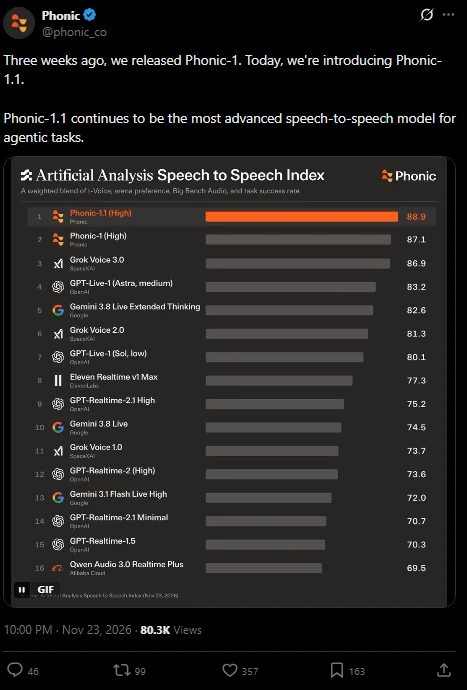
| Phonic-1.1 High led the checked Artificial Analysis composite at 89.1. | S2, independent dated snapshot. Phonic’s launch image showed 88.9. |
| Artificial Analysis measured Phonic-1.1 time to first audio at 0.80 seconds, versus 0.61 seconds for Phonic-1 High. | S2. This is a measured regression, not an end-to-end SLA. |
| Artificial Analysis reported $4.20 per hour as normalized benchmark cost. | S2. The calculation used a fixed 40-question Big Bench Audio subset. |
| Unknown from the six-source budget | What the buyer must obtain |
|---|---|
| Phonic-1.1 public list price, minimum spend and silence discount. | A dated written quote with currency and billing definitions. |
| Whether any discounted minutes apply to failed, abandoned or retried calls. | Billable-event rules and sample invoice line items. |
| Open weights, checkpoint access or self-hosting license scope. | License, deployment guide and support schedule. |
| Model-specific language guarantees. | Supported-language list and acceptance results for the buyer’s languages. |
| Production concurrency, availability and latency commitments. | Contracted limits, SLA, credits and exclusions. |
| Data retention, training use, hosting region and subprocessors. | Data-processing terms and current subprocessor list. |
| Full Duplex Bench, tau-Banking and tau-Entity results for 1.1. | Current results if the vendor claims them. Missing cells are not zero scores. |
Why is $4.20 per hour not a Phonic price?
Artificial Analysis’ Live Speech-to-Speech Index reports a normalized benchmark cost of $4.20 per hour for Phonic-1.1. The denominator matters. It is based on a fixed 40-question subset of Big Bench Audio, not a month of customer calls. AA expresses that fixed evaluation as an hourly normalized figure; the supplied pages do not establish elapsed audio time as its billing denominator. It does not state what Phonic charges a buyer for a minute of production audio.
Benchmark-normalized cost and workload cost answer different questions. The first describes how AA normalized the cost of one fixed evaluation. The second asks what a particular operation will pay for its call mix, tools, network path and support obligations. A benchmark can hold prompts, turn counts and infrastructure constant. A contact center cannot. Callers interrupt, wait, retry and abandon. Tool calls add text-model work. Recording, transport and telephony can sit outside the speech-model charge.
The benchmark also needs context. Big Bench Audio contains 1,000 spoken reasoning questions across four categories, scored correct or incorrect. Phonic-1.1 High scored 99.5, compared with 98.9 for Phonic-1 High. The benchmark is nearly saturated, so that small gap is not broad proof of better production reasoning. The 40-question cost subset should not be confused with the full 1,000-question evaluation.
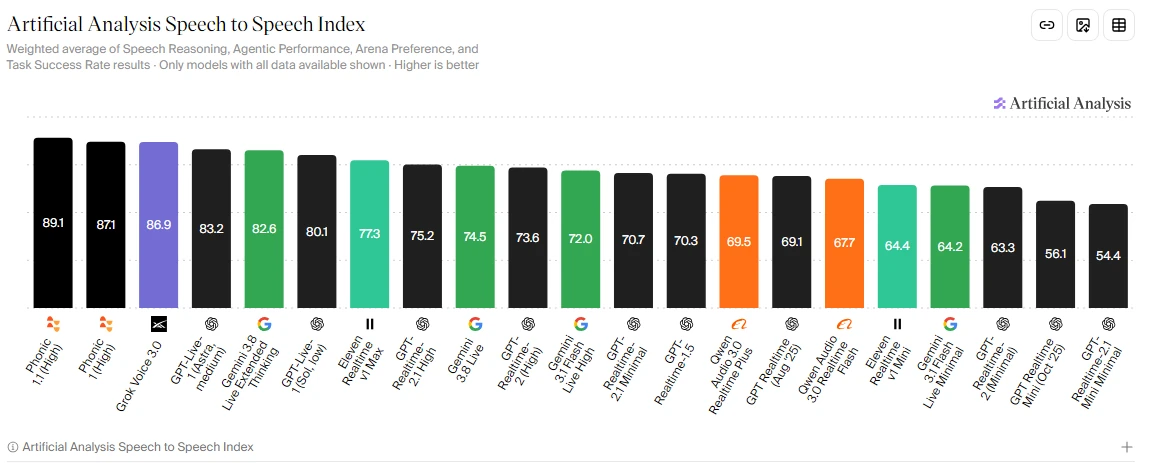
The composite itself is not a price-quality ratio. Phonic-1.1 High scored 89.1 in the checked live board, followed by Phonic-1 High at 87.1 and Grok Voice 3.0 high at 86.9. The same AA board listed GPT-Live-1 Astra medium at 83.2, Gemini 3.8 Live Extended Thinking High at 82.6 and Eleven Realtime v1 Max default at 77.3. Each value belongs to a named configuration. A buyer should not compare a High setting with a default setting and call the difference a model property.
| Model and evaluated configuration | AA index |
|---|---|
| Phonic-1.1 High | 89.1 |
| Phonic-1 High | 87.1 |
| Grok Voice 3.0 high | 86.9 |
| GPT-Live-1 Astra medium | 83.2 |
| Gemini 3.8 Live Extended Thinking High | 82.6 |
| Eleven Realtime v1 Max default | 77.3 |
BenchLM’s Phonic-1 page provides a baseline view of the earlier Phonic-1 model. It must not be relabeled as Phonic-1.1 evidence or used to fill a missing 1.1 price. The same discipline applies to missing benchmark cells. Full Duplex Bench, tau-Banking and tau-Entity results for 1.1 are not supplied. An empty cell means no evidence in this record, not a zero.
Two industry commentaries add cautions rather than neutral test results. OrcaRouter’s Eleven comparison criticizes latency and notes a missing Full Duplex cell. OrcaRouter’s index critique questions index and defect-rate interpretation and records a date anomaly. OrcaRouter is a commercial gateway vendor, so these articles are useful prompts for questions, not independent production validation. For the metric mechanics, use the benchmark teardown behind the cost claims.
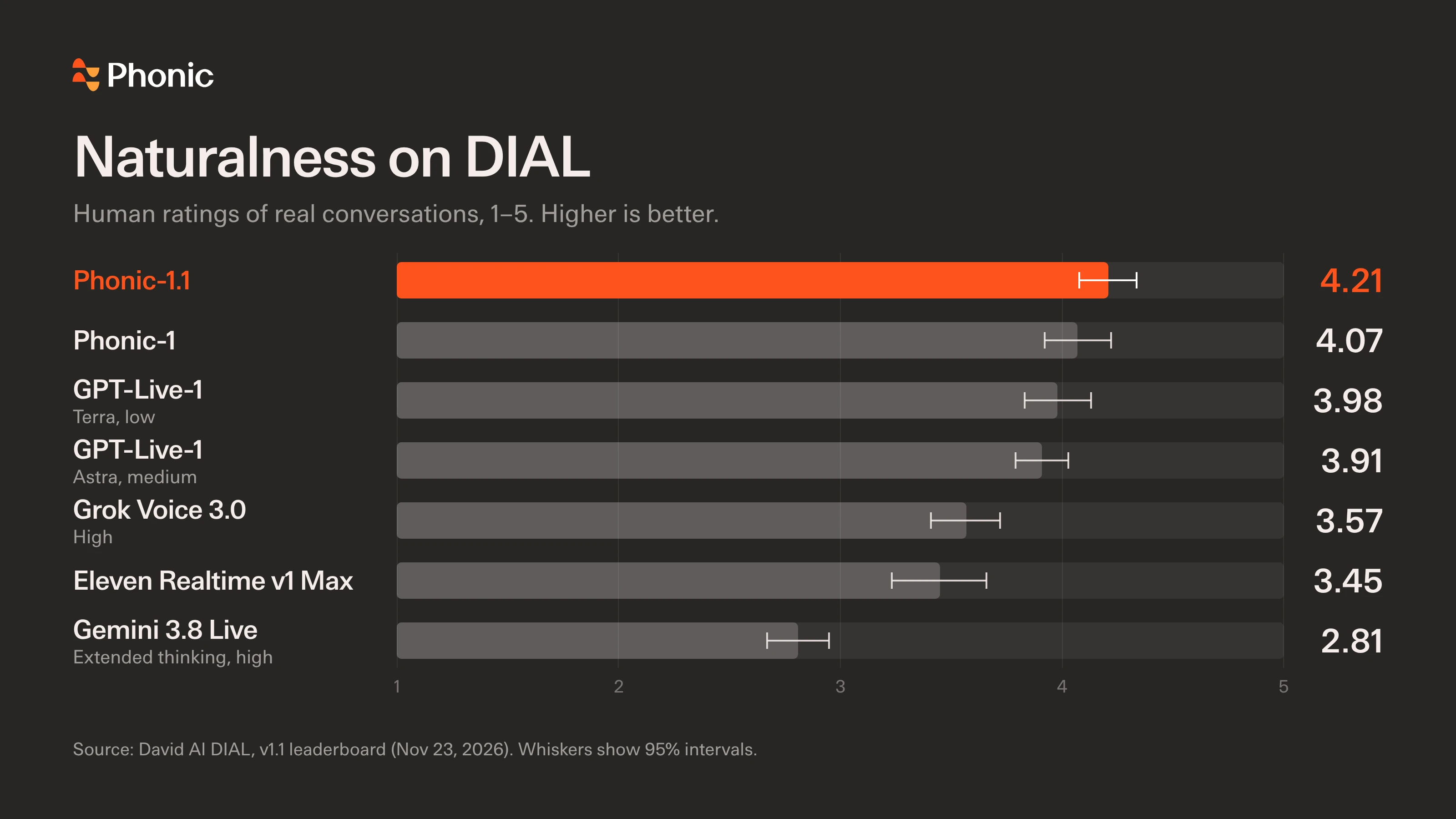
The strongest counterweight to the composite lead is a measured loss. Artificial Analysis put Phonic-1.1 time to first audio at 0.80 seconds, versus 0.61 seconds for Phonic-1 High. That is a 0.19-second regression, about 31%, even though 1.1 leads the composite. The supplied record does not define AA’s measurement boundary, so a procurement test must measure network and orchestration delay on the path your callers will use rather than copy a benchmark latency into an SLA.
How should a buyer build a workload cost model?
Start with the billable unit in the written quote. If the vendor bills voice minutes, the voice line is:
Workload voice charge = billable voice minutes × contracted voice rate per minute.
Then add every cost that does not disappear when the speech-model line is paid:
Total workload cost = voice charge + orchestration-token cost + transport + telephony + observability + storage + support.
Orchestration-token cost covers the text models that extract intent, plan actions, validate tool arguments or summarize calls. Transport covers the audio and event path. Telephony covers phone numbers, call minutes and carrier charges where applicable. Observability covers traces, quality monitoring and alerting. Storage covers recordings, transcripts and logs. Support covers any contracted premium service. Taxes and currency conversion belong in a separate, visible line.
Use variables until the quote supplies rates. Let B be billable voice minutes, R the written voice rate, T orchestration-token cost, N transport, P telephony, O observability, S storage and H support. The model becomes B × R + T + N + P + O + S + H. Record whether each component is usage-based, committed or included. Do not hide an included allowance inside a blended rate; it will change the overage math.
Here is a hypothetical arithmetic exercise, not a Phonic price. Assume a month contains 20,000 billable voice minutes. Assume fictional non-voice allowances of $1,200 for orchestration, $600 for transport, $700 for telephony, $500 for observability, $350 for storage and $500 for support. Those assumptions total $3,850. The fictional monthly model is therefore 20,000 × R + $3,850, before tax. If a future written rate were $0.01 higher, this workload would add $200 per month. R remains unknown until Phonic provides a quote. None of the dollar assumptions above describes Phonic’s charges.
Build low, base and high scenarios from call volume, average billed duration, retries and tool-call frequency. A successful-task cost is often more useful than cost per call: divide total workload cost by completed, correctly executed tasks. That exposes cheap conversations that never finish the job. The monthly API-cost estimation method provides a structure for the scenarios, while the API cost calculator can handle the surrounding text-model and orchestration portion. Neither tool can supply a missing Phonic voice rate.
Keep engineering effort in the decision even if it is not on the invoice. Integration, evaluation, redaction, monitoring and vendor management consume staff time. The SDK guide and gateway API reference are useful examples of the contract clarity a buyer should demand: endpoint behavior, authentication, errors and request semantics should be documented before procurement, not discovered during a launch.
Which minutes will Phonic actually bill?
The phrase “voice minute” is not a billing definition. Ask whether the meter follows caller time, connection time, model processing time or some combination. A call can include ringing, an interactive voice response menu, hold time, silence, tool execution and a final goodbye. Each interval may be treated differently. Ask the vendor to mark the start event, stop event and any excluded intervals on a session timeline.
Does the clock run during silence or incomplete calls?
Silence is a commercial question before it is a model feature. The supplied sources do not establish a Phonic-1.1 silence discount. Ask whether quiet time is billed, whether there is a threshold, and whether the threshold applies to caller silence, model silence or both. Then test a call with a deliberate pause and compare the invoice line to the recorded timeline.
Failed calls, abandoned calls and retries need separate rules. A failed connection should not silently become a successful voice session. An abandoned call may still consume telephony and model time. A retry after a network error may create two billable sessions unless the vendor provides idempotency or a credit rule. The error reference for failed sessions is a useful model for the event taxonomy your own logs should preserve.
How are increments, concurrency, taxes and currency handled?
Ask for the minimum increment and rounding rule. Per-call rounding and aggregate monthly rounding produce different invoices. Ask whether a 19-second call rounds to one minute, whether increments are six seconds or thirty seconds, and whether the rule is stated in the contract. Do not infer the rule from one invoice.
Concurrency can change both price and capacity. A low per-minute rate is less useful if the required number of simultaneous sessions triggers a higher tier or a hard cap. The rate-limit behavior reference shows why burst limits belong in pilot planning. Require the written quote to state the included concurrency, the measurement window and the response to a burst.
Finally, settle currency and tax treatment. Ask whether the rate is in USD or another currency, who bears conversion fees, whether taxes are included, and which jurisdiction applies. If the vendor can change prices, require notice timing and a right to terminate without a new minimum commitment. A quote without these details is a sales indication, not a procurement baseline.
What must the written quote settle before procurement?
A written quote should be specific enough that finance can predict an invoice and engineering can predict capacity. It should identify the product and configuration, the billing unit, the included allowances, the overage treatment and the effective dates. It should also attach the data-processing terms, SLA and exit provisions. Verbal assurances about discounts or flexibility are not enough.
| Topic | Written question | Evidence to retain |
|---|---|---|
| Rate | What is the currency, unit price, tier boundary, effective date and price-change notice? | Dated rate card or order form |
| Billing unit | What starts and stops the meter, and which silence or hold intervals count? | Billing definition plus session timeline |
| Minimum commitment | Is there a monthly or annual minimum, and do unused commitments expire? | Commitment schedule |
| Overages | What rate applies above an allowance, and is there a hard spend cap? | Overage clause and cap settings |
| Concurrency | How many simultaneous sessions are included, over what window, and what happens on a burst? | Capacity schedule and limit policy |
| Latency SLA | Which latency percentile is measured, from which boundary, with what credits and exclusions? | SLA with measurement method |
| Data retention | How long are audio, transcripts and logs retained, and how is deletion verified? | Retention schedule and deletion process |
| Training use | Are customer inputs or outputs used for training, and can that use be disabled? | Data-processing terms |
| Region | In which regions are inference, storage and backups performed? | Hosting and backup map |
| Subprocessors | Which subprocessors handle data, and what notice precedes a change? | Current list and change clause |
| Termination | What notice, fees and data-return obligations apply at termination? | Termination and transition clause |
| Export | Can the buyer export recordings, transcripts, metadata and configuration in usable formats? | Export schema and sample files |
| Rollback | What support is provided to move traffic back, and how long does export access remain? | Rollback plan and support commitment |
| Taxes and fees | Are taxes, carrier fees, support fees and currency conversion included or additional? | Fee schedule and sample invoice |
Attach a sample invoice to the quote process. It should show session identifiers, start and end times, billed duration, unit rate, rounding, status, credits and tax. The billing reference for usage reconciliation and the console guide to keys, usage and billing illustrate the level of usage visibility a buyer should expect from its own systems. If the vendor cannot provide line-item evidence, reconciliation becomes guesswork.
Commercial terms should also state how failed sessions are credited. Set up balance alerts and signed webhook patterns before the pilot so a budget problem is detected before it becomes an outage. Budget alerts are useful, but a contractual or platform-enforced cap is stronger. Use spend controls for a capped evaluation wherever the surrounding stack supports them.
How should a buyer run a Phonic-1.1 pilot?
A pilot should test the workload, the billing definition and the exit path together. Passing a benchmark is not an acceptance criterion. The production voice-agent architecture guide covers the broader system; the following plan focuses on procurement evidence.
1. Freeze a representative call set
Build a fixed set from real, consented call types. Include straightforward tasks, interruptions, silence, corrections, ambiguous requests, tool failures and calls that end without completion. Record the expected final action, not just the expected transcript. Test only languages the vendor has confirmed for Phonic-1.1; the supplied sources do not establish model-specific language guarantees.
Keep prompts, tools, voices and network conditions versioned. Run the current production stack on the same call set as the baseline. A candidate that sees easier prompts or warmer connections has not earned a comparison. Store session IDs and outcome labels so every later latency, quality and invoice claim can be traced to the same event.
2. Start in shadow mode and then staff testing
In shadow mode, send the candidate the same inputs without letting callers hear its output or allowing it to execute consequential actions. Compare transcripts, planned tool calls and final results with the baseline. This catches task failures without creating a customer incident. Keep the candidate’s actions in a sandbox until the comparison is understood.
Then run a staff test. Staff should interrupt, pause, change intent and ask for corrections. They should also test hold behavior and tool latency. Instrument first-audio latency, full response time, retries, tool errors and task completion. The metrics reference for usage evidence can inform the event schema, while the request-header reference explains how trace identifiers should travel with requests.
Pilot worksheet
Score the Phonic-1.1 procurement pilot
Replace neutral placeholders only with measurements from your fixed call set, staff test and invoice reconciliation. This worksheet is not a vendor score.
Scale: 1 = fails the requirement, 3 = acceptable with evidence, 5 = strong measured result.
Blind human ratings on your real callers and prompts.
Interruptions, false starts, silence handling and recovery.
Correct final tool calls, not just a fluent conversation.
Measured end to end on the network your users will use.
Written rate, billing unit, data terms and exit path.
Needs evidence: replace the neutral placeholders with measurements from your own pilot.
Weakest current evidence: none yet.
This is an editorial worksheet, not an Artificial Analysis score or a vendor guarantee.
60 out of 100. Needs evidence: replace the neutral placeholders with measurements from your own pilot.
3. Release 5% of eligible traffic behind a switch
After shadow and staff tests pass, route 5% of eligible traffic to the candidate. Keep the remaining traffic on the baseline. Use a feature flag or routing rule that can stop new candidate sessions immediately. The 5% share is a pilot control, not a claim about production readiness.
Before increasing traffic, define go/no-go gates in writing. Task success should meet the baseline within an agreed margin. First-audio latency should stay within the buyer’s end-to-end budget at the agreed percentile. Severe privacy or unauthorized-action failures should stop the pilot. Cost per successful task should remain within the approved scenario. Billed minutes should reconcile to session logs within an agreed tolerance. Set the thresholds before seeing results, or the pilot will be judged after the fact.
4. Reconcile the invoice and test the kill switch
At the end of the pilot, join the vendor invoice to session logs. Check start times, stop times, rounding, silence treatment, failed and abandoned statuses, retries, credits, taxes and currency. Investigate every mismatch, not only the largest one. A small systematic rounding error can become material at production volume.
Test the kill switch while traffic is live in the pilot. Stop new candidate sessions, drain active calls safely, return routing to the baseline and confirm that no new billable events continue unexpectedly. Revoke the candidate credential if needed. Preserve logs and recordings according to the retention policy, then verify export and deletion behavior.
Use an isolated evaluation credential with its own spend limit, following the one-key-per-project security pattern. Keep provider secrets out of client code using server-side API-key authentication, and apply the API-key security practices for AI applications to the pilot environment.
5. Make rollback a procurement requirement
A rollback is more than a routing flag. The orchestration layer, prompt set, tool schema and observability tags must return to the baseline as one versioned unit. The migration guide for changing an API base URL and the base-URL migration walkthrough show how to keep the surrounding stack portable. They do not make speech providers interchangeable, but they reduce avoidable lock-in around them.
Require an export of recordings, transcripts, outcomes and configuration before termination. Test that export during the pilot. Confirm how long the vendor will retain access after termination and who supports the transition. If the buyer cannot leave without rebuilding its history or losing its evaluation data, the commercial fit score should fall even when voice quality passes.
FAQ: Phonic-1.1 access, price and deployment
Can I buy Phonic-1.1 through a public API today?
The launch post said Phonic-1.1 was available through signup, documentation or a demo. The supplied record does not establish a public list price or a self-serve billing tier. Treat current availability, onboarding requirements and pricing as items to confirm directly with Phonic before procurement.
Is $4.20 per hour the Phonic-1.1 API rate?
No. It is Artificial Analysis’ normalized benchmark cost for a fixed 40-question Big Bench Audio subset. It is useful for comparing a controlled evaluation, not for predicting a production invoice. Your workload cost depends on billed minutes and the surrounding token, transport, telephony, observability, storage and support charges.
Does the startup program guarantee 144,000 minutes?
No. Phonic advertised 144,000 minutes across 12 months plus engineering access, subject to application. The supplied sources do not establish universal eligibility, monthly allocation rules, expiry, included services or the billing definition for those minutes. Get the program terms in writing.
Does enterprise self-hosting mean Phonic-1.1 is open source?
No. Self-hosting and open weights are different claims. The supplied sources do not establish open weights or a downloadable Phonic-1.1 checkpoint. Ask for the license, supported hardware, update policy and data-handling terms before treating self-hosting as an option.
Which benchmark result should influence procurement most?
Use the benchmark that matches the failure you need to prevent, then verify it on your call set. Big Bench Audio measures spoken reasoning. tau-Voice measures agentic tasks. Arena preference measures blind comparative preference, and task success measures correct final tool calls. The composite is a summary, not a universal voice-quality or price score. The side-by-side model comparison workspace can help organize the surrounding model decision.
Does this gateway serve Phonic-1.1?
No. Phonic-1.1 is not served here. This article is procurement guidance, not a route to a Phonic endpoint, model identifier or rate. Check the live model-status page before planning around any model that is actually listed.
Where does this gateway fit if Phonic-1.1 is not served here?
The honest offer is limited to the surrounding stack. If your voice agent needs text models for intent extraction, tool validation, reasoning or summarization, review the live model catalog and published rates, then compare the options in the model comparison workspace. The gateway’s published credit-pack pricing applies to those served models, not to Phonic-1.1.
You can also start with the gateway quickstart and create a scoped gateway key for the surrounding stack. Use a separate project key and a bounded budget for evaluation. This is an adjacent path for the non-voice parts of an agent. It does not provide Phonic-1.1 access, a Phonic price or a substitute for Phonic’s own quote and pilot process.