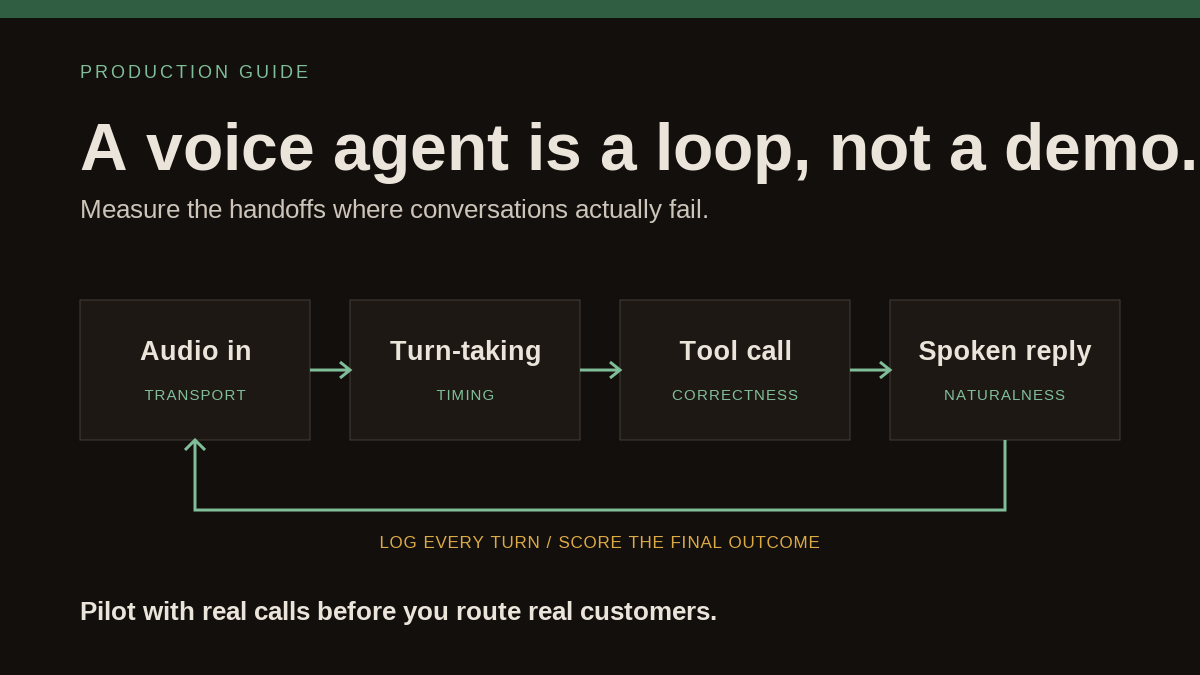
Phonic-1.1 is a candidate for the speech loop, not a complete production voice agent. Your application still owns audio ingress, endpointing, tool execution, authentication, observability, consent and fallback. The model can help produce conversational speech and agentic behavior, but it cannot by itself guarantee that a caller reaches the right outcome, that a booking happens once, or that an outage has somewhere safe to send the call.
Phonic introduced Phonic-1.1 on 2026-11-23 as a speech-to-speech model for agentic conversations. Its official launch post says access was available through signup, documentation or a demo. That makes it worth evaluating. It does not turn benchmark leadership into a production service-level agreement. Start with the Phonic-1.1 launch explainer for release context, then use the architecture and gates below to decide whether it belongs in your stack.
What should you take away before building?
TL;DR: Treat Phonic-1.1 as one replaceable component behind a session controller. Put a transport adapter, an endpointing policy, a validated tool layer and an outcome logger around it. Test with the same caller simulator and backend that you will use in a bounded pilot. Promote traffic only when task success, interruption handling, recovery, privacy and unit economics clear gates that you set in advance.
The evidence supports a trial, not a launch decision. Artificial Analysis showed Phonic-1.1 High first on its composite Speech-to-Speech Index at 89.1 when checked on 2026-11-24. The same model ranked seventh in the broader Speech Agent Arena. It also had a higher time to first audio than Phonic-1 High. Those results describe different things: aggregate benchmark standing, blind preference and responsiveness.
The most important production warning is turn-taking. Phonic’s reproduction of DIAL v1.1 reported at least one turn-taking defect in 46.3% of rated conversations for Phonic-1.1. That is better than several comparators in that chart, but it is not a production defect target. It is a reason to test overlap, silence and recovery before a caller depends on your agent.
Finally, procurement is incomplete. The six sources used here do not establish a Phonic-1.1 public list price, a transport endpoint or an SDK contract. Read the API and pricing due-diligence checklist before signing, and keep the model adapter separate enough to replace if access, cost or data terms do not fit.
What does the production voice loop actually contain?
Draw the loop as a sequence of owned boundaries, not as one model call. Audio ingress receives the caller stream, normalizes it and records packet loss, jitter and codec information. A transport adapter passes audio to the streaming speech model using the provider’s actual integration contract. The six sources do not supply a WebRTC or WebSocket endpoint, a model ID or SDK code, so none is invented here. Obtain those details through the access path Phonic advertises, then verify them in your own environment.
The session controller applies endpointing. It decides when the caller appears finished, when speech is a false start and when a pause is long enough to act. Model output may inform that decision, but the application still needs a policy for ambiguous silence, delayed packets and overlapping speech. Keep the policy configurable because network delay and caller behavior will differ from a benchmark run.
After the model signals an action, the tool layer validates it. A tool name must be allowed for the current caller and task. Arguments must match a schema, dates must resolve, identifiers must belong to the caller and the backend must enforce authorization again. The tool-calling contract for booking and support actions is a useful design reference for the surrounding agent loop, not a claim about Phonic’s protocol. Apply structured-output rules for validated tool arguments where your chosen integration supports them, then validate at the execution boundary regardless.
Only a successful backend result should become task evidence. Return a compact, typed result to the session controller. The controller updates state, generates or requests the spoken response, and streams it through the transport. After the call, write an outcome record that links the audio or transcript reference, model variant, tool attempts, final state, latency measurements and failure labels.
This separation matters operationally. You should be able to swap the speech model without rewriting booking logic, and swap the booking backend without changing transport. The streaming contract for incremental model output is a text-streaming analogue, not an audio transport specification. Likewise, the server-sent-events streaming guide explains incremental delivery but does not establish that SSE alone is suitable for bidirectional audio. The supported SDK guide applies to the surrounding API stack. Keep speech-specific integration code in its own adapter.
How should barge-in, silence and recovery work?
Barge-in begins when the caller speaks while the agent is talking. The application needs to detect the overlap, stop or attenuate outgoing audio, cancel any response that is no longer relevant and resume listening. The difficult case is not a clear interruption. It is a brief acknowledgment, background speech or a packet burst that resembles an interruption. Test all three rather than assuming voice activity alone is enough.
Silence needs bounded states. A short pause may mean the caller is thinking. A longer pause may mean the endpointing decision failed, the audio path broke or the caller left. Set a maximum wait, then choose a deliberate action: ask for clarification, offer a transfer or close the session. Do not loop indefinitely on a silence timer.
False starts need state rollback. If the caller begins a sentence, stops and restarts, the session should discard superseded interpretation rather than execute a partial tool request. Recovery must reconnect the current task state, not restart the whole conversation. For a booking, that means retaining the service and date while reconfirming the time. For support, it means retaining the authenticated account while checking the unresolved request.
The DIAL result gives this work a clear priority. Lower is better in the turn-taking chart, yet Phonic-1.1 still has defects in 46.3% of rated conversations. The inverse is 53.7% clean conversations. It does not mean 46.3% of turns failed, and it does not predict the rate on your phone network.
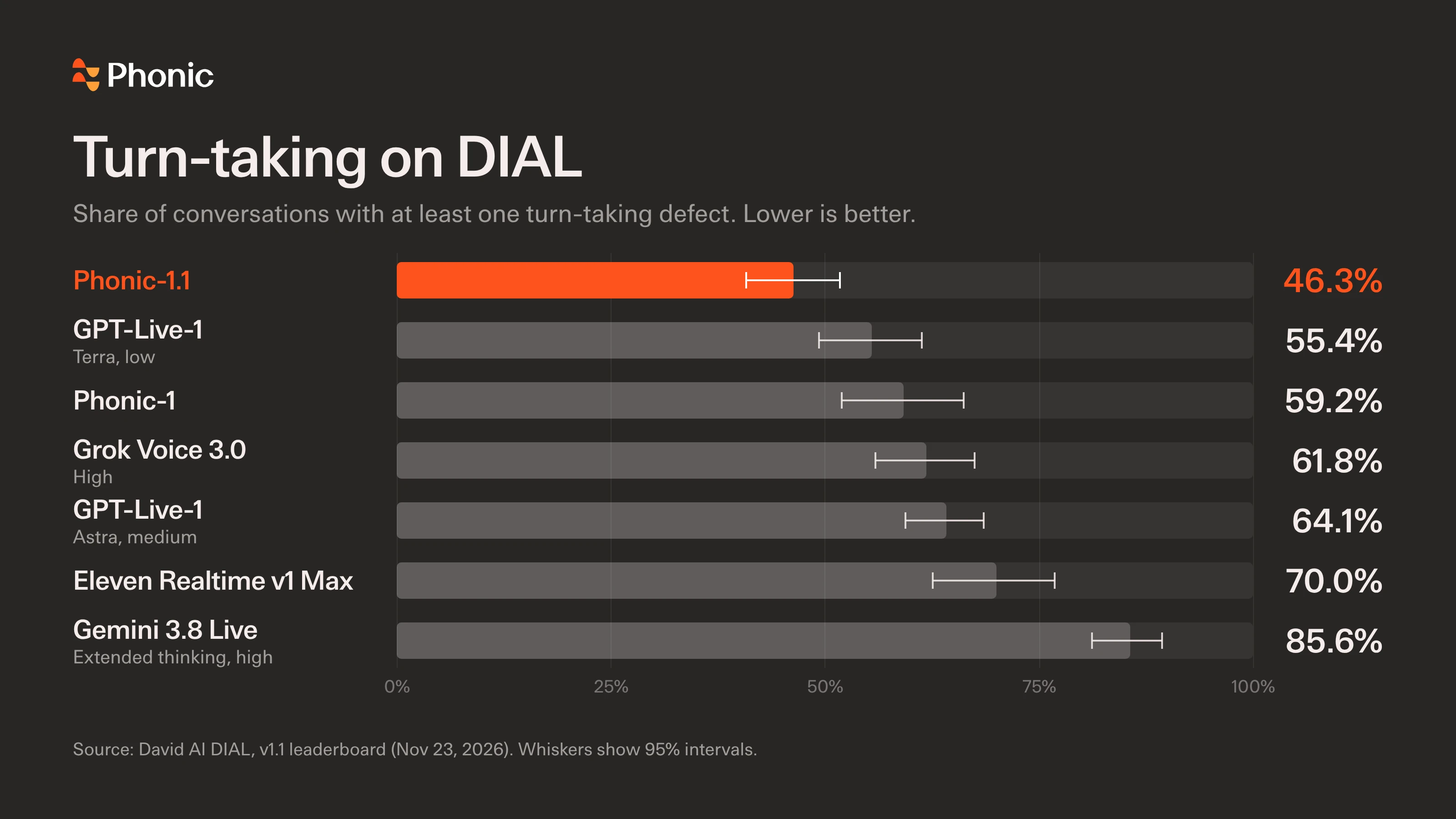
Show as table
| Item | Conversations with at least one turn-taking defect (%) |
|---|---|
| Phonic-1.1 | 46.3 |
| Phonic-1 | 59.2 |
Build scripted events for each case. Insert overlap at a known timestamp and check whether outgoing audio stops within your budget. Insert silence at three task stages and verify that state survives recovery. Add a false start before a time or order number, then confirm that no partial action executes. The streaming versus buffered response explainer helps explain why a fast complete response can still feel slow when the first audio arrives late.
How do tool calls become completed tasks?
Tool-call correctness is narrower than task success. A correctly formed lookup can still fail the caller’s goal. Artificial Analysis defines Arena task success as correct final task-completing tool calls. That makes the final backend state important, not just the presence of a function name in the transcript.
Consider a support call about a delayed order. The agent must identify the order, verify that it belongs to the caller, retrieve its current state and decide whether the request is a status check or a change request. A successful lookup completes only the first task. If the caller wants a replacement, the final action must be an authorized replacement request with the correct order identifier. Record both the intermediate call and the final resolution.
Consider a restaurant booking. The required arguments include the venue, date, local time, party size and caller contact details. Validate the date against the venue’s calendar and time zone. Check availability, then create the reservation with an idempotency key derived from the confirmed request. Return a booking reference. A spoken confirmation without a durable booking is not success, and two durable bookings for one confirmation is a serious failure.
Use negative tests before happy paths. Send a missing party size, an unavailable time, an order identifier from another account and a repeated confirmation after a timeout. The executor should reject the first three without side effects and deduplicate the fourth. The error reference for retries and failed actions can inform the surrounding stack’s policy, but each voice tool needs its own deadline and retry classification.
For asynchronous outcomes, attach a correlation ID to the session and publish a signed completion event. The signed webhook and alert patterns are a useful analogue for confirming that a long-running action finished. Do not mark the task resolved until the authoritative backend state is known.
Which metrics should the evaluation harness measure?
Use a provider-neutral harness. Keep the caller simulator, scenario prompts, audio conditions, network profile, tool backend, retry policy and human raters fixed. Change only the model adapter and its declared variant. Otherwise a difference in booking latency or backend errors will be misattributed to speech quality.
The simulator should produce repeatable audio with controlled overlap, pauses, accents, background noise and disconnections. Pair it with a backend fixture that records exact calls, arguments, authorization decisions and duplicate suppression. Run every candidate through the same sequence and randomize order to reduce drift. Keep human raters blind to the model name where practical.
Measure these signals at session level:
| Metric | Definition | What it informs |
|---|---|---|
| TTFA | Time from caller turn end to first audible agent audio | Perceived responsiveness and transport overhead |
| Interruption rate | Eligible barge-in events that do not stop outgoing audio within budget | Turn-taking policy and echo handling |
| Recovery time | Time from a failed turn to a valid task state | Silence, false-start and reconnect behavior |
| Task success | Correct final backend state without duplicate or unauthorized action | Whether the caller goal was completed |
| Naturalness | Blind human rating using a fixed rubric | Comprehension, pacing and caller comfort |
| Fallback rate | Sessions transferred or terminated without resolution | Coverage limits and escalation capacity |
| Cost per resolved task | All voice, text, transport and support cost divided by resolved tasks | Unit economics, not benchmark price |
Define TTFA precisely. Artificial Analysis measured Phonic-1.1 High at 0.80 seconds versus 0.61 seconds for Phonic-1 High, a 0.19-second regression of about 31%. That comparison shows why a composite leader can regress on one important signal. Your harness must measure from the caller’s turn boundary through your transport and model adapter, not copy a provider number. The performance notes for end-to-end latency help separate model time from network and tool overhead.
Report distributions, not only averages. Include median and p95 TTFA, interruption success by event type, recovery time by failure class and task success with a confidence interval. Separate provider infrastructure failures from application failures, rerun only under a predeclared rule and publish both raw and adjusted results. Otherwise retries can quietly improve the score.
Use the metrics reference for session-level observability as a starting point for traces. Every session needs a correlation ID, model variant, endpointing decision, tool attempt and final outcome label. Store enough evidence to replay a failure without retaining raw audio forever.
How do you turn benchmarks into pilot gates?
The Artificial Analysis Speech-to-Speech Index is an equal-weight composite of Big Bench Audio, agentic performance, Arena preference and task success, each worth 25%. Models need all four components. It is not a universal voice-quality score.
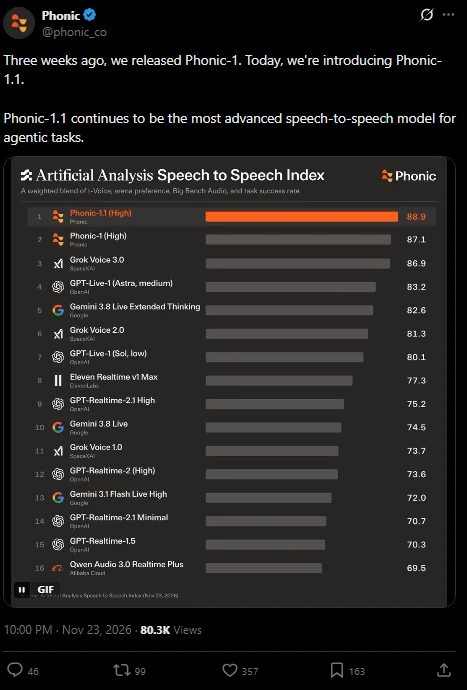
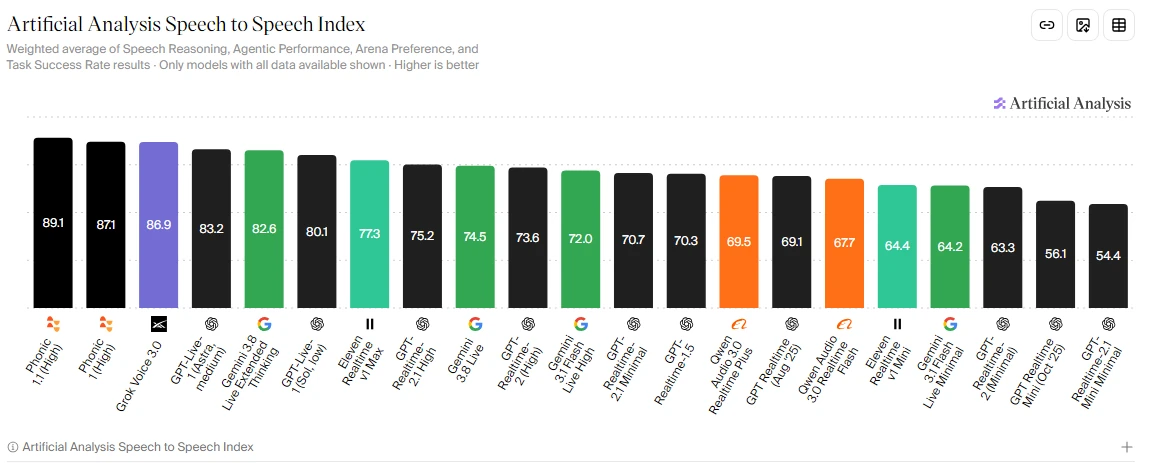
Phonic’s launch image showed 88.9, while the live Artificial Analysis Speech-to-Speech Index showed 89.1 for Phonic-1.1 High at check time. Preserve both as dated snapshots. Nearby AA live-board values were 87.1 for Phonic-1 High, 86.9 for Grok Voice 3.0 high, 83.2 for GPT-Live-1 Astra medium, 82.6 for Gemini 3.8 Live Extended Thinking High and 77.3 for Eleven Realtime v1 Max default. Variants matter; these are not interchangeable settings.
Big Bench Audio contains 1,000 spoken reasoning questions across four categories, scored correct or incorrect. Phonic-1.1 High scored 99.5 versus 98.9 for Phonic-1 High. The benchmark is nearly saturated, so that small lead is not broad proof of better reasoning.
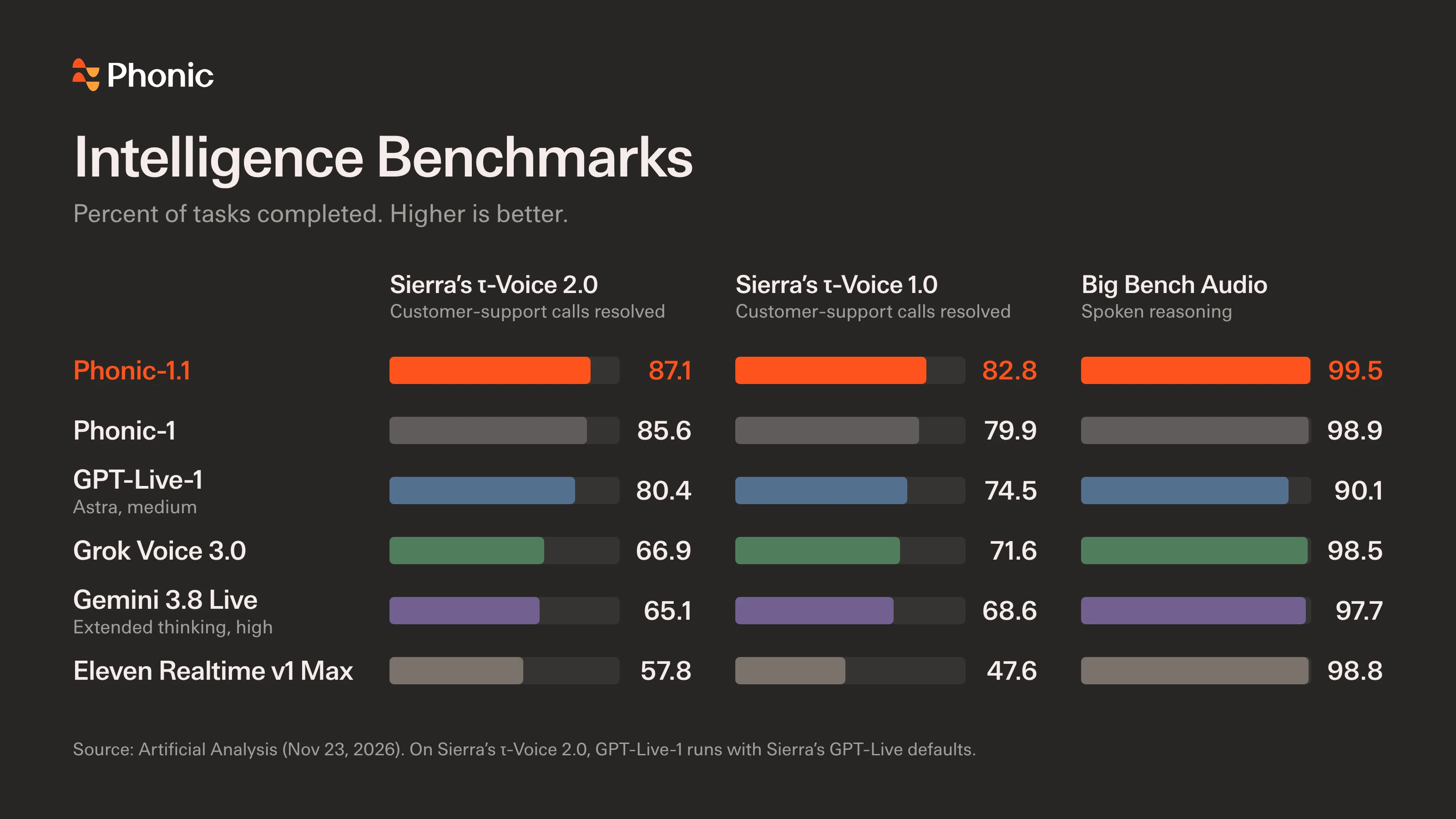
Tau-Voice 2.0 uses 50 English tasks in each of airline, retail and telecom, three trials and pass@1 averaged. GPT-5.5 at low effort simulates the caller. Infrastructure failures are excluded and rerun. Phonic-1.1 High scored 87.1 versus 85.6 for Phonic-1 High, and Artificial Analysis placed that gap within the margin of error. Tau-Voice 1.0 is a different benchmark and its scores are not comparable.
The Speech Agent Arena uses blind live voice conversations and Bradley-Terry preference Elo anchored to GPT-Realtime-1.5 at 1000. Phonic-1.1 High ranked seventh overall at Elo 1053 plus or minus 26, with 806 samples and 92.9% task success, with a 95% interval of 89.8% to 95.1%. First on the composite and seventh in the Arena are compatible statements. They measure different aggregates.
Use these results to choose stress cases, not to set guaranteed limits. A sensible starting gate is zero unauthorized or duplicate state changes in scripted high-risk tests. For live traffic, set a p95 TTFA budget, a minimum task-success floor and a maximum fallback rate against your incumbent workflow. Require the lower confidence bound to clear the success floor before expansion. The benchmark methodology teardown explains the source mechanics in more detail.
Commercial commentary also needs discipline. OrcaRouter’s index criticism raises questions about defect-rate interpretation and a date anomaly. OrcaRouter is a commercial gateway vendor, not a neutral hands-on evaluator. Treat its article as a prompt to inspect methodology, not as independent production validation.
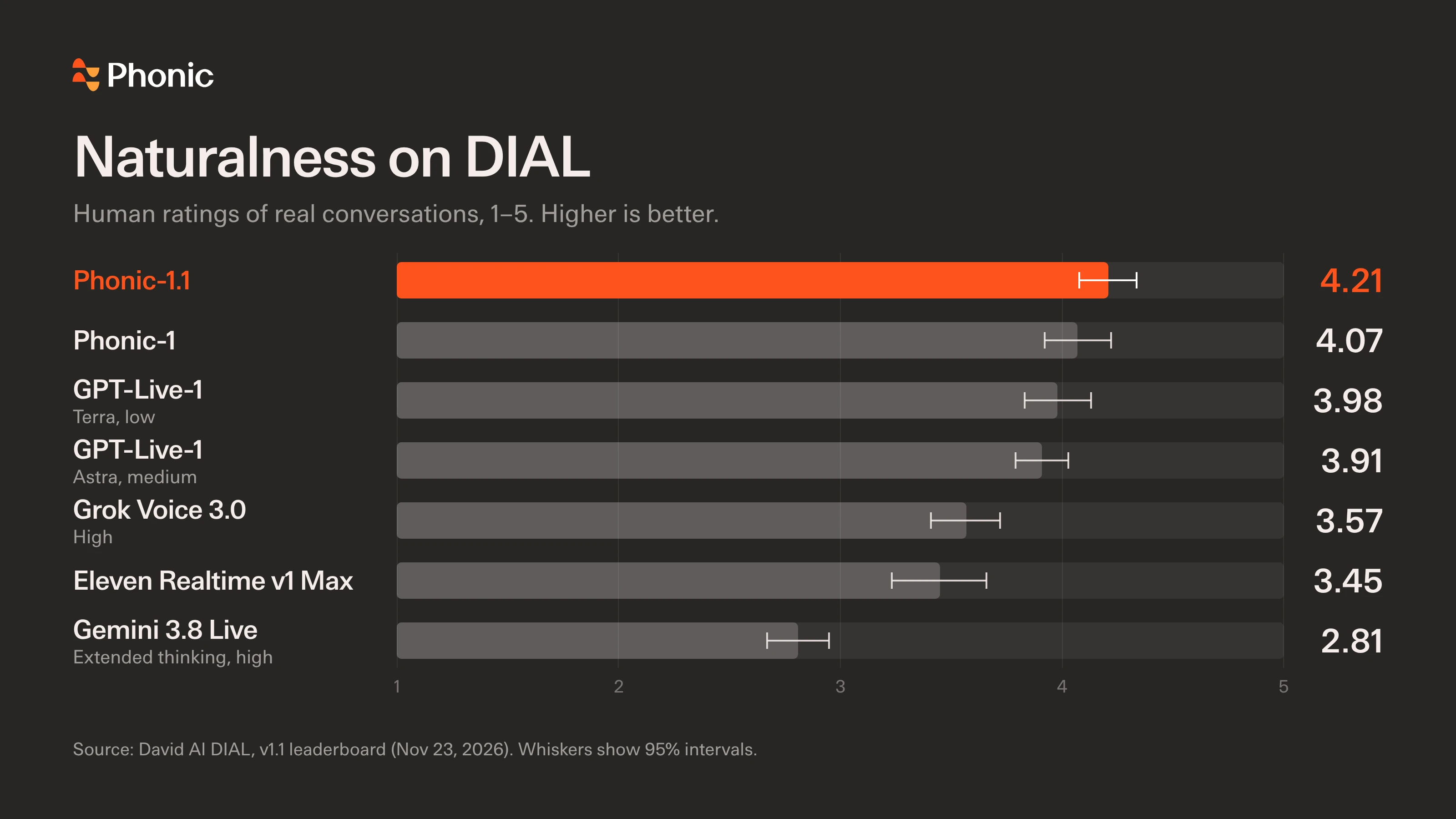
Naturalness is another input to the gate, not a substitute for completion. Phonic’s reproduction of DIAL v1.1 put its Phonic-1.1 row at 4.21 out of 5, Phonic-1 at 4.07 and Eleven Realtime v1 Max at 3.45. Higher is better, and the chart shows 95% intervals.
What data-handling controls must exist before live calls?
Consent comes before recording. Tell callers what is captured, why, where it is processed and how long it remains. Provide a path that does not require an unapproved recording. Check whether your jurisdiction and contracts require separate consent for evaluation recordings, transcription or human review.
Redact before broad access. Remove payment details, authentication secrets and unnecessary personal identifiers from transcripts and evaluation sets. Keep a restricted link between a redacted sample and its source only when replay is genuinely needed. The routing and privacy boundaries for recorded calls and the data-handling reference for transcripts describe the surrounding gateway’s boundaries; they do not establish Phonic’s terms.
Set retention by purpose. Raw audio, redacted transcripts, tool traces and quality ratings can have different lifetimes. Delete on schedule, record deletion evidence and make sure backups follow the same policy. Limit access by role, log reads and review access after the pilot.
Keep evaluation credentials separate from production. Store provider secrets server-side, never in a browser or mobile client, following the server-side API-key authentication pattern. Give each environment one project key with its own spend limit, and apply the API-key security practices for AI apps across the speech vendor and surrounding model stack. Evaluation keys should not be able to invoke production booking or billing tools.
How should you roll out and roll back?
Roll out in stages with written gates and named stop authority. The engineering lead owns the deployment, but the on-call engineer, support lead and privacy owner should each be able to halt new traffic. Anyone may stop for a suspected privacy breach, unauthorized action or unsafe caller experience. The incident commander decides whether to resume.
| Stage | Go gate | Who can stop traffic |
|---|---|---|
| Scripted tests | All critical negative tests pass; consent, redaction and idempotency are enforced | Engineering lead |
| Internal staff | No critical defect; task-success floor met; recovery and fallback reviewed | Support lead or engineering lead |
| Small traffic slice | p95 TTFA, fallback and cost stay within caps; success interval clears floor | On-call engineer or incident commander |
| Expansion | Two review windows pass; no open severity-one issue; support load is acceptable | Product owner, support lead or privacy owner |
Begin with scripted tests against fixtures. Cover malformed arguments, backend timeouts, duplicate confirmations, caller silence, overlapping speech and unsupported language. A high-risk action should fail closed. No booking or refund should occur unless authorization and validation pass.
Next, use consented internal staff on low-risk tasks. Keep a human transfer path visible. Review complete sessions, not only failures, because a successful transaction can still contain a confusing interruption or an unnecessary repetition.
Then route a small, bounded traffic slice. Size concurrency against rate-limit behavior for concurrent conversations, not against an assumed unlimited stream. Apply spend controls for a staged voice-agent rollout. Compare the slice with a control group and inspect differences by caller language, network type and task category. Check live status before routing production traffic, but do not treat a status page as a substitute for your own fallback test.
Expand only after two agreed review windows. A rollback should stop new sessions, drain or transfer active calls where safe, switch the feature flag to the prior workflow and preserve evidence. In-flight tool actions need reconciliation so rollback does not create a second booking. Publish an incident note with affected session IDs, caller impact and corrective action.
Which failure modes need explicit tests?
Failure handling is part of the product. A recovery path that was never exercised is a hypothesis. The following cases should appear in scripted tests and the staff pilot.
| Failure | Detection | Required response |
|---|---|---|
| Tool timeout | Deadline exceeded or backend state unknown | Retry only safe reads; reconcile writes; transfer if unresolved |
| Invalid arguments | Schema, date, identifier or authorization check fails | Reject without side effects; clarify once or transfer |
| Provider outage | Connection failure, repeated errors or health breach | Open circuit breaker; route to prior workflow or human queue |
| Duplicate booking | Same idempotency key or overlapping confirmation | Return existing reservation; never create a second record |
| Caller silence | No valid speech beyond the bounded wait | Clarify, offer transfer or close; do not loop forever |
| Language mismatch | Repeated misunderstanding or unsupported language signal | Route to supported language or human agent |
| Billing mismatch | Session usage and invoice units disagree | Pause expansion; reconcile correlation IDs and vendor usage |
For tool timeouts, distinguish a read from a write. Retrying an availability lookup may be safe. Retrying a booking without idempotency is not. For provider outages, measure detection time and time to fallback, not only uptime. A fast circuit breaker matters more than an optimistic retry count.
For caller silence and language mismatch, preserve dignity. The agent should acknowledge the limit and offer a real alternative, not repeat the same prompt. For billing mismatch, reconcile session IDs, start and end timestamps, billed units and failed-session treatment before increasing volume. The public sources do not establish a Phonic-1.1 billing unit, so make that a written procurement requirement.
What remains unknown before procurement?
The six-source record has useful gaps. It does not establish Phonic-1.1 open weights or a downloadable checkpoint. Phonic advertises enterprise self-hosting, but self-hosting is not the same as open source. The BenchLM Phonic-1 baseline page covers Phonic-1, not Phonic-1.1; do not relabel its data.
There is also a methodology conflict worth preserving. The live index payload’s agentic value of 82.7953 matches tau-Voice 1.0, while the current agentic chart and methodology present tau-Voice 2.0, where Phonic-1.1 scores 87.1. The supplied evidence does not prove which version feeds the published composite component. Do not silently choose one.
Full Duplex Bench, tau-Banking and tau-Entity results for Phonic-1.1 are not supplied. Missing cells are not zeros. Detailed DIAL sample sizes and rater protocol are also absent. These omissions limit how precisely benchmark results can be transferred to a specific production workload.
The $4.20 per hour reported by Artificial Analysis is a normalized benchmark cost from a fixed 40-question Big Bench Audio subset, not Phonic’s list price. No Phonic-1.1-specific public per-minute rate is established here. Phonic advertises a startup program of 144,000 minutes across 12 months plus engineering access, subject to application. It is not a universal offer.
Before procurement, obtain written answers on transport, supported audio formats, concurrency, rate limits, billing units, failed and abandoned call treatment, data retention, deployment options, support response and exit terms. Price the surrounding orchestration separately with the API cost calculator for the surrounding workload.
Which candidate fits your workflow?
Phonic-1.1 has a credible reason to enter a bake-off: strong composite benchmark standing, high Arena task success and better DIAL turn-taking than Phonic-1 in the supplied chart. It also has a concrete loss: time to first audio regressed from 0.61 to 0.80 seconds against Phonic-1 High. Neither result decides your production choice.
For vendor comparison, read how Phonic-1.1 compares with Eleven Realtime v1 Max. In the embedded Arena comparison, Phonic-1.1 High beat Eleven Realtime v1 Max default on agentic preference, 1052.47 to 975.09 Elo, but trailed on non-agentic preference, 1056.32 to 1135.44. OrcaRouter’s Eleven comparison adds latency criticism and notes a missing Full Duplex cell. That is commercial commentary, not neutral testing, and a missing result is not a zero.
Pilot worksheet
Score your Phonic-1.1 production pilot
Replace every neutral value with evidence from your own harness. These editorial weights are not Artificial Analysis weights and the starting score is not a Phonic result.
Scale: 1 = fails the requirement, 3 = acceptable with evidence, 5 = strong measured result.
Blind human ratings on your real callers and prompts.
Interruptions, false starts, silence handling and recovery.
Correct final tool calls, not just a fluent conversation.
Measured end to end on the network your users will use.
Written rate, billing unit, data terms and exit path.
Needs evidence: replace the neutral placeholders with measurements from your own pilot.
Weakest current evidence: none yet.
This is an editorial worksheet, not an Artificial Analysis score or a vendor guarantee.
60 out of 100. Needs evidence: replace the neutral placeholders with measurements from your own pilot.
Use the worksheet after the scripted and staff stages. A high naturalness rating cannot compensate for duplicate bookings. A low commercial score should block expansion even if task success is strong. The weighted total is a discussion aid; the hard privacy, authorization and idempotency gates still apply.
Which questions should you settle before a pilot?
FAQ
Is Phonic-1.1 a complete voice-agent platform?
No. It is a speech-to-speech model candidate. Transport, endpointing, tools, authentication, logging, consent and fallback remain application responsibilities.
Does 46.3% mean nearly half of turns fail?
No. The DIAL figure means at least one turn-taking defect occurred in 46.3% of rated conversations. It is not a per-turn rate, a production forecast or an SLA.
Does first place on the index make it the best voice agent?
No. The index is one equal-weight composite. Phonic-1.1 High was seventh in the broader Arena and had slower TTFA than Phonic-1 High. Workload fit and your own task results matter more than one rank.
Is $4.20 per hour the vendor price?
No. It is Artificial Analysis’ normalized cost for a fixed benchmark subset. The supplied sources do not establish a Phonic-1.1 public list price.
Can I use Phonic-1.1 through this gateway?
No. Phonic-1.1 is not served here. The gateway can support surrounding text-model orchestration, subject to the current catalog and rates.
What should be tested first?
Test unauthorized tool calls, invalid arguments and duplicate bookings before optimizing naturalness. Then test barge-in, silence and recovery on the actual network path.
What can this gateway do, and what can it not do?
This gateway does not serve Phonic-1.1. Nothing on this page should be read as a Phonic setup guide, a Phonic price quote or a promise of model availability. There has been no independent production validation of Phonic-1.1 in this article.
What is available is the surrounding orchestration stack. Start with the gateway quickstart, inspect the live model catalog for extraction, routing or reasoning components, and review the gateway pricing page for those adjacent services. Use a separate key from the speech provider and set spend limits before connecting real traffic.
If you are building that surrounding stack, create a scoped key for the orchestration layer. Keep the speech adapter independent, verify current availability and measure cost per resolved task before expanding. That is the useful conversion here: better control of the parts around the voice model, not a claim that the voice model is included.