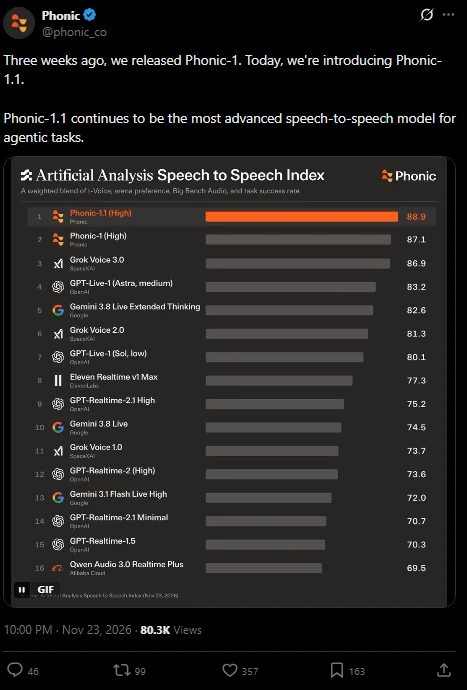
Phonic introduced Phonic-1.1 on 2026-11-23 as a speech-to-speech model for agentic calls. Artificial Analysis’ live board put Phonic-1.1 High first on its Speech-to-Speech Index at 89.1 when checked on 2026-11-24. That lead is meaningful within the published composite, but it comes with a concrete loss: time to first audio rose from 0.61 seconds for Phonic-1 High to 0.80 seconds. Support and booking teams have a reason to test the new model. Latency-critical flows should compare the complete interaction before moving traffic. Phonic-1.1 is not listed on this gateway.
What did Phonic launch, and where does the 89.1 come from?
Phonic’s launch announcement presents 1.1 as a speech-to-speech model for agentic conversations. The release date is 2026-11-23. The post says the model is available through signup, documentation or a demo. Those are three ways to begin an evaluation, not proof of a particular commercial contract or deployment model.
The launch screenshot reproduced in Phonic’s announcement preserves an earlier leaderboard capture. It shows Phonic-1.1 High at 88.9. The separate Artificial Analysis board checked for this article shows 89.1. Both numbers should stay attached to their dates. A leaderboard can move between captures, so calling one a mistake would discard useful provenance.
The live board is the basis for the headline in this article.
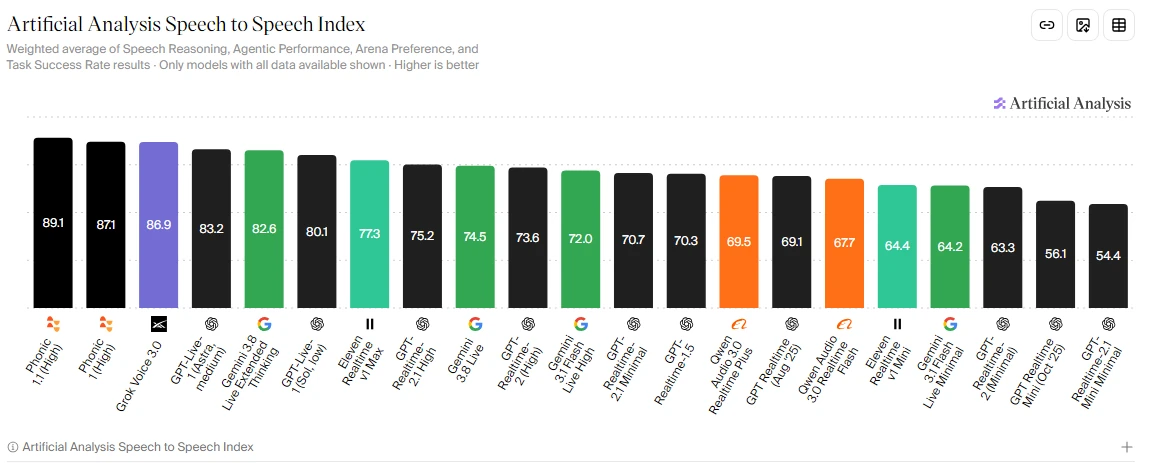
Artificial Analysis defines the index as an equal-weight composite. Big Bench Audio, agentic performance, Arena preference and task success each contribute 25%. A model needs all four components to appear. The live payload for Phonic-1.1 High is arithmetically consistent with 99.5, 82.7953, 81.1332 and 92.8962 divided by four, rounded to 89.1.
| Index component | Weight | Phonic-1.1 High value |
|---|---|---|
| Big Bench Audio | 25% | 99.5 |
| Agentic performance | 25% | 82.7953 |
| Arena preference component | 25% | 81.1332 |
| Task success | 25% | 92.8962 |
| Composite, rounded | 100% | 89.1 |
That arithmetic explains the score, but it also exposes a source conflict. The agentic payload value of 82.7953 matches tau-Voice 1.0, while AA’s current chart and methodology describe tau-Voice 2.0, where Phonic-1.1 High scores 87.1. The six sources do not settle which benchmark generated the index component at the time of the capture. This article does not silently substitute the newer score. Readers who want the component mechanics can continue with the full Phonic-1.1 benchmark teardown.
Why does the index lead matter if it is not universal voice quality?
It matters because the leaderboard combines several forms of evidence that matter to an agent: spoken reasoning, preferences from blind voice conversations, agentic task performance and correct final tool calls. Phonic-1.1 High leads the other published rows at 89.1, ahead of Phonic-1 High at 87.1, Grok Voice 3.0 high at 86.9, GPT-Live-1 Astra medium at 83.2, Gemini 3.8 Live Extended Thinking High at 82.6 and Eleven Realtime v1 Max default at 77.3.
The lead is not a universal voice-quality verdict. Equal weights are an editorial choice inside the index. They do not match every product’s priorities. A booking flow may care more about recoverable interruptions than a fraction of a point on spoken reasoning. An open-ended companion may care more about natural conversation than correct tool arguments. The index gives buyers a useful starting point, not a substitute for those judgments.
Consider two teams reading the same 89.1. A support team can value the task-success component because its cost of failure is a repeat contact or a wrong account action. A conversation product can value Arena preference because its users choose whether to keep talking. Both are rational responses to the same composite. Neither should describe the index as proof that every dimension improved. Before approving a model, write down which two or three outcomes would cause the pilot to fail. Those outcomes should determine the local scorecard, while the public index explains why the model earned a place in the test.
Big Bench Audio illustrates the limit. It contains 1,000 spoken reasoning questions across four categories, scored correct or incorrect. Phonic-1.1 High scored 99.5 versus 98.9 for Phonic-1 High. The benchmark is nearly saturated, so a 0.6-point lead does not establish broad reasoning superiority. The same caution applies to the index: a strong component can lift the total while leaving another weakness untouched.
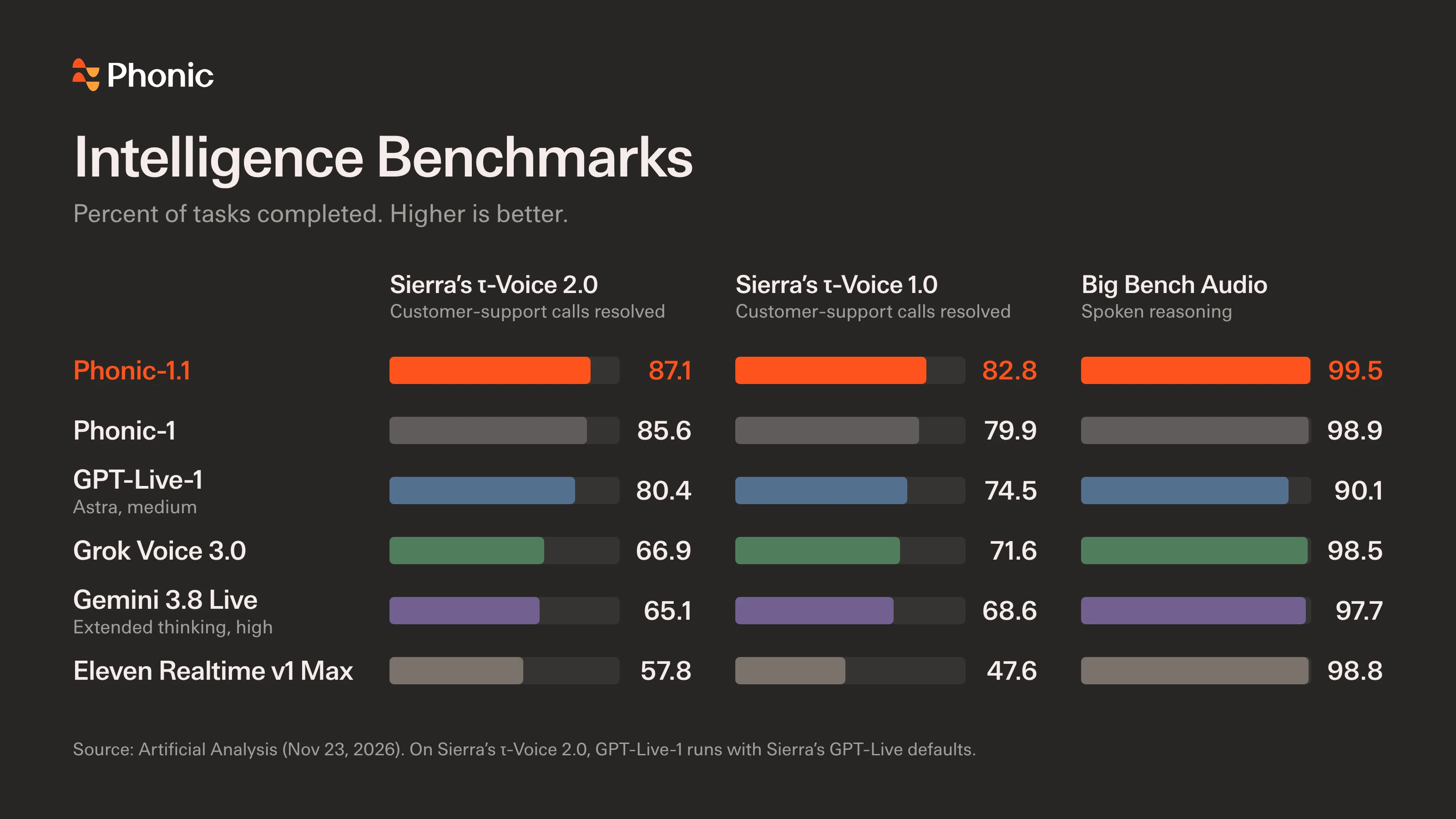
Tau-Voice 2.0 uses 50 English tasks in each of airline, retail and telecom. Each task gets three trials, and pass@1 is averaged. GPT-5.5 at low effort simulates the caller. Infrastructure failures are excluded and rerun. Phonic-1.1 High scored 87.1 against 85.6 for Phonic-1 High. AA’s launch commentary places that gap within the margin of error. These results are encouraging for task-oriented calls, but the difference is not decisive on its own.
The Speech Agent Arena asks a different question. It uses blind live voice conversations and Bradley-Terry preference Elo, anchored to GPT-Realtime-1.5 at 1000. Its task-success rate measures correct final task-completing tool calls, the kind of outcome described by the tool-calling contract behind agentic workflows. Phonic-1.1 High ranked seventh overall in the Arena at Elo 1053 plus or minus 26, with 806 samples and 92.9% task success. The 95% interval for task success was 89.8 to 95.1.
First on the composite and seventh in the overall Arena are different statements. They use different inputs and answer different questions. Preference also changes with context. In the embedded AA comparison, Phonic-1.1 High beat Eleven Realtime v1 Max default on agentic preference, 1052.47 to 975.09 Elo, but trailed on non-agentic preference, 1056.32 to 1135.44. OrcaRouter’s head-to-head commentary is useful for framing that trade-off, but it comes from a commercial gateway vendor rather than neutral hands-on testing.
What changed from Phonic-1 High?
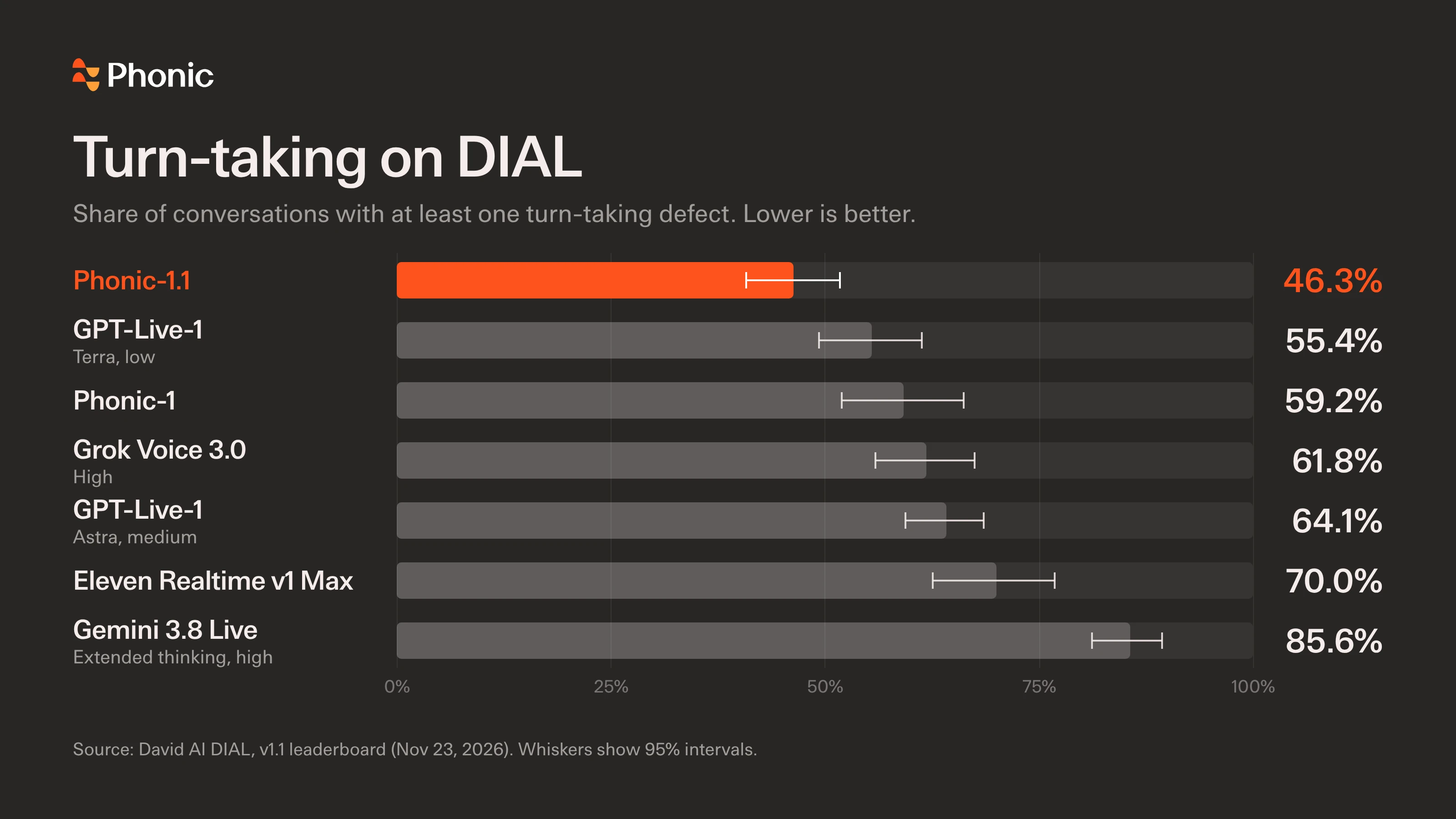
The version comparison has three measured improvements and one measured regression. The index rises by 2.0 points. DIAL naturalness rises by 0.14 points. The share of rated conversations with at least one turn-taking defect falls by 12.9 percentage points. Time to first audio then moves in the wrong direction.
| Metric | Phonic-1.1 | Phonic-1 | Change |
|---|---|---|---|
| AA index (High) | 89.1 | 87.1 | +2.0 |
| DIAL naturalness / 5 | 4.21 | 4.07 | +0.14 |
| DIAL conversations with a defect | 46.3% | 59.2% | -12.9 pp |
| AA TTFA (High) | 0.80s | 0.61s | +0.19s |
For a baseline outside the launch table, BenchLM’s Phonic-1 model page covers the previous model only. It should not be relabeled as Phonic-1.1 evidence. The launch-to-launch comparison above is the cleaner source for this decision because it keeps the published measurements together.
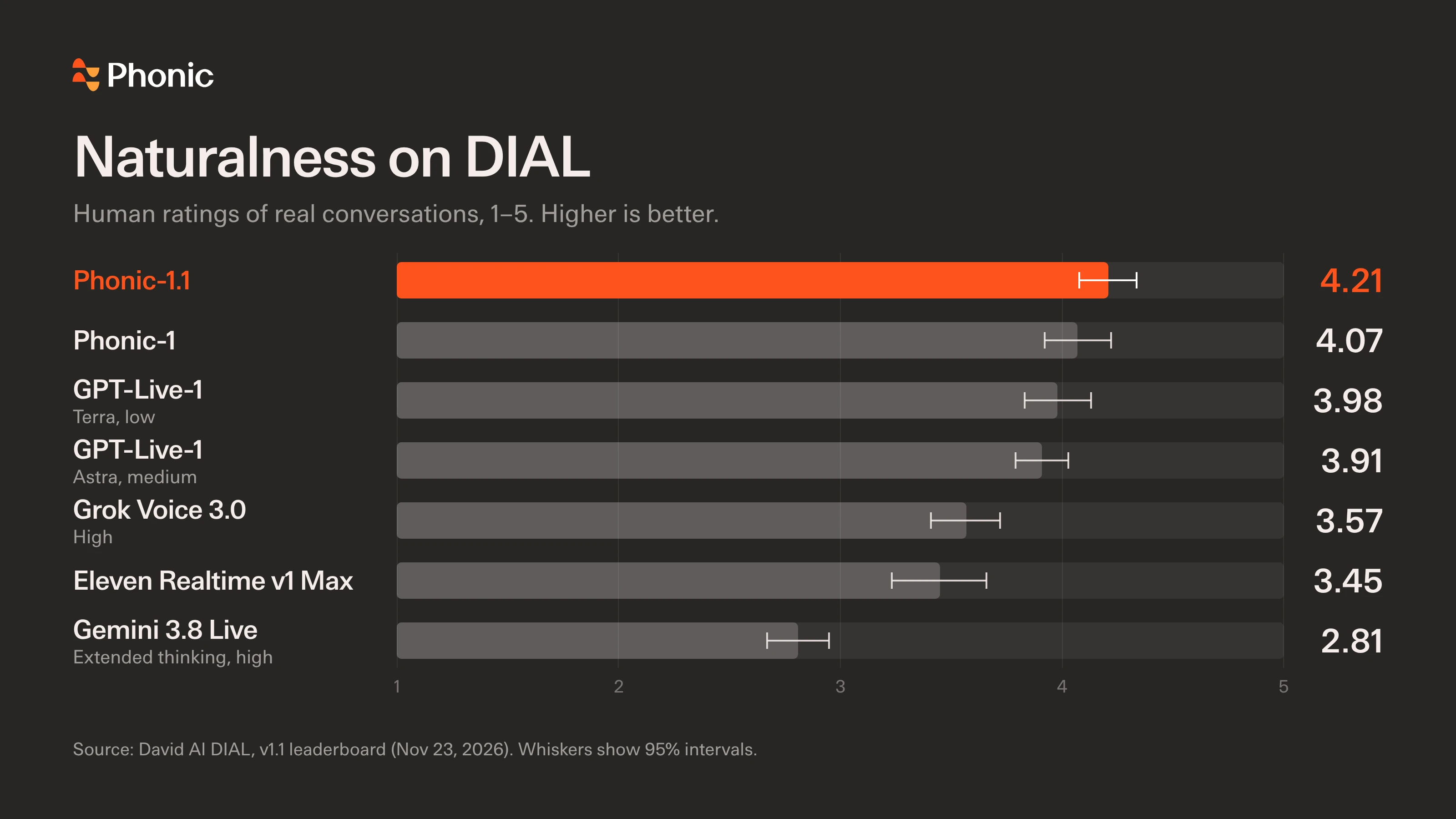
Naturalness improved across the full DIAL field. Phonic-1.1 scored 4.21 out of 5, compared with 4.07 for Phonic-1, 3.98 for GPT-Live-1 (Terra, low), 3.91 for GPT-Live-1 (Astra, medium), 3.57 for Grok Voice 3.0 (High), 3.45 for Eleven Realtime v1 Max and 2.81 for Gemini 3.8 Live (Extended thinking, high).
| Model and evaluated configuration | Naturalness / 5 |
|---|---|
| Phonic-1.1 | 4.21 |
| Phonic-1 | 4.07 |
| GPT-Live-1 (Terra, low) | 3.98 |
| GPT-Live-1 (Astra, medium) | 3.91 |
| Grok Voice 3.0 (High) | 3.57 |
| Eleven Realtime v1 Max | 3.45 |
| Gemini 3.8 Live (Extended thinking, high) | 2.81 |
How much does the 0.19-second latency regression cost?
Artificial Analysis measured Phonic-1.1 High at 0.80 seconds to first audio, against 0.61 seconds for Phonic-1 High. The new model is 0.19 seconds slower, about a 31% regression on that measurement. This is the cost a buyer should put beside the 89.1 index score, not hide below it.
The delay is small in isolation and cumulative in a call. If an agent needs ten first responses before completing a task, those responses add 1.9 seconds of waiting compared with the previous model. In a quick confirmation exchange, the caller may notice the extra pause before the agent begins. In a long support conversation, it may be minor. The right judgment depends on the interaction, which is why a benchmark cannot settle it.
Time to first audio is also not total response time. It says nothing by itself about how long a complete answer, tool call or recovery takes. The supplied record does not define AA’s measurement boundary, so speech transport, network path and application logic need separate local measurement. The streaming contract used by low-latency API clients governs incremental output, while streaming versus buffered response behavior explains why the first audible token changes perceived speed. Measure first audio and task completion separately on the network your users will use.
Does 46.3% defects mean nearly half of all turns fail?
No. Phonic’s DIAL v1.1 reproduction reports 53.7% clean calls and 46.3% with at least one turn-taking defect. The two figures are inverses. The denominator is rated conversations, not individual turns, and the supplied pages do not establish that those conversations represent every production call.
The distinction changes the operational reading. A 46.3% conversation-level defect rate can mean many conversations had one brief problem while others had several. It does not mean 46.3% of utterances failed, nor that 53.7% of turns were clean. A pilot needs a separate turn-level annotation if that is the product question.
Use two labels rather than one. At conversation level, record whether any interruption, false start or silence-handling problem occurred and whether the task still completed. At turn level, record what happened and whether the agent recovered. This keeps a recovered overlap from being treated the same as a stalled exchange. It also prevents a team from comparing its turn-level metric with DIAL’s conversation-level figure and concluding that the vendor benchmark is better or worse than the local result.
| Model | DIAL v1.1 conversations with a defect |
|---|---|
| Phonic-1.1 | 46.3% |
| GPT-Live-1 (Terra, low) | 55.4% |
| Phonic-1 | 59.2% |
| Grok Voice 3.0 (High) | 61.8% |
| GPT-Live-1 (Astra, medium) | 64.1% |
| Eleven Realtime v1 Max | 70.0% |
| Gemini 3.8 Live (Extended thinking, high) | 85.6% |
Lower is better, but lower is not zero. Nearly one in two rated conversations still had a turn-taking defect. Recovery quality matters alongside frequency: an interruption that the agent handles cleanly has a different user impact from a repeated failure to yield the floor.
OrcaRouter’s index critique raises useful questions about the index and defect-rate interpretation. Treat those as prompts for a local test. The commercial commentary does not replace the underlying measurements, and the missing Full Duplex Bench cell noted in its comparison is not a zero score.
Which use cases should pilot Phonic-1.1?
The strongest case is an agentic flow with bounded tasks, a measurable success condition and room to test a slightly slower first response. Support triage and appointment booking fit that shape when a human fallback exists. Open-ended conversation is plausible because naturalness improved, but preference evidence is mixed outside agentic calls. Latency-critical use cases are the weakest immediate fit because the measured regression points against them.
| Use case | Relevant evidence | First gate | Recommendation |
|---|---|---|---|
| Support | 92.9% Arena task success; fewer DIAL defects | Correct case outcome and clean escalation | Pilot with a bounded queue and human fallback |
| Booking | Tau-Voice gains; 87.1 on version 2.0 | Correct final reservation, not fluent confirmation | Pilot low-risk slots and reversals |
| Open-ended conversation | DIAL 4.21; weaker non-agentic Arena preference | Blind preference and interruption recovery | Test a narrow topic before broad exposure |
| Latency-critical | TTFA worsened from 0.61s to 0.80s | End-to-end response budget on target devices | Wait unless the extra 0.19s fits the budget |
A support pilot should score the final disposition, not whether the voice sounded pleasant. A booking pilot should verify that the action reached the right system and can be reversed. For both, use the production voice-agent architecture guide to separate transport, model behavior and tool execution. If the launch lead does not settle the vendor choice, compare how Phonic-1.1 compares with Eleven Realtime v1 Max, especially on non-agentic conversation.
How should a bounded pilot test the trade-off?
Start with a fixed set of real task types, stripped of personal data. Run the current model and Phonic-1.1 on the same prompts, network conditions and tool backend. Keep variants fixed. Phonic-1.1 High, GPT-Live-1 Astra medium and GPT-Live-1 Terra low are different configurations. A comparison that changes the model and the reasoning setting at once will not explain the result.
Log more than a satisfaction rating. Use request, token and error metrics for an evidence-led pilot to record session starts, failed turns, tool attempts and final outcomes. Add first-audio timing, complete-response timing, interruption recovery and caller abandonment. Store an outcome label for every session. A fluent call that creates the wrong booking is a failed task even if its naturalness score is high.
Pilot worksheet
Score your own Phonic-1.1 pilot
Score your own bounded Phonic-1.1 pilot. The neutral starting values are placeholders, not Phonic scores or an Artificial Analysis result.
Scale: 1 = fails the requirement, 3 = acceptable with evidence, 5 = strong measured result.
Blind human ratings on your real callers and prompts.
Interruptions, false starts, silence handling and recovery.
Correct final tool calls, not just a fluent conversation.
Measured end to end on the network your users will use.
Written rate, billing unit, data terms and exit path.
Needs evidence: replace the neutral placeholders with measurements from your own pilot.
Weakest current evidence: none yet.
This is an editorial worksheet, not an Artificial Analysis score or a vendor guarantee.
60 out of 100. Needs evidence: replace the neutral placeholders with measurements from your own pilot.
The worksheet weights naturalness, turn-taking, task success, latency and commercial fit for editorial decision-making. Adjust the conversation before using the result: a booking agent and an open-ended assistant should not necessarily value those criteria the same way. More importantly, replace every placeholder with observed evidence. A score built from launch screenshots is not a pilot score.
Control concurrency instead of staging a launch-day load test. Review rate-limit behavior under concurrent evaluation traffic, then increase sessions gradually. Put spend controls for a bounded voice-agent trial in place before the first run. Keep the provider credential out of the browser with API-key authentication without embedding secrets in a client. Prefer separate project keys with spend limits, and follow API-key security practices for AI applications when rotating and revoking the test key.
Do not send sensitive calls into an unapproved pilot. Define consent, retention and provider routing before recording audio. The routing and privacy boundaries for conversation data and the documented data-handling boundaries are useful checkpoints for that review. If a session fails, error handling for interrupted or failed sessions should determine whether the agent retries, transfers to a human or ends cleanly. Count failed and abandoned calls in the evaluation rather than excluding them after the fact.
Set acceptance thresholds before looking at the results. For example, require no regression in correct booking creation, a measurable improvement in clean-call recovery and an end-to-end first-audio budget that includes the extra 0.19 seconds. Those are decision rules, not claims about expected performance. Use the side-by-side model comparison page to keep the current alternative visible during the trial.
At the end, choose one of three outcomes: expand the traffic slice, revise the flow and test again, or stop. An expansion requires the measured task outcome and latency budget to hold together. A revision is appropriate when failures cluster around one recoverable step, such as confirmation or transfer. A stop is appropriate when the model misses the core outcome or when the commercial and data terms remain unsettled. Record the reason while the sessions are fresh so the next review does not fall back to the public index.
What can buyers verify about access and price?
Phonic’s launch post says access is available through signup, documentation or a demo. It also advertises an enterprise self-hosting option. That does not establish open weights or a downloadable 1.1 checkpoint. The supplied sources do not support calling Phonic-1.1 open source.
The startup program offers 144,000 minutes across 12 months plus engineering access, subject to application. It is conditional support for eligible applicants, not a universally available program. Dividing the allowance by 12 gives an average of 12,000 minutes per month, but that arithmetic does not establish the drawdown schedule, eligibility rules or renewal terms.
Ask what counts as a used minute. The launch announcement does not settle whether failed, abandoned or silent portions of a session are billed under the program, how concurrent calls consume the allowance, or what engineering access includes. Put those answers beside the eligibility decision in writing. A large headline allowance can still be a poor fit if the minutes arrive on a schedule your pilot cannot use or expire before the evaluation is complete.
The six supplied sources do not establish a Phonic-1.1-specific public list price. Do not infer one from the startup allowance or another provider’s rate card. Artificial Analysis reports a normalized benchmark cost of $4.20 per hour, calculated from a fixed 40-question Big Bench Audio subset. That is a benchmark normalization, not Phonic’s vendor price. The Phonic-1.1 API and pricing due-diligence checklist covers the commercial questions to settle in writing.
Build the pilot budget from measured session length and concurrency. The monthly API-cost estimation method is a starting structure, but voice minutes need their own usage model. Use the API cost calculator for a traffic forecast for the surrounding text-model work, then add the voice provider’s confirmed billing unit, minimums and failed-call treatment separately.
What is still unknown?
The supplied evidence leaves several decision-critical gaps. Detailed DIAL sample sizes and rater protocol are absent, so the published intervals cannot be turned into a precise claim about your callers. Full Duplex Bench, tau-Banking and tau-Entity results for 1.1 are not supplied. Missing cells are not zeros. They mark tests that still need evidence.
The live index also carries the unresolved tau-Voice version conflict described above. The launch table reports tau-Voice 1.0 at 82.8 for Phonic-1.1 and 79.9 for Phonic-1, while the current tau-Voice 2.0 table reports 87.1 and 85.6. Those are separate benchmark versions, and the small 2.0 gap sits within AA’s stated margin of error.
Finally, none of these sources is a production trial on your telephony path, device mix or tool backend. The AA time-to-first-audio result is a comparison input, not an end-to-end service guarantee. Until a local pilot measures interruptions, task completion, failure recovery and caller response, the operational size of the trade-off remains unknown.
Who should run a pilot, and who should wait?
Run a bounded pilot if you operate support or booking calls with clear success labels, can isolate a small traffic slice and can route failures to a person. You should also be able to measure first audio and task completion separately, cap spend, and review consent and retention before recording. Teams that already have that instrumentation can learn more from 200 controlled sessions than from another leaderboard refresh.
Wait if your product has a hard response budget that cannot absorb 190 milliseconds at the first audible response, if the interaction is mostly open-ended and non-agentic, or if procurement depends on a public list price the sources do not provide. Wait if you need Full Duplex Bench, banking or entity-resolution evidence before approval. Waiting is not a verdict on the model. It is a decision to collect the evidence your use case actually requires.
Frequently asked questions
Is Phonic-1.1 the best voice model?
It is first on the checked Artificial Analysis Speech-to-Speech Index at 89.1 for Phonic-1.1 High. It ranked seventh overall in the Speech Agent Arena. Those are different measures, so the accurate answer is that it leads the composite, not every voice evaluation.
Is the 46.3% DIAL defect rate a per-turn failure rate?
No. It is the share of rated conversations with at least one turn-taking defect, inferred as the inverse of 53.7% clean calls. The sources do not provide a per-turn rate or establish that the rated calls represent all production traffic.
Is 0.80 seconds to first audio too slow?
That depends on the complete interaction budget. It is 0.19 seconds slower than Phonic-1 High and can accumulate across several responses. Measure first audio and task completion on your own path before deciding.
Can I access Phonic-1.1 through this gateway?
No. Phonic-1.1 is not listed here. Phonic’s launch post points to its own signup, documentation and demo. The startup program requires an application and is not guaranteed.
Does Phonic-1.1 have a published per-minute price?
The six supplied sources do not establish a 1.1-specific public list price. The $4.20 per benchmark hour from Artificial Analysis is a normalized test calculation, not a vendor quote.
If you are building the surrounding stack, start here
A voice agent still needs text models for routing, extraction, summaries and back-office reasoning. Those workloads can use the models actually listed on this gateway. Review the live model catalog and published rates, then read the gateway’s published credit-pack pricing. For an existing application, the gateway quickstart for an existing text-model stack is the adjacent integration path.
None of those links provides Phonic-1.1 access. If the surrounding text-model stack is the part you need to evaluate, create an isolated gateway key for the rest of your stack. Keep the voice-provider pilot separate, with its own budget, credential, data review and acceptance thresholds.