Gemini 4 Neon and Grok 4.7 arrived two months apart, and they answer different questions. Google launched Neon on 2026-11-18, per Google’s launch post for Gemini 4 Neon, as the new top of its model picker. xAI released Grok 4.7 on 2026-09-21, per x.ai’s news page as noted in our catalogue, and Grok 4.7 is live and metered on our gateway today at our Grok 4.7 catalogue page. Neon is not listed here, and we will not imply otherwise. Our Gemini 4 Neon launch post covers Neon’s own story, including the picker change and Google’s positioning of it for complex coding, analytical reasoning and production-grade enterprise workflows, as 9to5Google’s launch report sets out. This post is the head-to-head: the index gap, the list prices, the context windows, the throughput column, and the billing rule that quietly rewrites Grok’s price at long prompts.
AA index and benchmarks: 61 against 35.49
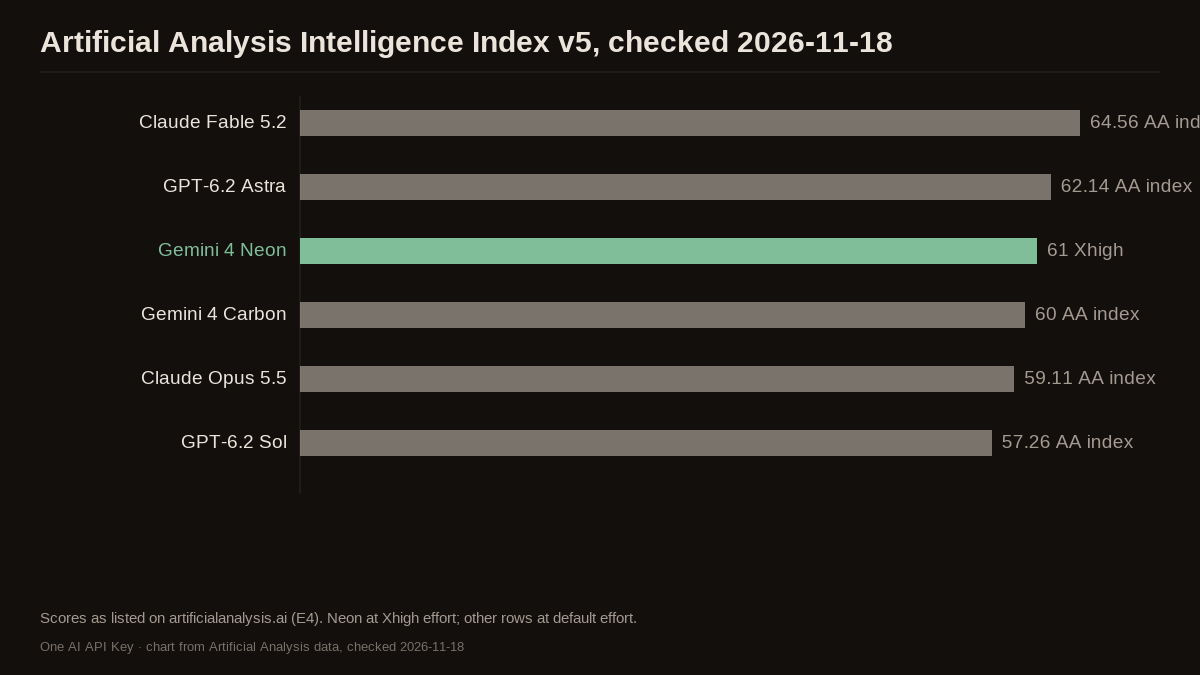
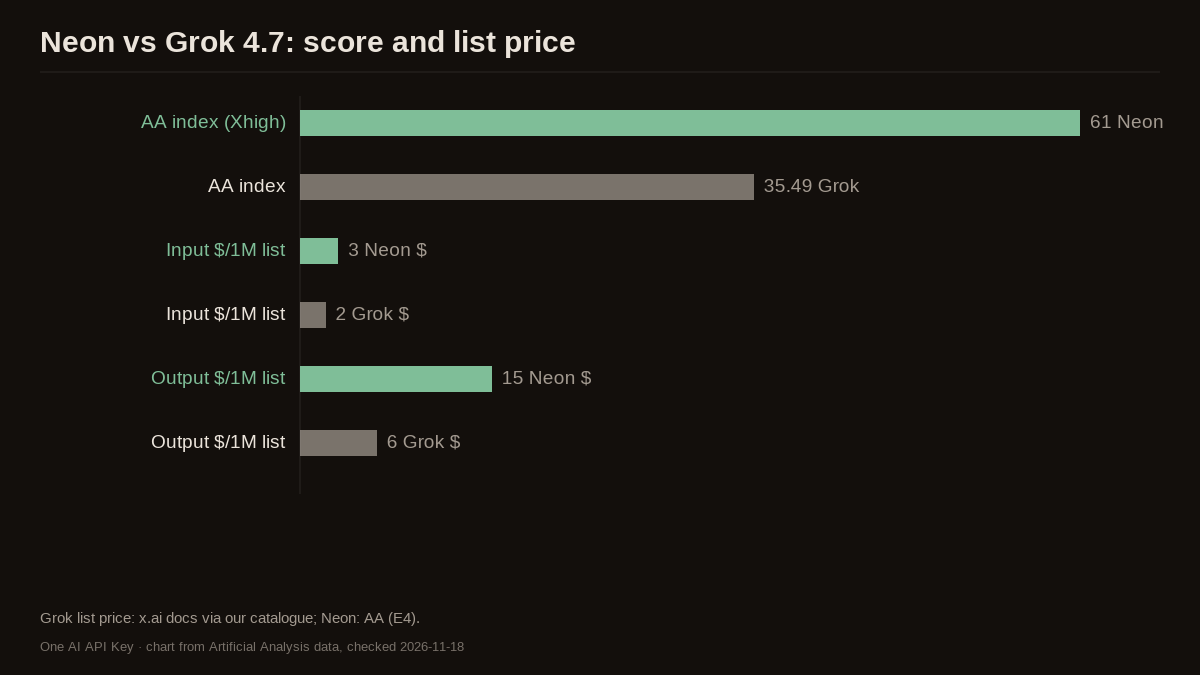
Artificial Analysis lists Gemini 4 Neon at 61 on the Intelligence Index v5 at Xhigh effort, and Grok 4.7 at 35.49, on the Artificial Analysis page for Gemini 4 Neon. Subtract the two and the gap is 25.51 points. On the Artificial Analysis leaderboard that places Neon sixth of the 96 models AA scores on the index at check time. Google claims third overall, as 9to5Google reported, so the rank wording conflicts between the two sources and we flag it rather than average it. Either way, the score gap between this pair is not a rounding error, and it holds at every effort tier AA lists: 61 at Xhigh, 60 at High, 55 at Medium, 44 at Low.
The tier ladder matters for routing, because lower effort trades score for cheaper, faster runs, and the tier you pick changes both lines of the bill. The Neon benchmarks teardown walks through the Google-published rows behind the index, including Legal Research Bench, Tax Agent Bench, Surge AI, Chartography at 73.5 percent, Agents’ Last Exam v1.1 at 75.8 percent and the AA Coding Agent Index at 58.6, all vendor-published figures via 9to5Google, not our measurements. One gap remains on the other side: Artificial Analysis publishes no effort-tier ladder for Grok 4.7, so its 35.49 is a single point, not a curve. A score is also not a price and not a speed, which is why the comparison tool and our rankings page exist beside the leaderboard. For family context, AA lists Neon’s siblings lower: Carbon 60, Hydrogen 54, Argon 50, with Flash-Lite at 12, so the 61 is the top of a ladder, not an isolated claim.
Google’s own benchmark table, as reported by 9to5Google, puts Neon first on Legal Research Bench, Tax Agent Bench and Surge AI, second on Agent Arena steerability, and lists Agent Arena Index 1336 across more than 4,200 sessions, HLE-Diamond at 71.3 percent, Terminal-Bench Science at 70.5 percent, Terminal-Bench 4.1 at 65.2 percent, RiemannBench at 84.0 percent, FrontierCode 2.0 at 46.2 percent at high effort and AutomationBench at 56.3 percent, plus a Vending-Bench 2 run cost of $16,843. Every one of those is a vendor-published number, and effort levels differ between vendors, so we report them as rows, not as a ranking.
Pricing: list against list, then our rate
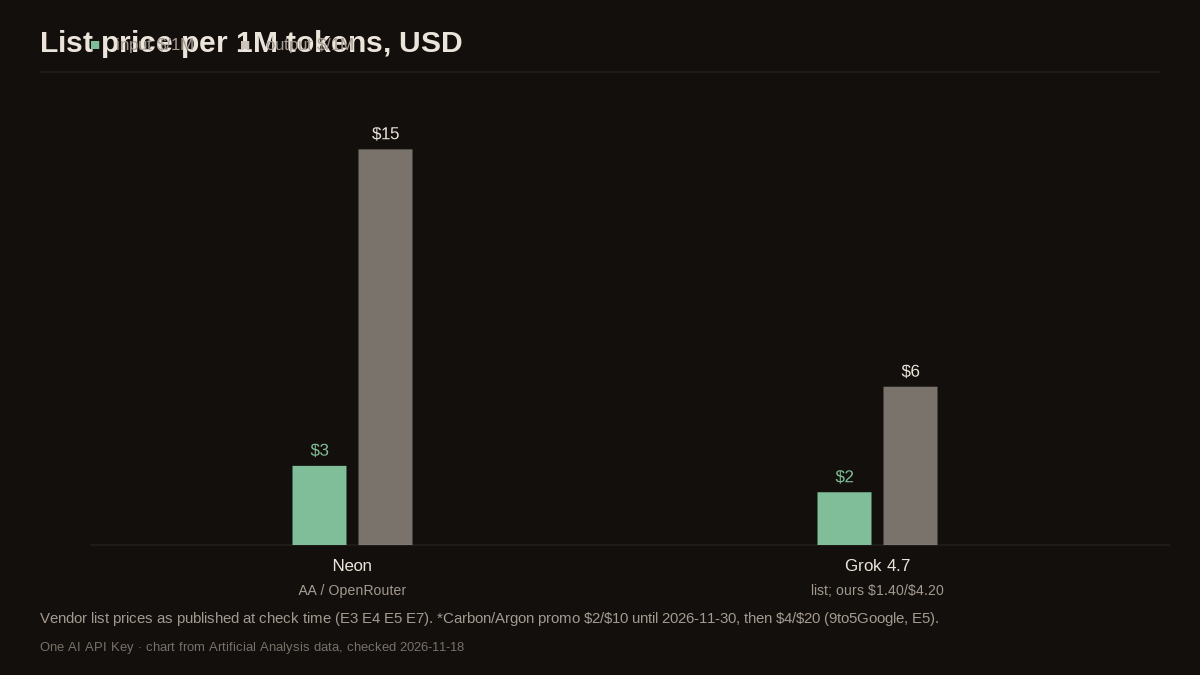
List price first. Artificial Analysis lists Neon at $3 per million input tokens and $15 per million output tokens, and OpenRouter’s model page for google/gemini-4-neon shows the same $3 / $15 among its four pricing rows. Timing caveat: 9to5Google reported at launch that Neon was not yet available on OpenRouter, and the page lists it now, so the OpenRouter rows are a later snapshot than launch day, and we date-stamp both. Our Neon pricing post does the full math on the AA run: $6.44 cost per task at Xhigh, 21.5 minutes per task, 283 million output tokens in the run, a 95 percent cache hit and a $2.21 blended rate, all as Artificial Analysis reports it. Google’s family pricing moved too: 9to5Google reports Argon and Carbon at a promo $2 / $10 until 2026-11-30, then $4 / $20, which is the ladder Neon’s $3 / $15 sits above.
Grok 4.7 lists at $2 input and $6 output per million, with cached input at $0.50, per xAI’s docs as mirrored in our catalogue. Through our gateway it sells at $1.40 input and $4.20 output, cached reads at $0.50, on the catalogue row linked above. At list, Grok is the cheaper input line by $1 per million, and at our rate the gap widens further. Our pricing page carries the live rates, and the cost calculator turns any prompt shape into a monthly number. A quick arithmetic check at list, one hundred thousand input and fifty thousand output tokens: Neon bills $0.30 in and $7.50 out, $7.80 total. Grok bills $0.20 in and $0.30 out, $0.50 total. That is the list-price story, and it is Grok’s.
Cached input changes the shape on both sides. Grok’s cached read at $0.50 is 25 percent of its $2 fresh rate, so repeated prefixes are where the list price stops being the whole bill. Neon’s AA run reached a 95 percent cache hit, which is how a $3 / $15 list turned into the $2.21 blended rate above. Cache geometry, not headline price, decides which model is cheaper on your traffic.
Long context: a 1M window against a 200K price line
Neon’s context window is 1,000,000 tokens, per Artificial Analysis. Grok 4.7’s is 500,000, per our catalogue. Capacity is the smaller half of the story. Our catalogue note on Grok 4.7 states the billing rule plainly: once a prompt is above 200,000 tokens, every token, input and output, bills at twice the list rate. The Qwen4-Max vs Grok 4.7 post called this the long-context price trap, and the arithmetic holds here too. A 400,000-token prompt bills 400,000 input tokens at $4 per million instead of $2, and output doubles from $6 to $12 per million, at list. Our Grok 4.7 release post documents the same step from xAI’s own materials, including the code shape of the rule.
Neon, at the AA prices, has no such tier: $3 and $15 hold at any length inside the 1M window. A 400,000-token prompt costs $1.20 in input at Neon’s list, against Grok’s $1.60 at the doubled list rate, before a single output token. Add output and the long-prompt gap widens again in Neon’s favour, because Grok’s multiplier sits on top of an already higher completion rate. The window sizes matter on their own. Workloads between 200K and 500K tokens fit both windows, but they pay Grok’s doubled rate while Neon’s list price stays flat. Above 500K tokens, only Neon’s window holds the full prompt, because Grok 4.7’s ceiling is 500,000. Capacity and price therefore move on different lines, and a workload that is cheap at 100K can be dear at 400K on one side and flat on the other. Our best frontier models November 2026 roundup tracks how each listed model prices long work, side by side. Two honest caveats. First, whether cache-read tokens inside a long Grok prompt also inherit the 2x tier is not documented anywhere we can verify, so treat the first long bill as the measurement, not this table. Second, a window is capacity, not recall. A 1M context that loses the thread at 400K is worth less than a 500K that holds it, and the only probe that answers that question is your own.
Tokens per second: 110 published, one side silent
Artificial Analysis lists Neon at roughly 110 tokens per second. For a 1,000-token answer that is about nine seconds of generation, arithmetic only. At the same rate a 30,000-token agent turn takes roughly four and a half minutes of generation, which is the number that decides whether a coding loop feels live or batch. AA publishes the 110 figure as a speed listing, not a guarantee, and real throughput depends on your prompt, your effort tier and the route. For Grok 4.7, no independent throughput figure was published at check time, and we do not guess. A silent speed column is not a slow model. It is an unmeasured one. The honest statement is that Neon’s speed is a published number you can budget against today, and Grok’s is not, so run your own probe on your own prompts before you sign a latency-sensitive workload to either side. Our gateway meters real throughput for every model we serve, so Grok 4.7’s live rows will show what the route actually delivers under your traffic, not what a launch table promised.
Release dates, and one naming trap
The dates are clean. Grok 4.7 released 2026-09-21 per x.ai’s news page, as our catalogue note records, and our catalogue shows the model added to our board on 2026-10-08. Neon launched 2026-11-18 per Google’s post, and Google’s own docs guide for the model is already live. Both are shipping products, not rumors. On Google’s side, 9to5Google reported that Neon replaces Argon in the picker, that 3.1 Pro was removed, that Flash-Lite becomes Auto, and that the picker now offers Auto, Hydrogen, Neon and Carbon, with Neon reserved to AI Pro and AI Ultra subscribers. None of that changes the API comparison above, but it explains why the launch landed as a picker story rather than a plain model drop.
One confusion to kill early. The neon.com docs describe a Neon AI Gateway serving Databricks-hosted gemini-4-argon at $4 / $20 with a 1M window, which is a different product from Google’s Gemini 4 Neon, despite the shared word. If you search for Neon API docs you will land there first. The Gemini model our own catalogue does list is Gemini 4 Argon, again not the Google Neon release, and we label it as such.
How to call Grok 4.7 today
Grok 4.7 answers now, on the OpenAI-compatible route with model id grok-4.7. The quickstart guide covers the first request, and the API reference covers the fields, including streaming and tool calls. Our catalogue lists text and image input, tool calling, vision, reasoning, structured output, streaming and caching on the row, so the capability list is not the gap. Set max_tokens deliberately on a reasoning model, because thinking tokens spend output budget before the answer arrives. xAI published its own comparisons against Grok 4.6 on release; treat those as vendor numbers, and let ten prompts with known good answers do the real evaluating.
Which workload leans which way
Short-prompt, high-volume work under 200K tokens is where Grok 4.7’s price wins, at our rate or at list, and it is live today. Long-context agents whose prompts cross 200K are where Neon’s flat $3 / $15 and 1M window change the math, though Neon is not routable here yet. Score-sensitive reasoning leans Neon by 25.51 points on the AA index. Latency-sensitive work has only one published speed figure in this pair, Neon’s 110 tokens per second, so budget with a probe, not with a launch table. Match the workload to the mechanic, not the headline.
Meter it before you believe either column
Every number above is a list price or a vendor table. Your bill is the real one. The usage log shows per-request tokens, the models catalog mirrors the rate the upstream bills, and our monthly cost guide turns those rows into a budget. The first metered long-prompt bill is the only place the 2x rule becomes real, and it is the only place a cache-hit assumption becomes a number.
Where to try it
Gemini 4 Neon is not on our gateway, so there is nothing to route there yet, and we will not pretend otherwise. Grok 4.7 is, live and metered, and the free lane gives 100 requests plus 5,000,000 tokens daily, refilled at 05:30 IST, with a $10 trial credit on new accounts. Open chat to probe Grok 4.7 on your own prompts, or create an account at console sign-up and put your first real workload on the meter today.