Google launched Gemini 4 Neon on November 18, 2026, and Artificial Analysis has since listed Moonshot AI’s Kimi K3.1 Pro on the same Intelligence Index. Readers asked for a head-to-head, so here is the honest shape of one. Neon arrives with an index score, a price, a speed figure and a context window published by an independent tracker. K3.1 Pro arrives with an index score and a name, and the benchmark rows stop there. This post has no benchmark table, because there is nothing honest to put in one. What follows is the score, the price, the ecosystem and the data gap, with every number attributed to the page it came from, and nothing here is our own measurement of either model. It is the comparison piece in the cluster that opened with our launch explainer, and it follows that post’s rule: we date-stamp every claim, we separate list price from what we charge, and we do not fill gaps with guesses.
Two models, and one name to get right
Gemini 4 Neon is Google’s newest flagship. Google’s launch post for Gemini 4 Neon went up on November 18, 2026, written by Koray Kavukcuoglu. 9to5Google’s launch report describes the positioning as complex coding, analytical reasoning and production-grade enterprise workflows, and says Neon replaces Argon in Google’s model picker, that the picker now offers Auto, Hydrogen, Neon and Carbon, that Gemini 3.1 Pro was removed, that Flash-Lite became Auto, that four thinking levels ship with the model, and that access sits inside AI Pro and AI Ultra rather than a free tier. On our side, the Gemini 4 model we serve is Gemini 4 Argon, a different listing, and Neon is not on this gateway at check time.
One naming flag comes before any number, because it changes every sentence below. The request that reached us asked about Kimi K3 pro. The AA page lists Kimi K3.1 Pro. We use the AA name throughout and log the conflict as C4 in our ledger. The Kimi model our catalogue actually serves is Kimi K3, from Moonshot AI, listed with text and image input, a 1,048,576-token context window, and best-for tags of agentic coding, large repositories and tool use. Our catalogue charges $0.353 input, $5.67 output and $0.30 cached input per million tokens against a vendor list of $3 and $15. Kimi K3.1 Pro is not listed on our gateway at check time, and we publish no price for it. The K3 versus K3.1 split is not new to us. Our Qwen4-Max versus Kimi K3.1 post flagged the same gap between a vendor’s table column and the id we serve, and the lesson carried over: a label in a launch table is not a model id on a gateway.
| Spec | Gemini 4 Neon | Kimi K3.1 Pro | Kimi K3 on our gateway |
|---|---|---|---|
| Vendor | Not stated in our checked sources | Moonshot AI | |
| AA index v5 | 61 at Xhigh | 46.45 | No AA row |
| AA speed | ~110 tokens/sec | Not published | Not published |
| Context | 1M tokens | Not published | 1,048,576 tokens |
| List price per 1M | $3 in / $15 out | Not published | $3 in / $15 out |
| Our rate per 1M | Not listed here | Not listed here | $0.353 / $5.67, cache $0.30 |
AA index benchmarks: 61 against 46.45
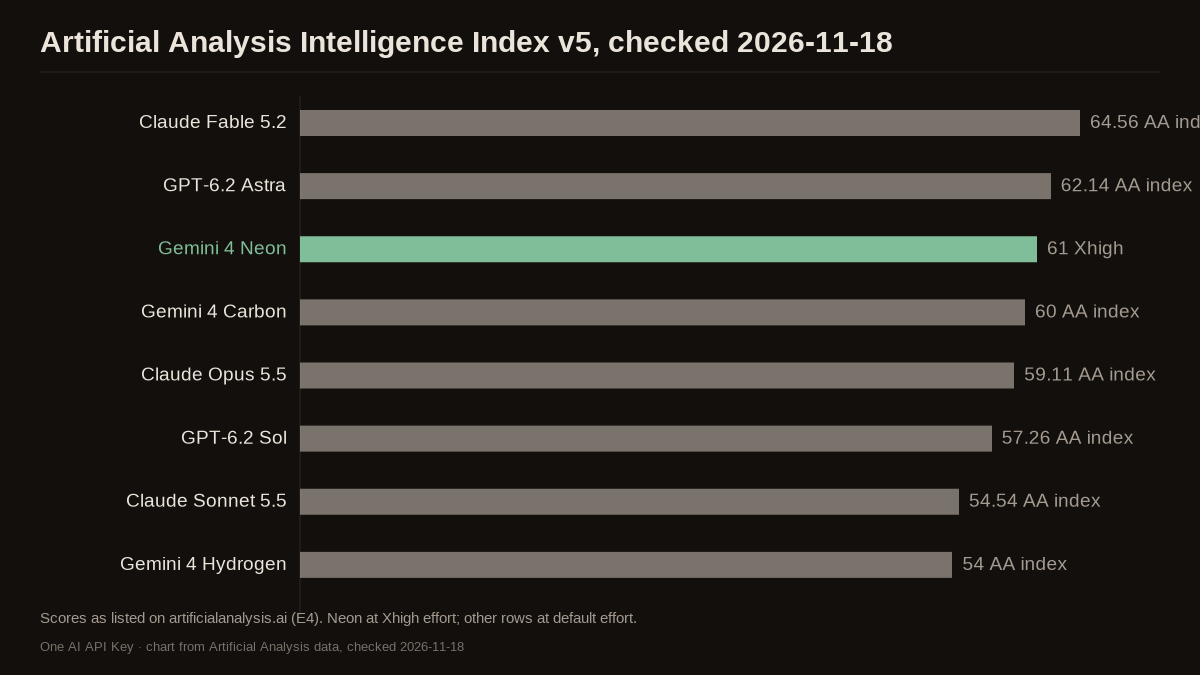
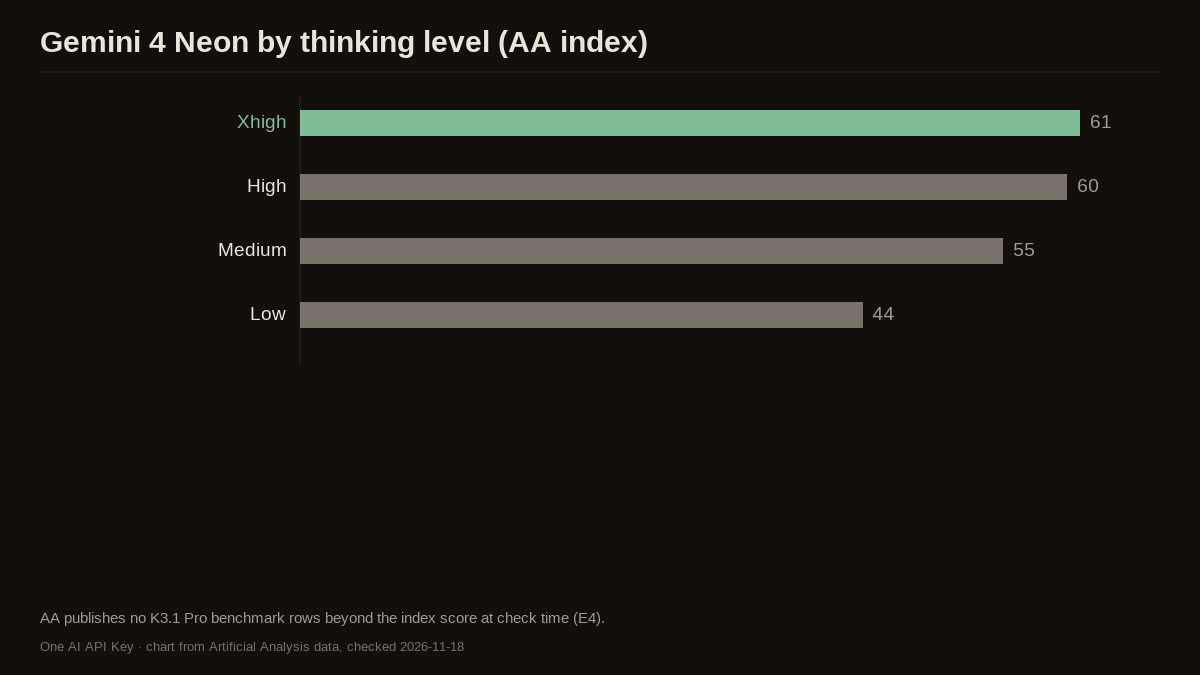
Artificial Analysis page for Gemini 4 Neon lists an Intelligence Index v5 score of 61 for Neon at Xhigh effort, which AA places at number 6 of 96 models, with effort tiers of 61 at Xhigh, 60 at High, 55 at Medium and 44 at Low. The same page lists Kimi K3.1 Pro at 46.45. The gap is 14.55 points. Read the tiers with care: the 61 is the Xhigh number, so a Medium setting scores 55 on the same index.
Two context points keep the gap honest. First, a conflict flag, C1: AA’s wording is number 6 of 96, while 9to5Google reports that Google claims third overall. We cite each claim to its own page and do not average them. Second, the gap is a wide one on this index, not a rounding error. It is larger than the 1-point step between Neon at 61 and Carbon at 60 on AA’s Gemini 4 family ladder, and larger than the 10.96-point step from K3.1 Pro at 46.45 down to Grok 4.7 at 35.49.
Google’s own launch material, as reported by 9to5Google, adds rows of its own: an AA Coding Agent Index of 58.6 ranked first, Terminal-Bench 4.1 at 65.2 percent, FrontierCode 2.0 at 46.2 percent at high effort, Agents’ Last Exam v1.1 at 75.8 percent, HLE-Diamond at 71.3 percent, AutomationBench at 56.3 percent, Chartography at 73.5 percent, Terminal-Bench Science at 70.5 percent, RiemannBench at 84.0 percent, Agent Arena steerability at number 2, Legal Research Bench and Tax Agent Bench at number 1, and Vending-Bench 2 at $16,843. Those are Google-published numbers, not independent measurements, and they sit next to the AA index rather than inside it. Effort tiers move the bill as well as the score, since AA’s Xhigh run cost $6.44 per task over 21.5 minutes, which makes the Medium tier the cheaper setting to test first. Our Neon benchmarks teardown walks those rows one by one, and our November 2026 frontier roundup places Neon beside Fable 5.2 at 64.56 and GPT-6.2 Astra at 62.14 on the same index, with Anthropic rounding its own score to 65.
The data gap, stated plainly
Here is the part most comparisons skip. Artificial Analysis publishes no Kimi K3.1 Pro benchmark rows beyond the index score at check time. That sentence is the whole finding, and we will not paper over it. There is no Terminal-Bench row, no FrontierCode row, no cost-per-task run and no speed figure for K3.1 Pro on the AA page, so any table pairing Neon rows against K3.1 Pro rows would carry invented numbers on one side. We do not do that. The comparison therefore stands on three legs: the index score, the price surface, and the ecosystem. A comparison tool can line up two models that both have rows, and it cannot fill a row that does not exist. Vendor material on a vendor harness does not replace an independent row, and our catalogue’s best-for tags are our own summary, not a harness result. What would change this post, in order: AA publishing K3.1 Pro benchmark rows, AA or the vendor publishing a K3.1 Pro price, and our catalogue listing K3.1 Pro. Until one of those happens, the most honest sentence we can write about the pair is the one this post opens with.
Pricing: list rates, our rate and cost per task
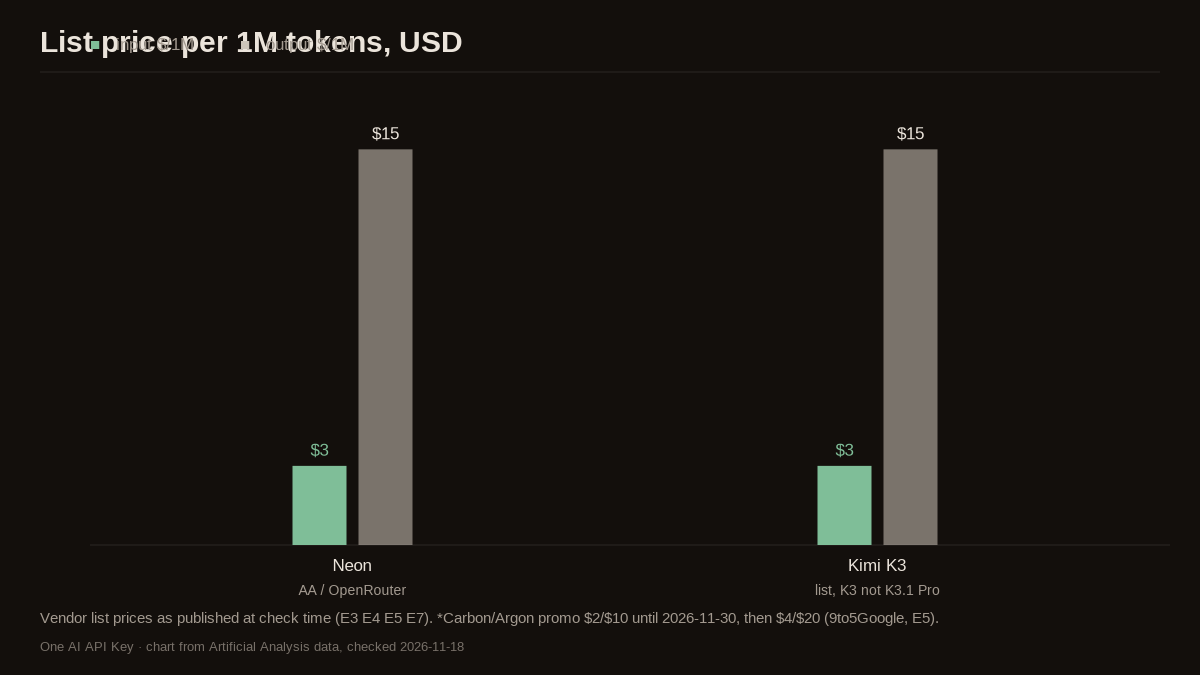
Neon’s list price is $3 per million input tokens and $15 per million output tokens. AA publishes that price, and Gemini 4 Neon on OpenRouter lists the model with four pricing rows including the same two. A timing flag, C2: 9to5Google reported at launch that Neon was not yet available on OpenRouter, and the OpenRouter page lists it now. We read both pages as date-stamped snapshots rather than a contradiction.
Kimi K3 has two price surfaces, and they are not the same number. The vendor list is $3 input and $15 output per million. Our gateway listing charges $0.353 input, $5.67 output and $0.30 cached input per million. Both surfaces belong to Kimi K3, the model we serve. Kimi K3.1 Pro has no verified price we can cite at check time.
Cost per task arithmetic, straight from those per-million rates. A call of 100,000 input tokens and 50,000 output tokens costs $1.05 at Kimi K3 list, $0.32 at our rate, and $1.05 at Neon list. The same call on our gateway with half the input cached costs $0.32 as well, because cached input at $0.30 barely moves the bill. If your agent keeps a stable system prompt, the cached column is the one to watch, and if every call is one-shot, the fresh column is your bill. AA’s measured Neon run at Xhigh effort is a different animal: $6.44 per task, 21.5 minutes per task, 283 million output tokens in the run, a 95 percent cache hit rate, and a blended $2.21. Those are AA’s numbers for AA’s harness, and the distance between $6.44 and the $1.05 list arithmetic is exactly why measured runs and list rates must not share one column.
| Route | 100,000 in plus 50,000 out, fresh input | Same call, half input cached |
|---|---|---|
| Kimi K3 list, $3 in / $15 out | $1.05 | No cache price published |
| Kimi K3 on our gateway | $0.32 | $0.32 |
| Gemini 4 Neon list, $3 in / $15 out | $1.05 | No cache price published |
Our cost calculator reproduces the token math for your own volumes, our monthly cost guide turns it into a budget, our token glossary explains the caching mechanic behind the $0.30 row, and API pricing and plans collects every rate we charge.
Agentic coding and ecosystem
K3’s best-for tags in our catalogue are agentic coding, large repositories and tool use, with a 1,048,576-token context window and text plus image input. That is a repo-scale agent profile on paper. Neon’s profile, per AA, is a 1M-token context and roughly 110 tokens per second, and per 9to5Google it ships with four thinking levels and appears in the launch coverage’s Antigravity mention. On the Artificial Analysis leaderboard, the order above K3.1 Pro runs Fable 5.2 at 64.56, GPT-6.2 Astra at 62.14, Opus 5.5 at 59.11, GPT-6.2 Sol at 57.26, Sonnet 5.5 at 54.54 and GPT-5.6 Terra at 51.33, which puts 46.45 in context below every score named here and well under the 61 Neon holds. AA’s Gemini 4 family ladder reads Carbon 60, Hydrogen 54, Argon 50, Flash-Lite 12, then Gemma E4B at 5 and Gemma 31B at 4, and 9to5Google reports Argon and Carbon promo pricing of $2 in and $10 out until November 30, 2026, then $4 and $20. The catalogue and live rankings show what we actually meter, and our coding-agent model guide covers how to weigh an index score against throughput, price and effort tiers.
Where to try it
Neon is reachable through Google’s AI Pro and AI Ultra tiers and through the OpenRouter listing above. It is not on this gateway, and we will not imply otherwise. Kimi K3 is live here today at the listing linked above. Start in the chat playground, or create an account at the console signup. New accounts get a $10 trial credit, and the free lane grants 100 requests plus 5,000,000 tokens daily, refilled at 05:30 IST. Wire either path through the quickstart and the API reference, generate a starter config with the config generator, manage keys on the console keys page, and point your client at https://api.oneaiapikey.com/v1. Then run your own workload for a week before you choose, because the missing K3.1 Pro rows matter more than any score we could quote here.